High charging, but new interior harness?
Even though you may not see where the wire goes, thanks to the wire diagrams in the Factory Service Manual, we know where they connect - almost.
The more typical power supply scheme was like this.
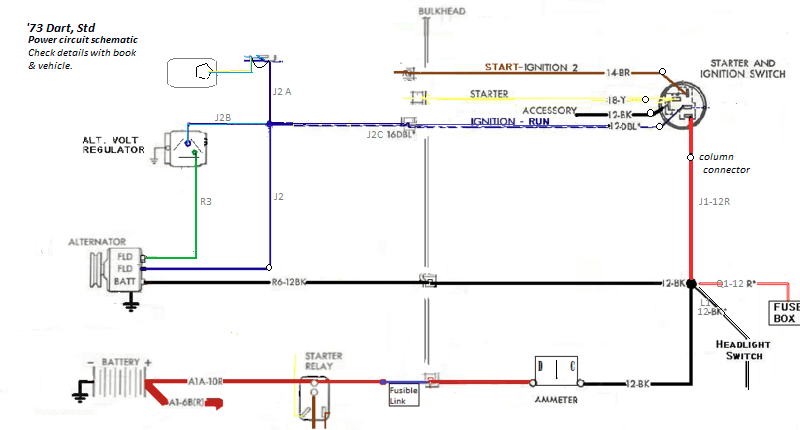
On this one you can measure the drop in voltage from:
alternator output (BATT terminal) to starter relay, and the current flow to the battery seen by the ammeter.
alternator output to alternator field terminal with the blue wire, as well as at the ballast resistor.
Measuring the voltage to ground at ballast resistor and field terminals will give a pretty good sense of what voltage the regulator at the sense connection.
Photo essay here and explanation in the post above it. Charging Battery with Alternator - Warning
So what you can do is use a voltmeter to measure the voltage drops right after starting. Because of your intended addition to the system, its a good check to make at this time.
Even though you may not see where the wire goes, thanks to the wire diagrams in the Factory Service Manual, we know where they connect - almost.
Take a photo of this and the firewall. Chrysler used molded rubber grommets through the firewall for various circuits depending on the year, model, and option. It's possible yours has the battery feed coming through the grommet to the ammeter and then back out the grommet to a terminal post where it joins the alternator output and feeds back through the bulkhead connector. This was one of the optional arrangements.
The more typical power supply scheme was like this.
On this one you can measure the drop in voltage from:
alternator output (BATT terminal) to starter relay, and the current flow to the battery seen by the ammeter.
alternator output to alternator field terminal with the blue wire, as well as at the ballast resistor.
Measuring the voltage to ground at ballast resistor and field terminals will give a pretty good sense of what voltage the regulator at the sense connection.