Fresh engine, wiped cam? Tick? (new pics added)

-
my brother and I will be heading over there Saturday...(my brother is an accomplished engine machinist and builder)...he should know fairly easily after looking at it what it will need to get back up to snuff....he did mention that running the stock rockers with a voodoo cam and those springs is a matter of when, not if, the pushrods end up punching thru, or the rockers busting up, not to mention the nonadjustability....
he also looked up those piston part numbers, fortunately (since you're running open chamber heads) they have a raised quench dome - i was wondering why even run D-dish with open chamber heads...
if you have any block specs handy, that would be helpful also....deck height, etc....
 
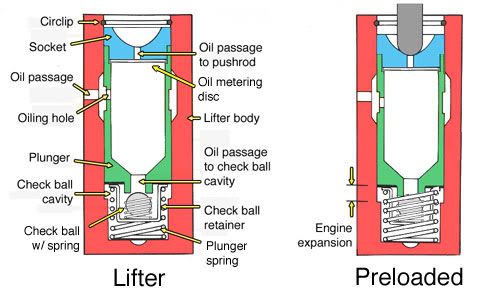
You have to figure, the pushrod cup is what is moving (rattling), it's free to travel, because there is no spring behind the cup. The only thing that holds the cup in place is the clip, so there is some travel between the plunger and the clip. I did leave the lifter sit in oil overnight and I tried to pump it up this morning. Still no pressure, other then spring tension. Like I said earlier... before I took these apart I couldn't move the plunger at all, whether that was because it was stuck, or it held oil pressure at that time, i don't know.

Liftersize.jpg
 
I would definetly be having a chat with the guy that built this.He,s happy with the work you did for him?Look at the mess you got out of the deal,he should be making it right for you.Good luck.
 
You really need to see what the installed height is on them. I dont think there is a problem with the Comps, and they did save a little (very little if the heads were apart anyway...) on labor for cutting the spring seats and guides. Much more important for almost any lifter these days is the ability to adjust the preload. Stamped rockers cant, so it's more of a challenge to get it right the first time.
 
lifter-Exploded.jpg


What I beleve has happened is that the plunger has been bottomed out and is stuck.
This has caused the oil ports to be misaligned. You have to get them back up where they belong. Once you do that, they should be ok.


The valve springs are another story. The springs that Lunati called for have stock installed height of 1.65" with 120 pounds of pressure at that height.
The Comp springs you have are supposed to be installed at 1.75" and that should provide 130 pounds at the seat. If the installed height is less than 1.75", the pressure is even higher. That spring is most likely designed for a cam with more lift than you have. Even if the installed height is 1.75", you are still exceeding the recomended open pressure by 85 pounds. I don't like that one bit....it's harder on the entire valvetrain than it needs to be.
Lunati's spring tech page:
http://www.lunatipower.com/Tech/Valvetrain/ValveSpringTech.aspx

There is absolutely nothing wrong with the stock rockers in your app, but you must make sure everything is correct as a package. Any time you go mixing and matching parts you are tempting fate.

You really need to find out:
1>installed height
2>seat pressure
3>open pressure at 1.25"
and once you have that strait
4>correct pushrod length
 
OK here are a couple more thing to chew on.......like you don't have enough opinion already:-D

Hang on, its a long one!!!!!

FIRST, I agree with mopar340dave in that the push rod was to long! so long that the hyd "port" of the lifter wasn't working from day 1!
The spring in side was what was taking up the play and eventual collapse from constant moment......like the video shows when there was no oil.
That's why it wont pump up now. oil is leaking around the plunger, do to excessive were...........OK getting to deep into it again,sorry.

If the push rod would have been any longer, the valve would have been held open and the eng would NOT have started(THIS IS SPECULATION, YOU HAVEN'T PROVED IT ONE WAY OR THE

OTHER.....YET
:clock:)

SECOND, The spring is a bit high(pressure wise).....but if it was installed at 1.75,(Causing the push rod to push even deeper into the lifter) I thing its acceptable....as in,... not the cause of you problem, or a part of your problem.


THIRD,.... FOR GET ABOUT EVERY THING EXCEPT THE CAUSE OF THE PROBLEM! Which i thing, the hole lot of us, believe is the PUSH ROD LENGTH.

THIS IS MY WAY OF FINDING OUT PUSH ROD LENGTH!

First, (if you are NOT sending you lifters/cam back to lunati)

You need to fill up one of you lifters with GLUE! Yes glue, you could even us super glue. What every you us it must have the plunger up agenced the clip. Now you have a solid lifer of proper height( You could also set the lifter down .040" but that gets more complicated)

Now, You need to by a adj push rod from who who ever you decide to by the push rods from.....I don't matter, pick one and get and adj push rod.

Now with this push rod you can set your proper push rod length.

once you have adj the push rod to (0) end play, lock the nut.

Now if the height of all the valve stems are the same, sent the adj push rod back and tell them. You want .040" longer then the push rod you sent back.
By using a straight edge across all the valve. And using a thickness gauge, you can find out how many thousands difference there is between. them.

Example: Say you lay a straight edge across the valves on one head and the shortest valve is .020" shorter(which it shouldn't be.) so you adj the push rod to the tallest valve/ rocker arm.
Now you need to average it.

The shortest valve is > .020"/ by 2=.010". Now .010+.040=.050" so now you send the push rod back and tell them that you need a set of push rods .050" longer then the push rod you sent back.

A Side Note here, According to "Mother Mopar", there lifters have a

.180" travel and .030 at either end, is Not usable, so that leave you with 120 to play with in the middle.

so i would say from .040 to .080" would be a safe place to play with any Hyd lifter(only ASSuMe...ing here!) so the .050 would be in the safe zone with some margin on either end.

YOU Have to PROVE the push rod is yourrrrrrr problem, before you can go any further.......
JMHO.

Final note, if you glue a lifter, Make Sure you paint it a bright color so it don't get installed (accidentally) and bend/ brake valve/piston!:read2:

 
Cudafever...if the installed height on the comp springs is 1.65"...the pressure is WAY too high.
If the installed height on the comp springs is 1.75"...the pressure is still substantially higher than recommended by Lunati, but the 350 pounds on the comp springs is measured at .500" lift.. The Lunati pounds of pressure was measured at only .400" lift at the valve so the actual difference between the two springs may not be as wide as it appears.
If the installed height is 1.75", that means that the rocker geometry is now really off. The rocker will be contacting the valve .100" higher than it should...that puts the other side of the rocker (the pushrod cup) even lower, making the pushrod seem even longer...a .100" thick shim under the rocker shafts would solve that issue, I suppose.
I would never run a set of springs that were that far off of the cam specs. It's just not a good idea.

Everything needs to be checked, especially the valve installed height, spring seat and open pressure, spring bind measurement, retainer to valve seal clearance at max lift, valve to piston clearance at max lift, pushrod length and pushrod clearance to the head and gasket.

P.S. The preload should be kept on the low side to avoid any possibilities of the valve being "pumped" into the pistons! This is why they invented the "anti-pump up" lifters.


Good stuff here:
http://www.popularhotrodding.com/tech/0607phr_camshaft_basics/lifters_pushrods.html

I especially like this part, since some on this forum doubted me when I said it on another thread! Read it and weep, non-believers!!!
"Because a flat lifter can initially accelerate faster than a roller, we find that with cams under about 270 to 278 degrees of off-the-seat duration, a flat tappet can produce as much or more area under the curve. It also used to be claimed that a flat lifter design was substantially inferior to a roller lifter in the friction department. Though this was, to an extent, correct 20 years ago, we find that new super oils have eaten substantially into whatever friction reduction advantage the roller may have had over a flat lifter."
 
Yes, there is a lot to figure out here. Kielbasa did come over, and take a look.
To make a long story short... I am looking into adjustable rockers, and new lifters.
The preload seems different for each rocker, and the only way (although maybe not 100% proper) to fix this is with adjustable rockers, so I can set each lifter at it's own pre-load. Since I don't have a lot of cash right now I'm either looking into the the 273 mechanical adjustable rockers or used Crane Ductile Iron Rocker Arms. I posted something in the "wanted" section too.

What is sad is... This might not even be where the tick is coming from! lol! That would suck... BUT this needs to be fixed anyway.
 
Were you guys able to measure the installed height, spring bind limit, retainer to valve seal clearance, valve to piston clearance and spring seat/open pressures?

I don't remember if I told you in one of my posts or on the phone, but the factory stamped rockers ALWAYS vary. They do not vary enough to mandate the adjustable rockers but the adjustables are an upgrade and may actually make a little bit more power across the board just due to equalizing cylinder pressures because of a theoretical "even filling" and "even emptying" of the cylinders.


P.S. This sentence from the PHR article also backs up what I was telling you about the dif between a solid and a hydraulic cam/lifter set-up:
"If valvetrain noise is of little or no concern, then a solid cam is the way to go, as there are no worries about hydraulic lifter collapse."
 
Well... I can tell you that they did have to machine the head to get the spring to fit, they also did not us any type of shim under the spring. The spring is just resting on the head.

From what I can tell, in my limited knowledge the Spring installed height is about 1.85".

Also for what it's worth. They did put clay on the pistons and rotated the assembly to make sure that the valves would not hit. That is way they ended up grinding a bit away on the quench pad of the piston.

Is this the correct why to tell installed spring height?

installedheight1.jpg


installedheight2.jpg
 
Yes, as long as the tip of your caliper is resting on the actual spring seat.

Remember what I just said about your rockers?
Again, from that article:
"Rockers
Rockers not only operate the valves, but they are also extremely useful as a valvetrain tuning aid. Most of the V-8s we deal with have stamped-steel rockers. These are cheap, but if used for lifting the valves much more than about 0.500 (500 thousandths) will cause accelerated guide wear."
 
The real screwy part is, if that 1.85" is accurate, you now have the valve side of your rocker .200" higher than stock so your pushrod side is now .150" low!
As if that didn't suck enough, your spring pressure will be lower than optimal...that means you will never be able to spin it to it's potential.
 
The way that you're measuring that 1.85" figure includes the spring retainer, just FYI. It likely means that your installed height is actually close to the 1.75" specified for those springs. Provided, as pointed out, your measuring to the actual spring seat. And it still means that the tops of those valves are higher than the stock height was, which means a different length pushrod should have been used just based on that measurement alone.
 
Yes, that measurement is including the retainer. I just measured the retainer and it was .087" Good point.

I also measured the spring with the valve open, and the spring was 1.66, for what ever that's worth? I'd have to check that one again. I'm running in and out of the garage at 2:30 A.M. :)

coilheight.gif
 

http://www.popularhotrodding.com/tech/0607phr_camshaft_basics/photo_20.html

What we are looking at here are the most critical parts of the valvetrain. If the springs surge, the hydraulic roller lifters collapse, and the pushrods vibrate, the valvetrain motion is adversely affected to the tune of 100 hp or more. If you don't know what you are shopping for, you can end up with a combination of parts that do just that.

^^^This statement applies to all hyd valvetrains.


You need to measure the spring with the valve open to it's actual lift....492"/.513"...I think you said...and while you are at it, check coil bind (measure distance between coils at max lift, and check piston to valve clearance (piston at top dead center and measure how far past your max lift the valve can go before hitting the piston...you need at least .080") and check to see that you have at least .090" between your retainer and valve seal at max lift.
 
Cudafever...if the installed height on the comp springs is 1.65"...the pressure is WAY too high.
If the installed height on the comp springs is 1.75"...the pressure is still substantially higher than recommended by Lunati, but the 350 pounds on the comp springs is measured at .500" lift.. The Lunati pounds of pressure was measured at only .400" lift at the valve so the actual difference between the two springs may not be as wide as it appears.
If the installed height is 1.75", that means that the rocker geometry is now really off. The rocker will be contacting the valve .100" higher than it should...that puts the other side of the rocker (the pushrod cup) even lower, making the pushrod seem even longer...a .100" thick shim under the rocker shafts would solve that issue, I suppose.
I would never run a set of springs that were that far off of the cam specs. It's just not a good idea.

Everything needs to be checked, especially the valve installed height, spring seat and open pressure, spring bind measurement, retainer to valve seal clearance at max lift, valve to piston clearance at max lift, pushrod length and pushrod clearance to the head and gasket.

P.S. The preload should be kept on the low side to avoid any possibilities of the valve being "pumped" into the pistons! This is why they invented the "anti-pump up" lifters.


Good stuff here:
http://www.popularhotrodding.com/tech/0607phr_camshaft_basics/lifters_pushrods.html

I especially like this part, since some on this forum doubted me when I said it on another thread! Read it and weep, non-believers!!!
"Because a flat lifter can initially accelerate faster than a roller, we find that with cams under about 270 to 278 degrees of off-the-seat duration, a flat tappet can produce as much or more area under the curve. It also used to be claimed that a flat lifter design was substantially inferior to a roller lifter in the friction department. Though this was, to an extent, correct 20 years ago, we find that new super oils have eaten substantially into whatever friction reduction advantage the roller may have had over a flat lifter."

Dave, the spring pressure may be to height.....even at 1.75.......and i agree with all else said above!.................

Just wanted to keep his focused on the push rod issue, before over whelming him with the rest.

myasylum, you side the lifter depths varied.........what was the average depth in to the lifter?
 
"myasylum, you side the lifter depths varied.........what was the average depth in to the lifter?"

I may have said that, but I don't know what I was talking about now?? :tard:
I might not have known what I was talking about at the time?? :tard: :tard:
A lot of this is overwhelming to me. The guys that came over pretty much focused on getting the correct push rod length, and new lifters.

As I say, I know during assembly, they used clay on the pistons, and rotated the engine. They also then mic'd the clay to make sure it was in spec. The Valve and piston didn't hit then (after the piston was notched). My fear is if I get shorter push rods that I just may need, is that then going to change the dimension of the valve travel height... Then again if the push rods were jammed into the lifters before... it should work the way it's suppose to now.

I mean, I know that the dimensions of the springs, coil bind and all that do have a effect, but even if it is way off there is nothing I can do about all of that as of right now, if I wanted to make it all perfect and precise.

all I should need to do, is get an adjustable push rod, find pre load, and figure out the length from there. (once again... I think??) :sign10:
 
Here is a closer look of the pistons installed and where they notched for valve clearance.

Also on the surface you can read that it says "9.590" maybe that has something to do with how much the block was decked??? Once again...:sign10:

piston.jpg
 
Shorter push rods won't open the valves further than they were before, you shouldn't have any new valve to piston issues.

9.590 is probably the deck height. Standard deck height should be 9.599 or 9.6, depending on where you look and who you ask. Which means your block was decked .009" or .010".
 
Myasylum, you are correct. That 9.59 is your deck height from crank centerline.

By itself, it does not help ya. You still have to do the proper measuring for the pushrods.
 
Myasylum, I have a set of ball/cup pushrods (a couple sets, actually) I will have to check the length of em. Might get lucky and be the right size for you!
Dave

I measured them. They are 7.33" so they may or may not work for you. i have 14 used and one still new in the package. A new pair goes for $20 at Jegs. Part #69691-2

I'll sell the 15 I have for $30+shipping. These are for the adjustable rocker arms.


The other set I have are also 5/16" crane cro-moly ball and cup....7.24"....part #99756
Complete set, $50 + shipping.
 
Correct me if I am wrong here, but what is the length of the valves, did they cut the spring pocket for the installed height or put .100 longer valves in the heads. If the valves are stock length then the rocker geometry should remain stock reguardless of the installed hieght, then we have to look at the base circle of the cam and the depth of the pushrod cup in the lifter to come up with the right pushrod length. If they sunk the valves in the head or went to longer valves then every thing above is true.
 
My freind just bought a cam from lunati for his 340 and it was not purple.

You can check the lift with a dial indicator buy using a solid lifter and a adjustable rocker.

Then there's always the part # on the cam.

Oh buy the way i called lunati a second time and talked to shane THIS TIME and he said the small block cams are painted purple.
I MADE TWO PHONE CALLS TO THE SAME COMPANY AND GOT TWO PEOPLE WITH TWO DIFFERENT ANSWERS.:roll:
Anyways \\\\\\\\\\\ good luck8)


i put a lunati cam in my 318 it had purple on it
 
-
Back
Top Bottom