Mopar Oil Filters Any Good?

-

BrianT

Here we go again...
FABO Gold Member
Joined
Mar 13, 2007
Messages
6,765
Reaction score
4,628
Location
Kansas City, Mo
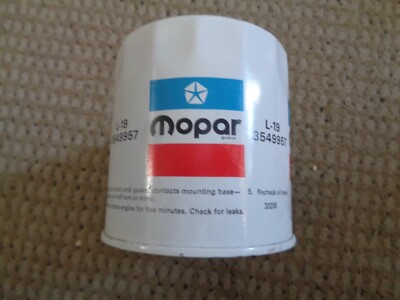
I found a guy that has some NOS Mopar oil filters for sale. I was just wondering how these would compare to a modern WIX filter? I like the looks of them but don't want to run one if they are inferior quality. Thanks in advance for you help!

Edit: I had to go back and edit this thread. I wasn't clear the first time. Would you run a 30-40 year old NOS filter on a high horsepower engine? Do you think that the filtering material could be compromised? Thanks

1776250820133.png
 
Last edited:
I think they were pretty good Brian, my engine building buddy used to swear by them. Obviously made by one of the major suppliers, it may even have been Wix. Sometimes you can tell if you compare the end caps.
 
I heard one time that Wix was the maker of Mopar filters. This was a few years back. If that's still the case today, I don't know. I only use Wix. Never had any problems.
 
I found a guy that has some NOS Mopar oil filters for sale. I was just wondering how these would compare to a modern WIX filter? I like the looks of them but don't want to run one if they are inferior quality. Thanks in advance for you help!

View attachment 1716532531


Here's what I use.

Mother Mopar approved with a Mopar part number.

Available at any Dodge dealership. (note I said Dodge LOL !! )


1776267580159.png
 
All the above filters bypass a significant amount of oil that doesn't get filtered during normal use. The only filter I know of that doesn't ever bypass any oil is from Jomar.

Jomar filters saved my bottom end from damage with I blew out all the needle bearings in my T&D rockers due to improper valve train geometry.

This damage happened over time, and I never found an intact needle bearing in the pan. There were parts of them in the heads. It was strange, and took Dwayne Porter to figure out what caused it. None of the debris made it back into the bottom end. That's the Jomar 100% No Bypass difference.
 
Back in the day, I would’ve had no problem running this filter. I guess what I’m concerned about is now that the filter and paper are 30 years old couldn’t it possibly have deteriorated? We’ve all picked up a old cardboard box that crumbles in your hands.
 
All the above filters bypass a significant amount of oil that doesn't get filtered during normal use. The only filter I know of that doesn't ever bypass any oil is from Jomar.

Jomar filters saved my bottom end from damage with I blew out all the needle bearings in my T&D rockers due to improper valve train geometry.

This damage happened over time, and I never found an intact needle bearing in the pan. There were parts of them in the heads. It was strange, and took Dwayne Porter to figure out what caused it. None of the debris made it back into the bottom end. That's the Jomar 100% No Bypass difference.

I was under the impression that the only time oil bi passed any filter is if it was clogged or there was a restriction.

As found when researching filter operation....


The oil filter bypass valve opens when the pressure across the oil filter exceeds a certain threshold. This happens when the oil filter gets clogged and can no longer allow oil to pass through efficiently. A clogged oil filter restricts the flow of oil, which causes a buildup of pressure behind the filter. This pressure triggers the valve to open and allows oil to bypass the filter entirely and flow directly into the engine. It ensures that the engine still receives lubrication, albeit without filtration. This is a temporary solution until the filter can be replaced. The valve will close again once the pressure normalizes, and the oil starts flowing properly through the filter again.

The bypass valve is typically set to open at a pressure between 8 and 15 psi, depending on the engine and the filter design. This ensures that oil can still circulate if the filter gets clogged but prevents the valve from opening too soon. It’s worth mentioning that the bypass valve doesn’t open just because you accelerate. However, if the filter is already partially blocked, high RPMs or sudden acceleration can spike oil pressure enough to trigger the valve. The valve responds to pressure, not directly to acceleration, but they’re related when it comes to oil flow.
 
Yes, good points. It also depends on which oil viscosity you run, which on cold starts can open the bypass, and/or let it open slightly during operation, as you mentioned. Also, Jomar posted this information:


"Professional Filter Test Results​


Posted by John Baranowski on Mar 11, 2017

Initial test Results on the Jomar “Professional Filter” for FORD and MOPAR Engines:

This test was performed at an independent facility using a Peterson dry-sump style pump and Mobil-1 10w-30w oil. The pump was run at 3400 RPM shaft speed (6800 RPM Engine speed). The filters were mounted on a Peterson single filter adaptor with #12 lines plumbed in and out. The oil flow rate was approximately 8.5 GPM. Twelve other National Brand oil filters (all with internal pressure relief bypass valves) were also tested. These internal bypass valves open up when the resistance to flow across the filter element exceeds the opening pressure of the relief valves.

In most cases the pressure differential necessary to open the valve(s) is about 8 PSI. The pressure drop of these 12 National Brand oil filters averaged 14.83 PSI, with a high reading of a 24 PSI drop across the filter to a low reading of an 8 PSI drop. This means that MOST of the oil pumped into these other fillers never passes through the filter element but instead “short circuits” through the bypass valve and back into the engine UNFILTERED.

The Jomar “Professional Filter" without an internal bypass valve had a pressure drop of ONLY 8 PSI while filtering 100% of the oil! The choice for an engine builder or racer of Ford or Mopar engines is simple. Filter SOME of the engine oil while MOST of it goes back into the engine unfiltered, or filter ALL of the oil with a Jomar “Professional Filter".

The Jomar “Professional Filter" has a heavy duty case with a volume of 55.6 cu. In. it has a large 450 sq. in. of 20 micron filter element and 5 full mounting threads. It weighs a hefty 1.4 lbs and has an anti drain back flapper plus an internal standpipe which helps to equalize the flow through the filter element.

To Conclude, these are no compromise, No-Bypass spin-on filters for Ford and Mopar high performance engines."

I believed them, and bought a case. As I mentioned above this post, I believe it save my bottom end after a valve train incident.

 
I found a guy that has some NOS Mopar oil filters for sale. I was just wondering how these would compare to a modern WIX filter? I like the looks of them but don't want to run one if they are inferior quality. Thanks in advance for you help!

View attachment 1716532531
When I worked in the automotive trade back in the late 80s/early 90s those filters were all we used, no matter the make or model of vehicle, never had a problem with them.
 

No one has answered the OP's actual question. For what it's worth, I've been running NOS filters in my 56 Plymouth that are most likely more than 30-40 years old. Hasn't been a problem yet.

Not sure I would run such an old filter - even though new - in a more high performance motor.
 
Brian - I would NOT run that old of a filter. Filters typically have a sealer/glue in them be it on the end caps or the bypass or whatever. In my mind, that glue would deteriorate over time to where I wouldn't trust it. There are plenty of up-to-date filters you can go buy and run today. Why risk it as you have a gorgeous high-end car!

As for the bypass aspect of filters, for OEM designs, the bypass DOES typically open on cold starts. Cold, thick oil in the winter cannot be pushed through the media without some going through the bypass. Think if you get some water that freezes in the filter blocking some of the paper media. Again, this is one of many reasons the OEM's are designed to bypass. You have to account for far too many variable not to have a functioning bypass. Where trouble comes in is when an aftermarket company markets a filter for numerous applications. There is no guarantee that the bypass is designed the same as was designed by the OEM. So you may get more or less (bypass) depending on what it is. Hence my recommendation is to buy/use the OEM-spec'd orginal filter whenever possible. That being said, there is no such thing for our old LA and BBM engines anymore!
 
does anyone remember Larry, Ed, and Howie who ran the Fram, Prestone, Champion trailer at the national events?
when Allied Sig owned them? after fram burned them in the contract
someone had bought the rights to mopar logos and they were working to make a new line of 100 pt filters
never happened, I have 2 test silk screened wix filters in mopar

also agree I would never run a 50 year old filter
 
-
Back
Top Bottom