Fabricated A-Body spindle ideas and discussion

-
Something else to keep in mind is that it appears that most of the aftermarket kits for the S197 use the back of the caliper mounting ears while the stock caliper bolts to the front of the ears. At least the ones that adapt a radial mount caliper, even the GT350 calipers, seem to do that. So, if we want to be able to all of the available kits intended for an S197, the width of the ears needs to be maintained or at least be able to allow for matching.
 
So here are Hotchkis' recommendations for alignment in their UCA kit for A-Bodies.

View attachment 1716395378

Seems like designing in 7 degreed positive caster maybe isn't so far off the mark.

I don’t think it is, aiming for 7° with the ability to go at least 1° in either direction seems about right to me. With power steering the additional steering effort wouldn’t be an issue, that’s really the only reason I dialed mine back. Although I do think you’d want to look into how much jacking effect you’re getting once you get into the +8° range since that does have the potential to upset the car’s balance on turn in and transitions if it gets too extreme.
 
I don’t think it is, aiming for 7° with the ability to go at least 1° in either direction seems about right to me. With power steering the additional steering effort wouldn’t be an issue, that’s really the only reason I dialed mine back. Although I do think you’d want to look into how much jacking effect you’re getting once you get into the +8° range since that does have the potential to upset the car’s balance on turn in and transitions if it gets too extreme.
 
Isn’t easier to start with a c6 or c7 spindle?

I don’t think so. Couple of reasons why; doesn’t bolt to the car without custom control arms, hubs that have 5x4.5 pattern don’t have tone rings, no idea on what brakes work but already have SP brakes worked up and the Mustang options should yield all kinds of options.

If I was building a COC, I would be all over those, but for a TB suspension I think it would be far more work.
 
One of the bad things about travel and having time to think and research is sometimes you end up learning stuff you wish you didn’t. In this case it isn’t huge, but still.

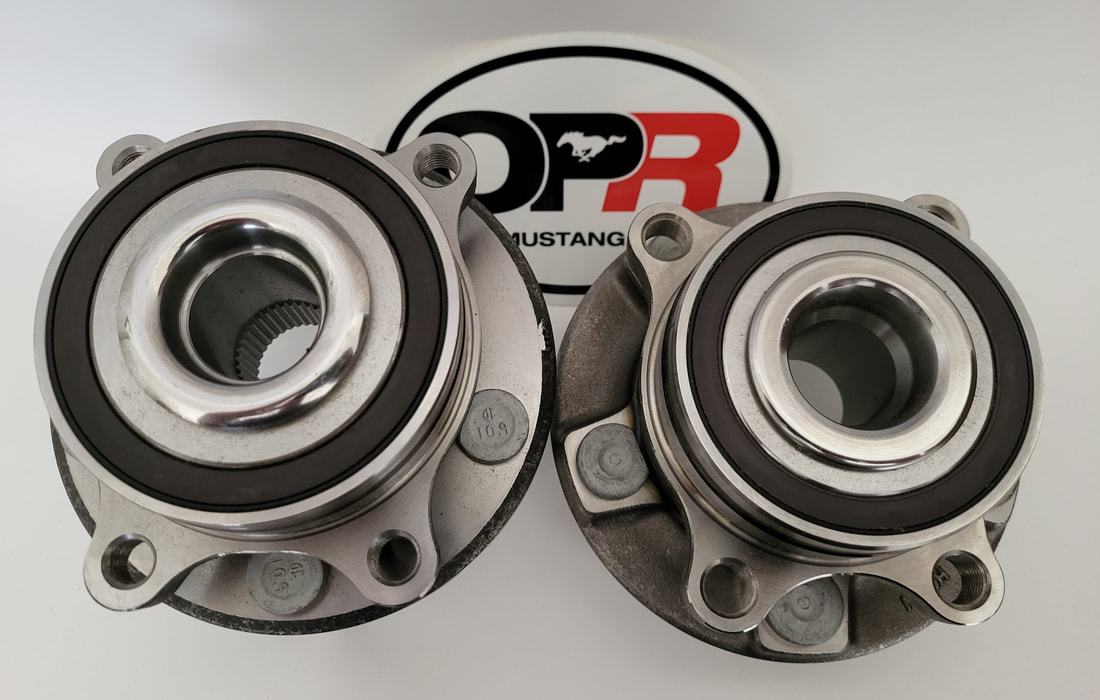
I’ve been grouping all MagnaRide cars into one group when in fact the Mach 1 had a different wheel bearing and hub, and is the same one as the 2020+ Explorer.

Here is the standard MagnaRide hub next to the Mach 1.

s550-to-s650-hub-back_orig.jpg


Being that it is used on all S650 Mustangs, seems like it should be available for some time. And isn’t a “Shelby” part.

In addition to that, I am re-thinking my idea to move the caliper to the front of the spindle. Seems like that is bad for adding brake cooling.

Not saying I am going to change directions, but it has me thinking.
 
I tried to do some more calculations with the app but it didn't work as well as I wanted. Going to keep looking for a good desktop program.
 
@DionR if you're going through all this to redesign a spindle, why not incorporate a screw in LBJ and make a divorced steering arm? Perhaps odd to have a screw in LBJ attached to the spindle, but its no different than the stock LBJ in theory.

That would extend the project and add a new level to it.

If I add the 7 degrees positive caster it will require (I assume) an adjustable UCA, but those are already designed and can just be purchased from @BergmanAutoCraft. If I redesign the LBJ, I have to design a new steering arm at the very least.

Add that it would complicate the hub bolts as right now the lower bolt is hidden behind the LBJ and has to be tightened before the LBJ can be assembled to the spindle. Adding the sleeve to screw the LBJ to would probably require dropping the LBJ 1-2" and would require the LBJ to be removed to replace the hub if required.

I guess rotating the hub bolt pattern 45 degrees would solve that, maybe.

I have started leaning towards the '73-4 LCA and steering arm, just because that arm doesn't have wear parts and the LCA accepts a screw in LBJ so it has the advantage of avoiding the low quality parts that seem to be prevalent with most replacements now.

Hmm...not sure. I will have to think on the idea some. Thanks!
 
Note that the later B-Body LCA requires some fabrication as well since Firm Feel doesn't look to carry a kit for the swap. And the LCA might be longer than the A-Body one so geometry would be affected as well.
 
I tried to do some more calculations with the app but it didn't work as well as I wanted. Going to keep looking for a good desktop program.
I found my AutoWare CD and got their suspension pro running. We just need measurements to all pivots from vehicle center, an arbitrary line at the front of the vehicle, and from the floor. I won’t be getting to my car for a few weeks to a month so I can’t grab those off mine. But if you have them feel free to send them to me.
 
Based on this post, I am going to have to revise my layouts for the extended balljoint roll center. I assumed the extended balljoint used in the @BergmanAutoCraft arms was 1" taller, but it looks like it is only 1/2" taller which results in a net 1" overall when combined with the taller F-Body spindle.

@BergmanAutoCraft, is there room to go taller or would the balljpoint foul the wheel if you used a 1" taller balljoint with the F-Body spindle?

Shifting the mount back to engineer in the 7 degrees caster will move the UBJ closer to the wheel as well, so I suspect I am running out of room quickly.

Which prompts another though. This spindle design will probably require an 18" wheel. No option for someone to run a 17" wheel if they didn't want to step up in wheel size. I guess if someone wanted the extra caster they can run a stock spindle so not a lot of need. The only things missing would be the cartridge style wheel bearing and the option to run ABS.
 
I found my AutoWare CD and got their suspension pro running. We just need measurements to all pivots from vehicle center, an arbitrary line at the front of the vehicle, and from the floor. I won’t be getting to my car for a few weeks to a month so I can’t grab those off mine. But if you have them feel free to send them to me.
I usually use the centerline of the wheel as my fore/aft zero. Otherwise you should be able to use @DionR's measurements. I'd assume his are more accurate than my old ones and I'm several months away from being able to measure mine.
 
Looking for some input.

I wouldn't say I am at a crossroad, but I will say I am wavering on the S550 rear hub some. I don't like that someone has to source/machine washers and a bolt to set bearing preload. Plus, I guess they is a bit of an issue in the stock application due to losing the preload and roasting the wheel bearings. And I think the GT350/Mach 1 bearing has a better design due to the width of the bearing and both are pre-loaded avoiding the need for a bolt and washers. The only real advantage I see to the S550 rear hub is the bolt pattern is much easier to align with the LBJ bolts.

Of the two pre-loaded bearings, the Mach 1 seems to be the preferred setup. Even the GT350 bolt on hub experienced enough deflection that the speed sensors lost readings and caused issues.


I don't believe I will ever load the front suspension as much as an S550 with a 19x11 wheel, nor do I expect anyone else will. But I am always wondering if the best wouldn't be better.

I don't know where the GT350 bearing came from, but I suspect it is an Explorer application. I know it wasn't designed for the GT350 because it is splined like the rear bearing or like a 4WD/AWD front bearing. Base on OP Mustangs blog post, I believe the Mach 1 front bearing is off a 2020 or 2021+ RWD Explorer. In addition, it appears to be the same front wheel bearing used on all S650 Mustangs, so it should be easily accessible at some point.

Currently the GT350 hub doesn't seem that bad to source, but the Mach 1 hub is proving to be harder right now. Even the late Explorer hub doesn't seem to be easy to source locally, but they have a couple of options on RockAuto so I suspect it is just that they are new enough that the parts stores aren't stocking them. The Mach 1/S650 hub currently appears to be dealership only (PR3Z-1109-B).

Note that the part numbers probably won't match up between a Explorer and a Mustang, but that is due to different length wheel studs, not because the bearing is different. I don't believe it will be an issue for this application whether the Mustang or the Explorer hub is used unless someone starts building CF wheels in 18x9.5 sizes. :D

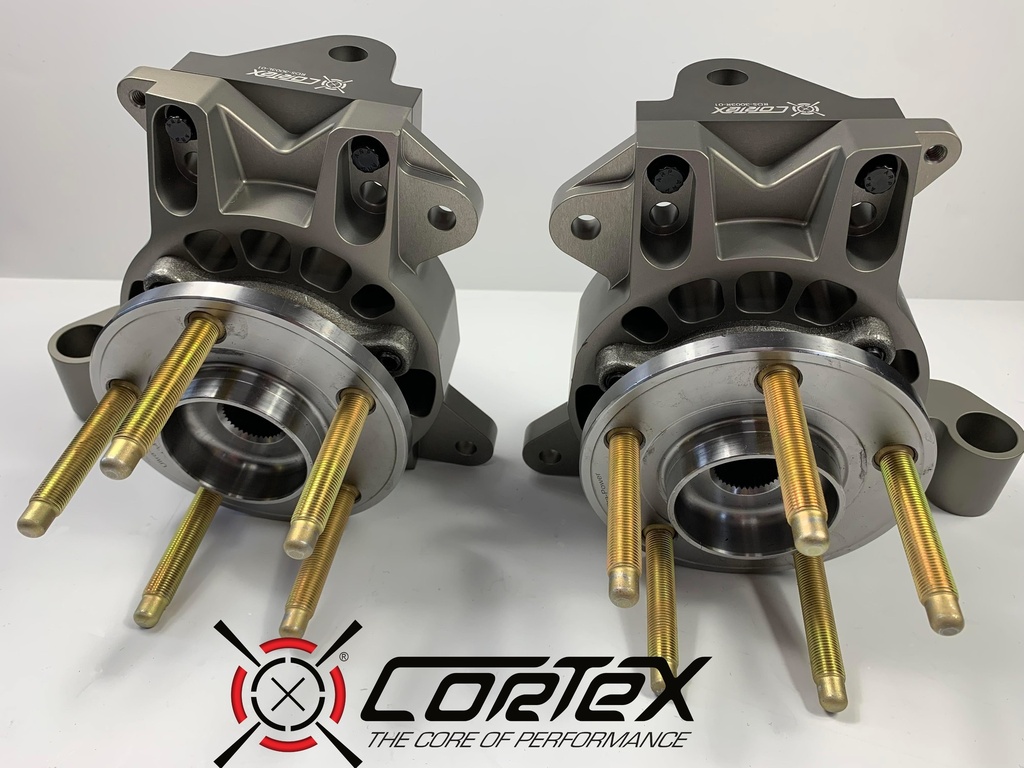
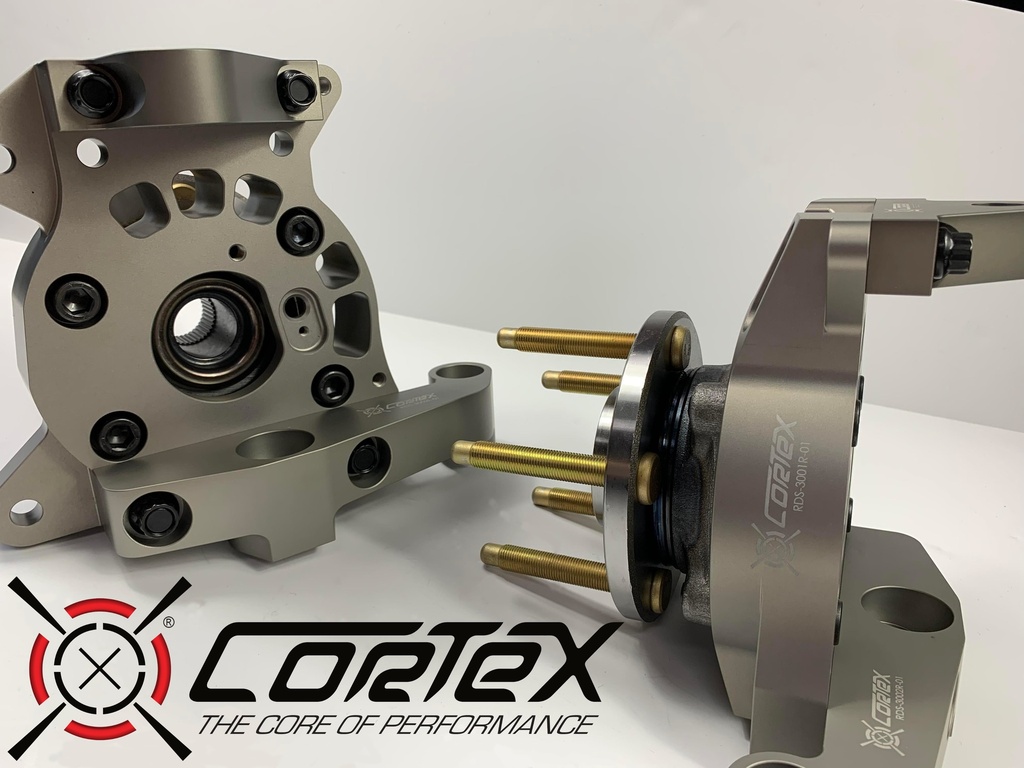
Then I tripped over this spindle:

%5BRDS-3000%5D%20Radial%20X%20Spindle%2C%20Gen%203%2C%2064-70%20Mustang-Cougar%2C%20FOX%2C%20SN95%2C%20SLA%2C%20Track%2C%20set


CorteX%20Gen-3%20Radial-X%20Spindle%20Assembly%20-%20Pair


Radial X Spindle, Gen 3, 64-70 Mustang/Cougar, FOX, SN95, SLA, Track, set

This one appears to use the GT350 hub, so other's have looked at this as well.

And it uses the S197 brake setup and lists the following as brake options:
  • OEM 4 Piston Brembo Calipers (2007-2013 GT500, 2011-2014 Boss 302, 2011-2014 GT PP)
  • OEM S550 6 Piston Brembo Calipers (Except GT350, GT500)*
  • Brembo FF6 Pista 380x35mm or 355x35mm 2005-2014 Mustang
  • Wilwood Aero6 14 x 1.25 or 15 x 1.25, 2005-2014 Mustang
  • Brembo XB105 Calipers with both 355x32mm, 380x32mm rotors, 380x34mm, and also 380x35mm
  • Brembo XA6 and XA4 Calipers with 380x32mm rotors or 380x35mm
  • Brembo XA2.E7 4-piston (E7), 2005-2014 Mustang application 355 x 32 mm rotors
  • Wilwood Aero6 with 14×1.25 rotors
  • AP Radi-Cal 2005-2014 Mustang kit 372 x 34mm rotor
  • Stoptech ST40 or STR40, 355 x 32 Rotors for 2005-2014 Mustang
  • Stoptech ST60 or STR60, 355 x 32 or 380 x 32 rotors for 2005-2014 Mustang
  • Baer 6R/S Calipers 14×1.25 rotors 2005-2014 Mustang
  • Baer 6P Calipers and 14×1.25 rotors 2005-2014 Mustang
This makes me lean pretty hard in the direction of using the Mach 1/Explorer hub and setting it up for the S197 brakes. The other nice thing about the Mach 1 hub is that it is shorter between the back of the mounting flange and the face of the hub so it should make getting the LBJ bolts under it easier.

Any one have any thoughts?

I currently plan to pick up an Explorer hub from NAPA where I can return it after I take some measurements and model it. Plus I plan to try and get the offset distance I need for the S197 caliper to CL of rotor dimension this weekend. Then I will see where it all goes.

 
This is an honest question Dion. What exactly are you trying to gain by going to all this trouble over using a factory spindle arrangement?
 
Looking for some input.

I wouldn't say I am at a crossroad, but I will say I am wavering on the S550 rear hub some. I don't like that someone has to source/machine washers and a bolt to set bearing preload. Plus, I guess they is a bit of an issue in the stock application due to losing the preload and roasting the wheel bearings. And I think the GT350/Mach 1 bearing has a better design due to the width of the bearing and both are pre-loaded avoiding the need for a bolt and washers. The only real advantage I see to the S550 rear hub is the bolt pattern is much easier to align with the LBJ bolts.

Of the two pre-loaded bearings, the Mach 1 seems to be the preferred setup. Even the GT350 bolt on hub experienced enough deflection that the speed sensors lost readings and caused issues.


I don't believe I will ever load the front suspension as much as an S550 with a 19x11 wheel, nor do I expect anyone else will. But I am always wondering if the best wouldn't be better.

I don't know where the GT350 bearing came from, but I suspect it is an Explorer application. I know it wasn't designed for the GT350 because it is splined like the rear bearing or like a 4WD/AWD front bearing. Base on OP Mustangs blog post, I believe the Mach 1 front bearing is off a 2020 or 2021+ RWD Explorer. In addition, it appears to be the same front wheel bearing used on all S650 Mustangs, so it should be easily accessible at some point.

Currently the GT350 hub doesn't seem that bad to source, but the Mach 1 hub is proving to be harder right now. Even the late Explorer hub doesn't seem to be easy to source locally, but they have a couple of options on RockAuto so I suspect it is just that they are new enough that the parts stores aren't stocking them. The Mach 1/S650 hub currently appears to be dealership only (PR3Z-1109-B).

Note that the part numbers probably won't match up between a Explorer and a Mustang, but that is due to different length wheel studs, not because the bearing is different. I don't believe it will be an issue for this application whether the Mustang or the Explorer hub is used unless someone starts building CF wheels in 18x9.5 sizes. :D

Then I tripped over this spindle:

%5BRDS-3000%5D%20Radial%20X%20Spindle%2C%20Gen%203%2C%2064-70%20Mustang-Cougar%2C%20FOX%2C%20SN95%2C%20SLA%2C%20Track%2C%20set


CorteX%20Gen-3%20Radial-X%20Spindle%20Assembly%20-%20Pair


Radial X Spindle, Gen 3, 64-70 Mustang/Cougar, FOX, SN95, SLA, Track, set

This one appears to use the GT350 hub, so other's have looked at this as well.

And it uses the S197 brake setup and lists the following as brake options:
  • OEM 4 Piston Brembo Calipers (2007-2013 GT500, 2011-2014 Boss 302, 2011-2014 GT PP)
  • OEM S550 6 Piston Brembo Calipers (Except GT350, GT500)*
  • Brembo FF6 Pista 380x35mm or 355x35mm 2005-2014 Mustang
  • Wilwood Aero6 14 x 1.25 or 15 x 1.25, 2005-2014 Mustang
  • Brembo XB105 Calipers with both 355x32mm, 380x32mm rotors, 380x34mm, and also 380x35mm
  • Brembo XA6 and XA4 Calipers with 380x32mm rotors or 380x35mm
  • Brembo XA2.E7 4-piston (E7), 2005-2014 Mustang application 355 x 32 mm rotors
  • Wilwood Aero6 with 14×1.25 rotors
  • AP Radi-Cal 2005-2014 Mustang kit 372 x 34mm rotor
  • Stoptech ST40 or STR40, 355 x 32 Rotors for 2005-2014 Mustang
  • Stoptech ST60 or STR60, 355 x 32 or 380 x 32 rotors for 2005-2014 Mustang
  • Baer 6R/S Calipers 14×1.25 rotors 2005-2014 Mustang
  • Baer 6P Calipers and 14×1.25 rotors 2005-2014 Mustang
This makes me lean pretty hard in the direction of using the Mach 1/Explorer hub and setting it up for the S197 brakes. The other nice thing about the Mach 1 hub is that it is shorter between the back of the mounting flange and the face of the hub so it should make getting the LBJ bolts under it easier.

Any one have any thoughts?

I currently plan to pick up an Explorer hub from NAPA where I can return it after I take some measurements and model it. Plus I plan to try and get the offset distance I need for the S197 caliper to CL of rotor dimension this weekend. Then I will see where it all goes.


Yeah, the cortex is one of the best designed spindles I have seen. With the bolt on steering arm and ball joint mounts it is easy to use for a lot of different applications. I also think the s197 caliper setup is probably the way to go because there is so many options for it at all different price levels.
 

This is an honest question Dion. What exactly are you trying to gain by going to all this trouble over using a factory spindle arrangement?

Maybe some background is in order.

I started the project because I wanted to use an LX/LC hub so I could wire up an ABS module from a late model Challenger. I wasn’t looking to add ABS, but was wanting to feed the “stock” speed signal to the PCM so it could run the factory cruise control. This is in the G3 swap car, so this would be with a factory (NGC) PCM.

I pivoted to the idea of S550 hub when I decided I couldn’t trust the bolt pattern on the aftermarket hubs. Regardless of my opinion on what the factory bolt pattern is or is not, the aftermarket hubs are definitely 115mm and that killed using those hubs.

So the number one reason I started the project was wheel speed sensors for cruise control.

I also want a cartridge style bolt on hub. Frankly, I’m not comfortable with 32# brake rotors hanging off the stock spindle pin. Not that it is generally a problem, but since I want tone rings, it makes a ton of sense (to me) to get away from that style spindle and go to something more modern.

In the subsequent time, I have decided I do want to wire up ABS. I believe the system from an 09 or maybe 10 Challenger could be retrofitted, but I think the better plan is a system out of an S197. But that part of the project is for much later.

I also want to engineer in caster. I think the factory designed the original suspension with 1/2 degree negative caster and rolling the spindle back to get about 6 degrees positive caster drops the OTR about 3/4” or so. I suspect that maintaining the designed OTR location by engineering in positive caster will have benefits.

Big brakes are a given as well.

I would also add that I like this kind of stuff.
 
Last edited:
I forgot to add that height can be added to the spindle. Not a big deal as there are longer balljoints to do the same thing, but it could be useful if it saved money over a longer balljoint.

Besides, why should we be the only ones without an aftermarket spindle. Even better if it is something that people could weld up in their own garage for 1/5th the cost of something like the Cortex, even if it isn’t a shiny billet CNC piece.
 
About losing preload on the rear, the cv stub is working against traction. Also, the caged plates /prevailing torque nuts are one time use and the hub to spline engagement is supposed to be a wedge fit. Any rotation between the hub and the cv stub on the splines from braking or traction will loosen the clamp load (all right hand thread. Spring-like axle shafts such as 300M that absorb torque peaks help too). Not a problem for the front. Spindle type mounting is better than a bolt/cv stub since the weight of the rotating assembly is reduced.

I once bought cobra axles from Factory Five to use with a miata 8.8 (I had the mazda hubs broached) but then realized why the half shafts were so cheap (about 25 years ago). They were sourced from China and the splines could be rocked on the hub. I sold them to another builder (full disclosure to the buyer). I don't know if he used them or not. I had Moser make custom length shafts so I could use oem cv joints.

I have granada spindles on my '67 mustang with a UCA lowered an inch like the GT350. When deciding on a name, I'm guessing cortex never heard of a cotex. Lovely product though.

I need to retire so I have time to work on all this (rough) stuff, but then I wouldn't need to drive anywhere. Too many irons....
 
About losing preload on the rear, the cv stub is working against traction. Also, the caged plates /prevailing torque nuts are one time use and the hub to spline engagement is supposed to be a wedge fit. Any rotation between the hub and the cv stub on the splines from braking or traction will loosen the clamp load (all right hand thread. Spring-like axle shafts such as 300M that absorb torque peaks help too). Not a problem for the front.

I thought about that and figured it would be less (no?) issue. Having a pre-loaded bearing makes things simpler either way.

Spindle type mounting is better than a bolt/cv stub since the weight of the rotating assembly is reduced.

Not following you there. Can you elaborate?

I have granada spindles on my '67 mustang with a UCA lowered an inch like the GT350.

I remember reading about that mod and not understanding the goal. While I still can't say what the actual results are, I am glad to have gained enough understanding to see the reasons why they do that.

I need to retire so I have time to work on all this (rough) stuff, but then I wouldn't need to drive anywhere. Too many irons....

I should add that (for me) this spindle idea is a longer range project. When my G3 car rolls down the road for the first time it will be on a suspension full of left over stock parts.

At some point it will get a full suspension makeover, but will stay a TB suspension as I am even more convinced that the COC "better geometry" is just sales jargon and probably an outright lie. And when I do the suspension upgrade, it would be cool to use this spindle and be able to add ABS (at a later time). I think an F-Body spindle and my current Scat Pack brake kit would do the job fine if this falls apart, though.

So I'm not currently working on this so I can run out and bolt it on. This is a project I work on while I can't be in the garage.
 
With a hub assy made for a spindle as part of the knuckle, the hub is rotating with the outer race. A driven axle has the hub rotating with the inner race along with the cv stub or bolt and machined washers you were describing earlier. Not a huge difference in weight but notable.

The GT350 uca pivot is lowered to increase the camber gain. The arm has to be shimmed outboard to keep the same camber setting, but it pulls the ubj inboard more in bump, less in droop due to a falling ratio. A generally good angle for ucas is around 7 degrees from level for a virtual swing arm pivot just outboard of the opposite side tire.
 
Last edited:
For anyone that cares, here is a 2022 Ford Explorer front knuckle.

1746223068515.png


This would explain the funky bolt pattern on the GT350 and Mach 1 hubs.
 
-
Back
Top Bottom