Is this condenser needed?

-

gerahead

Glutton for Punishment
Joined
Aug 19, 2009
Messages
957
Reaction score
289
Location
Maple Grove, MN
The project is a 71 Dart getting a 318 to 340 swap. The engine is allegedly from a 72 Challenger. When I bought the car, it was a roller with several pickup loads of parts and the engine had been partially disassembled already so I don't have a reference. The question is this . . . . the coil had a condenser with an eyelet pigtail attached to the + terminal of the coil. The pigtail is just long enough for the condenser to get attached at the coil bracket mounting boss on the intake manifold. Not wanting to trust anything I can't confirm, is this condenser needed? I have a couple different versions of the wiring schematics including the factory service manual and none of them show this condenser. Thanks!

Jim

PXL_20250801_182120220.MP.jpg
 

Thanks guys for the quick responses! Yup, I'm still running the breaker point distributor as well!

Jim
 
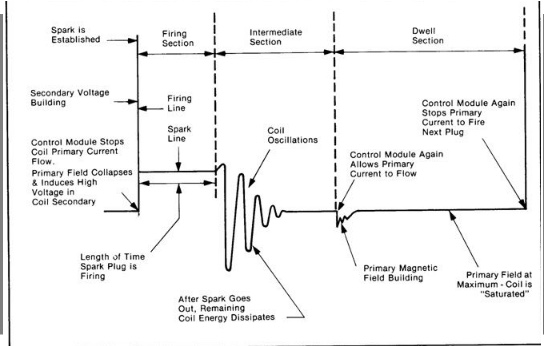
It IS necessary, and it's not just for radio noise. The condenser (capacitor) helps provide a low impedance path to ground during the spark event. When the points open, the coil is magnetically charged. The cap INSIDE the distributor has zero charge because the points were closed. The magnetic field collapses, and causes a generating effect in the coil primary. This causes a current flow from ground up through the distributor cap and charges it up. Meanwhile, the radio cap "helps" to provide a short, low Z path for that circuit. When the magnetic field runs out of steam, the dist. cap is charged, and discharges through the coil, re-charging the magnetic field. The repeats over and over, until the load (the spark plug) on the coil causes this "ringing" oscillation to finally peter out. Then the points close and starts all over again, battery current recharging the magnetic coil field.

The event I'm describing starts at the first vertical line. The "spark line" is flat because the plug is loading down the power of the coil, and the ringing/ oscillation cannot be seen, until the power peters out enough that the coil cannot maintain spark across the plug,

This whole process needs a complete circuit path, and the radio condenser insures a low Z path to ground, through ground, and back to the distributor. So the circuit electrical path is distributor body / ground, through the dist condenser, out the primary coil lead, through the coil, out the coil + and to ground back through the positive circuit, the key, batter, and back to ground. BUT IT IS IMPROVED by the radio cap which shuts that from coil + direct to ground


xSecondary-Ignition-Sections.jpg.pagespeed.ic.dDa8nA36EO.jpg
 
Last edited:
It IS necessary, and it's not just for radio noise. The condenser (capacitor) helps provide a low impedance path to ground during the spark event. When the points open, the coil is magnetically charged. The cap INSIDE the distributor has zero charge because the points were closed. The magnetic field collapses, and causes a generating effect in the coil primary. This causes a current flow from ground up through the distributor cap and charges it up. Meanwhile, the radio cap "helps" to provide a short, low Z path for that circuit. When the magnetic field runs out of steam, the dist. cap is charged, and discharges through the coil, re-charging the magnetic field. The repeats over and over, until the load (the spark plug) on the coil causes this "ringing" oscillation to finally peter out. Then the points close and starts all over again, battery current recharging the magnetic coil field.

The event I'm describing starts at the first vertical line. The "spark line" is flat because the plug is loading down the power of the coil, and the ringing/ oscillation cannot be seen, until the power peters out enough that the coil cannot maintain spark across the plug,

This whole process needs a complete circuit path, and the radio condenser insures a low Z path to ground, through ground, and back to the distributor. So the circuit electrical path is distributor body / ground, through the dist condenser, out the primary coil lead, through the coil, out the coil + and to ground back through the positive circuit, the key, batter, and back to ground. BUT IT IS IMPROVED by the radio cap which shuts that from coil + direct to ground


xSecondary-Ignition-Sections.jpg.pagespeed.ic.dDa8nA36EO.jpg


67Dart273,
Thanks for the technical description, I follow that explanation. Interesting that the manual or the other schematic that I have doesn't show that condenser!

Jim
 
To be fair, there's lots of "rigs" that have left that off, notably, tractors. But things would be at least some better if it was included. Wire length, such as a motorhome or trunk mount battery, could make a difference
 
@67Dart273

But is there not (on any points Mopar) already a capacitor at the breaker points, performing the function you describe??
 
The project is a 71 Dart getting a 318 to 340 swap. The engine is allegedly from a 72 Challenger. When I bought the car, it was a roller with several pickup loads of parts and the engine had been partially disassembled already so I don't have a reference. The question is this . . . . the coil had a condenser with an eyelet pigtail attached to the + terminal of the coil. The pigtail is just long enough for the condenser to get attached at the coil bracket mounting boss on the intake manifold. Not wanting to trust anything I can't confirm, is this condenser needed? I have a couple different versions of the wiring schematics including the factory service manual and none of them show this condenser. Thanks!

Jim

View attachment 1716437029

In short, it is not necessary for basic ignition operation. More details about its function and usage are described in the following.


The radio interference suppression capacitor attached to the coil is one of three interference suppression capacitors in the ignition and charging systems for contact point ignition systems. These capacitors, also referred to as condensers, filter transients on the +12 volt ignition, charging regulation, and supply feeds at points that might cause radio interference, or noise. These capacitors are described in the following:

  • At the ignition coil: A capacitor is connected between the coil primary, or positive (+), terminal and ground by mounting with the coil bracket. The capacitor filters transients that appear on the primary wiring from the opening and closing of the contact points, and subsequent coil magnetic field build and collapse. This is separate and different to the condenser in the distributor itself that assists with coil primary current during field collapse and potential contact point arcing.

  • In the alternator: A capacitor is installed at the output terminal or incorporated into the output terminal to filter possible transients leading to radio noise. Although the battery itself serves as a large filter capacitor in effect overall, the capacitor at the alternator output provides immediate filtering at that point.

  • At the instrument cluster voltage regulator: A capacitor is installed at the +12 volt input to the cluster regulator, or voltage limiter, and is grounded in the cluster to filter transients from the cluster regulator mechanical points opening and closing.

The radio interference suppression capacitor for the ignition coil primary lead, plus the alternator and cluster regulator capacitors continued when electronic ignition was introduced. The ignition coil primary capacitor served a similar purpose to filter transients, induced on the primary ignition circuit, from the coil current switching transistor in the electronic control unit (ECU) and subsequent coil magnetic field build and collapse.

In 1973, a running change was made to add an additional radio interference suppression capacitor to the auxiliary resistor circuit. This capacitor was added to the connection between the ECU and the 5 ohm ballast resistor at the green wire with red tracer. In early 1974, ECU part number 3755550, was released which included the radio noise suppression capacitor internally.

In 1978, the radio interference suppression capacitor for the ignition circuit was incorporated into the wiring harness at the voltage regulator connector in the blue wire on the supply side of the ballast resistor. This capacitor in the wiring harness performed the same function as the earlier primary circuit arrangement at the coil, but offered a simpler production assembly, and a more direct filtering on the supply side of the ballast resistor.

Some later factory radio systems also incorporated a transient/noise filter choke, which is an inductor, in the +12 volt power supply lead near the radio itself.

The capacitors at the alternator and instrument cluster voltage regulator should not be removed or disabled in general, although the instrument cluster voltage regulator and alternator can continue to function without the capacitor.

The capacitor at the coil, or later integrated in the wiring harness, will not affect the ignition itself if removed from a point system. It likely will not negatively affect a factory electronic ignition if removed, but transients could lead to false triggering in the ECU if large enough. The capacitor is not a parasitic device in this function and should be generally left in place unless there is a specific reason to remove it, particularly if the vehicle is equipped with an AM radio.

The capacitor at the coil must be removed with aftermarket ignitions that are of the capacitive discharge (CD) or multi spark discharge (MSD) varieties.

For a stock point or electronic ignition, if the capacitor in the ignition primary circuit fails open circuit, it will have no effect other than possible radio noise or even less likely ECU false triggers. Although uncommon, if the capacitor in the ignition primary circuit fails as a short circuit, it will shut down the ignition, and could lead to wiring damage.

 
Last edited:
Interesting that the manual or the other schematic that I have doesn't show that condenser!

Jim

The factory service manuals discuss the radio suppression capacitors in Accessories Group Section (1), in the sub-section about Radios and Antennas. Different years have some differences in details. The ignition coil primary radio interference suppression capacitor is not shown on the wiring diagrams until it was integrated into the wiring in 1978.

From a 1966 manual:
Screenshot 2025-08-01 11.19.49 PM.png
 
The factory service manuals discuss the radio suppression capacitors in Accessories Group Section (1), in the sub-section about Radios and Antennas. Different years have some differences in details. The ignition coil primary radio interference suppression capacitor is not shown on the wiring diagrams until it was integrated into the wiring in 1978.

From a 1966 manual:
View attachment 1716437161

Vaanth,
This image is exactly what I have and how it is configured. Thanks for the link and the prior explanation. I wouldn't have thought to look there unless I had stumbled across it by accident. Useful information! Thank you, sir!

Jim
 
@67Dart273

But is there not (on any points Mopar) already a capacitor at the breaker points, performing the function you describe??

Yes. 67dart273 explains the function of this additional condenser in the first paragraph of his initial reply. The system will run without it, but it works better with it.
 
-
Back
Top Bottom