

You are using an out of date browser. It may not display this or other websites correctly.
You should upgrade or use an alternative browser.
You should upgrade or use an alternative browser.
anyone know what this intake fits?
- Thread starter dustinmoran91
- Start date
-
Bulldozer
free ice cream sandwiches
buick /olds 215 V8 1961-63
dustinmoran91
Well-Known Member
lol wow that was fast! and they only made them for 3 years?buick /olds 215 V8 1961-63
thats interesting, id never seen anything like it before and found it in a mopar graveyard but i was baffled by what it would fit. wonder if it would be worth anything to anyone?

Oklacarcollecto
Life is an experiment
buick /olds 215 V8 1961-63
Lol, it was easy wasn't it?
Bulldozer
free ice cream sandwiches
lol wow that was fast! and they only made them for 3 years?
thats interesting, id never seen anything like it before and found it in a mopar graveyard but i was baffled by what it would fit. wonder if it would be worth anything to anyone?
im not really sure, you could toss it on Ebay or the HAMB and see what happens, its got to be worth something to someone. funny how gm had the same firing order as our V8s.
Bulldozer
free ice cream sandwiches
lol, it was easy wasn't it?
lol
dustinmoran91
Well-Known Member
lol i was in the process of google searching for images of intakes to fit all the brands to see what would have intake runners set up like that. id never even heard of a 215 v8 before. i searched it and there was one on ebay at $76 right now with 5 bids on it. i don't really wanna hassle with ebay because of seller fees and things like that. maybe itll be a cool wall hanger lol

lol wow that was fast! and they only made them for 3 years?
thats interesting, id never seen anything like it before and found it in a mopar graveyard but i was baffled by what it would fit. wonder if it would be worth anything to anyone?
Saying they were made for only 3 years is a little bit misleading. The FACT is that the rights to this engine were sold to who-ever-the-heck makes Rovers and they used that engine until just recently
http://en.wikipedia.org/wiki/Rover_V8_engine
This is a photo of a 70, which used sidedraft carbs, I'd guess for better hood clearance, or maybe just because the Brits are weird
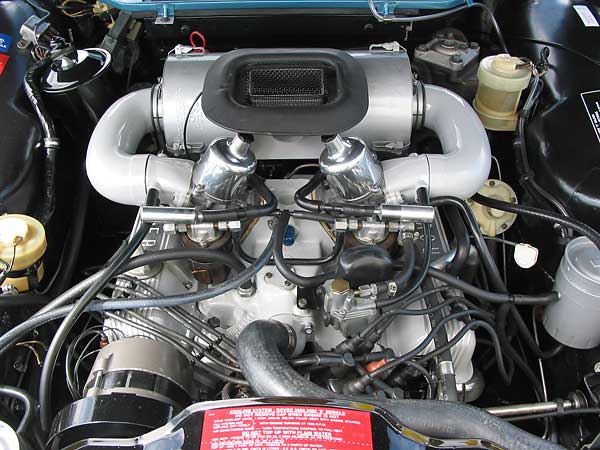
dustinmoran91
Well-Known Member
Saying they were made for only 3 years is a little bit misleading. The FACT is that the rights to this engine were sold to who-ever-the-heck makes Rovers and they used that engine until just recently
http://en.wikipedia.org/wiki/Rover_V8_engine
This is a photo of a 70, which used sidedraft carbs, I'd guess for better hood clearance, or maybe just because the Brits are weird
Since i dont know how many were made or pretty much anything about them, i talked my brother into throwing it on ebay for me with a starting bid of $20. I figure if someone wants it enough to bid $76 on the other one listed i might get a few bucks for mine also
C130 Chief
Mechanical Genius
dustinmoran91
Well-Known Member
I googled it and i found people putting stroker kits in them and revving the crap out of them. They gotta be a good little motor lol
Oklacarcollecto
Life is an experiment
Since i dont know how many were made or pretty much anything about them, i talked my brother into throwing it on ebay for me with a starting bid of $20. I figure if someone wants it enough to bid $76 on the other one listed i might get a few bucks for mine also
He sure used small pictures, no part number and didn't list the application.
http://www.ebay.com/itm/215-v8-inta...Parts_Accessories&hash=item27cbce5b52&vxp=mtr
dustinmoran91
Well-Known Member
He listed the manufacturer part number in item specifics, i dont know why the pictures are small. Their the same ones i used on this thred. Also neither of us knows any of the applications it came on. Thats part of the low price lol we figured at that price people might roll the dice and take it off my hands
OldmanRick
Well-Known Member
Oklacarcollecto
Life is an experiment
The circle in the pic is the Winters foundry mark.......same as where the LT1, LS6 and L88 Chevy manifolds came from. Someone restoring a early 60's Olds F85 or Pontiac Tempest would be interested in it.
Plus this one has the early casting number.
dustinmoran91
Well-Known Member
Lol price is going up with every post! Lol just kiddin. It serves me no purpose so i dont need to make much on it as long as it goes to a home where it will get used and help someone who needs it. Plus im learning alot from this thread about early small block stuff.
OldmanRick
Well-Known Member
Interesting reading if you care....lol.
Aluminum 215
From 1961-1963, Oldsmobile manufactured its own version of the Buick-designed, all-aluminum 215 engine for the F-85 compact. Known variously as the Rockette, Cutlass, and Turbo-Rocket by Oldsmobile (and as Fireball and Skylark by Buick),[8] it was a compact, lightweight engine measuring 28 in (71 cm) long, 26 in (66 cm) wide, and 27 in (69 cm) high (same as the small-block Chevy),[9] with a dry weight of only 320 lb (150 kg).[10] The Oldsmobile engine was very similar to the Buick engine, but not identical: it had larger wedge(rather than hemispherical)-shaped combustion chambers with flat-topped (rather than domed) pistons, six bolts rather than five per cylinder head, and slightly larger intake valves; the valves were actuated by shaft-mounted rocker arms like the Buick and Pontiac versions, but the shafts and rockers were unique to Oldsmobile. With an 8.75:1 compression ratio and a 2-barrel carburetor, the Olds 215 had the same rated hp, 155 hp (116 kW) at 4800 rpm, as the Buick 215, with 220 ft·lbf (300 N·m) of torque at 2400 rpm. With a 4-barrel carburetor and 10.25:1 compression, the Olds 215 made 185 hp (138 kW) at 4800 rpm and 230 lb·ft (310 N·m) at 3200 rpm with a manual transmission. With a 4-barrel carburetor and 10.75:1 compression, the Olds 215 made 195 hp (145 kW) at 4800 rpm and 235 lb·ft (319 N·m) at 3200 rpm with an automatic. The Buick version was rated at 200 hp with an 11to1 compression ratio.
The basic Buick/Olds 215 V8 went on to become the well known Rover V8, which still remains in limited production. The Range Rover V8 utilized the Buick-style pistons, heads, and valve train gear.
The Oldsmobile engine block formed the basis of the Repco 3-liter engine used by Brabham to win the 1966 and 1967 Formula One world championships. The early Repco engines produced up to 300 bhp (220 kW), and featured new SOHC cylinder heads and iron cylinder liners. The 1967 and later versions of the Repco engine had proprietary engine blocks.
In the mid-1980s, hot rodders discovered the 215 could be stretched to as much as 305 cu in (5 l), using the Buick 300 crankshaft, new cylinder sleeves, and an assortment of non-GM parts.[11] It could also be fitted with high-compression cylinder heads from the Morgan +8. Using the 5 liter Rover block and crankshaft, a maximum displacement of 317.8 cu in (5,208 cc) is theoretically possible.[12]
[edit] Turbo Jetfire
In 1962 and 1963 Oldsmobile built a turbocharged version of the 215. The small-diameter Garrett T5 turbocharger with integral wastegate was manufactured by Garrett AiResearch and produced a maximum of 5 psi (34 kPa) boost at 2200 rpm. The engine had 10.25:1 compression and a single-barrel carburetor. It was rated at 215 hp (160 kW) at 4600 rpm and 300 lb·ft (410 N·m) at 3200 rpm. In development, the high compression ratio created a serious problem with spark knock on hard throttle applications, which led Olds to use a novel water-injection system that sprayed metered amounts of distilled water and methyl alcohol (dubbed "Turbo-Rocket Fluid") into the intake manifold air-stream to cool the intake charge. If the fluid reservoir was empty, a complex double-float and valve assembly in the Turbo-Rocket Fluid path would set a second butterfly (positioned between the throttle butterfly and the turbocharger) into the closed position, limiting the amount of boost pressure. Unfortunately, many customers did not keep the reservoir filled, or had mechanical problems with the turbocharger system which resulted in many of the turbo-charger installations being removed and a conventional 4 barrel carburetor and manifold installed in its place.
The turbocharger was offered only in a special Jetfire model, which was the second turbocharged passenger car offered for public sale. The Chevrolet Corvair Spyder Turbo also manufactured by GM was ahead the Oldsmobile Jetfire Turbo by only a few weeks. Only 9,607 were sold in two model years, and many were converted by dealers to conventional four-barrel carbureted form.
Aluminum 215
From 1961-1963, Oldsmobile manufactured its own version of the Buick-designed, all-aluminum 215 engine for the F-85 compact. Known variously as the Rockette, Cutlass, and Turbo-Rocket by Oldsmobile (and as Fireball and Skylark by Buick),[8] it was a compact, lightweight engine measuring 28 in (71 cm) long, 26 in (66 cm) wide, and 27 in (69 cm) high (same as the small-block Chevy),[9] with a dry weight of only 320 lb (150 kg).[10] The Oldsmobile engine was very similar to the Buick engine, but not identical: it had larger wedge(rather than hemispherical)-shaped combustion chambers with flat-topped (rather than domed) pistons, six bolts rather than five per cylinder head, and slightly larger intake valves; the valves were actuated by shaft-mounted rocker arms like the Buick and Pontiac versions, but the shafts and rockers were unique to Oldsmobile. With an 8.75:1 compression ratio and a 2-barrel carburetor, the Olds 215 had the same rated hp, 155 hp (116 kW) at 4800 rpm, as the Buick 215, with 220 ft·lbf (300 N·m) of torque at 2400 rpm. With a 4-barrel carburetor and 10.25:1 compression, the Olds 215 made 185 hp (138 kW) at 4800 rpm and 230 lb·ft (310 N·m) at 3200 rpm with a manual transmission. With a 4-barrel carburetor and 10.75:1 compression, the Olds 215 made 195 hp (145 kW) at 4800 rpm and 235 lb·ft (319 N·m) at 3200 rpm with an automatic. The Buick version was rated at 200 hp with an 11to1 compression ratio.
The basic Buick/Olds 215 V8 went on to become the well known Rover V8, which still remains in limited production. The Range Rover V8 utilized the Buick-style pistons, heads, and valve train gear.
The Oldsmobile engine block formed the basis of the Repco 3-liter engine used by Brabham to win the 1966 and 1967 Formula One world championships. The early Repco engines produced up to 300 bhp (220 kW), and featured new SOHC cylinder heads and iron cylinder liners. The 1967 and later versions of the Repco engine had proprietary engine blocks.
In the mid-1980s, hot rodders discovered the 215 could be stretched to as much as 305 cu in (5 l), using the Buick 300 crankshaft, new cylinder sleeves, and an assortment of non-GM parts.[11] It could also be fitted with high-compression cylinder heads from the Morgan +8. Using the 5 liter Rover block and crankshaft, a maximum displacement of 317.8 cu in (5,208 cc) is theoretically possible.[12]
[edit] Turbo Jetfire
In 1962 and 1963 Oldsmobile built a turbocharged version of the 215. The small-diameter Garrett T5 turbocharger with integral wastegate was manufactured by Garrett AiResearch and produced a maximum of 5 psi (34 kPa) boost at 2200 rpm. The engine had 10.25:1 compression and a single-barrel carburetor. It was rated at 215 hp (160 kW) at 4600 rpm and 300 lb·ft (410 N·m) at 3200 rpm. In development, the high compression ratio created a serious problem with spark knock on hard throttle applications, which led Olds to use a novel water-injection system that sprayed metered amounts of distilled water and methyl alcohol (dubbed "Turbo-Rocket Fluid") into the intake manifold air-stream to cool the intake charge. If the fluid reservoir was empty, a complex double-float and valve assembly in the Turbo-Rocket Fluid path would set a second butterfly (positioned between the throttle butterfly and the turbocharger) into the closed position, limiting the amount of boost pressure. Unfortunately, many customers did not keep the reservoir filled, or had mechanical problems with the turbocharger system which resulted in many of the turbo-charger installations being removed and a conventional 4 barrel carburetor and manifold installed in its place.
The turbocharger was offered only in a special Jetfire model, which was the second turbocharged passenger car offered for public sale. The Chevrolet Corvair Spyder Turbo also manufactured by GM was ahead the Oldsmobile Jetfire Turbo by only a few weeks. Only 9,607 were sold in two model years, and many were converted by dealers to conventional four-barrel carbureted form.

bad440
everything,all the time..
used to see quite a few of these engines in vegas when i was a kid...
dustinmoran91
Well-Known Member
Wow that pretty good stuff. Hard to believe i found this intake in thr back seat of a mopar in a town so small you barely knlw you drive through it lol

C130 Chief
Mechanical Genius
The Buick/Rover 215 is a different design from the nailhead entirely. Look at the basic architecture, and you'll see it has more in common with the big block Mopar than a nailhed. It is of the engine family that the V6, 300, 340, 350 evolved out of, and was scaled up to make the 400, 425, 455.
The horizontal valve covers were only that way to give it the "Buick look" and went away in later design revisions.
The horizontal valve covers were only that way to give it the "Buick look" and went away in later design revisions.
Bulldozer
free ice cream sandwiches
those nailheads are some ugly *** engines lol
dustinmoran91
Well-Known Member
those nailheads are some ugly *** engines lol
I think they look cool!
-
Similar threads
- Replies
- 1
- Views
- 274


- Replies
- 26
- Views
- 952


- Replies
- 3
- Views
- 637


- Replies
- 2
- Views
- 234















