Fabricated A-Body spindle ideas and discussion

-
So, I was able to find this free online analyzer program. I haven't been able to put all the numbers @DionR came up with into it, but I think it would be interesting to create a model of the different options.


Here are the numbers I got off my layout for the 1" extended balljoint with the F-Body spindle. Going to just paste images of the values I entered.

1750813507214.png


1750813525987.png


1750813555726.png


1750813698162.png


I think this link will give you everything filled in?

default values
 
Here are the numbers I got off my layout for the 1" extended balljoint with the F-Body spindle. Going to just paste images of the values I entered.

View attachment 1716422459

View attachment 1716422460

View attachment 1716422461

View attachment 1716422462

I think this link will give you everything filled in?

default values
Looks like the link works. Interesting the values are different than what you came up with in your layout. Did you account for the angle change you had mentioned?
 
Looks like the link works. Interesting the values are different than what you came up with in your layout. Did you account for the angle change you had mentioned?

I did account for that. But all that really did was change the effective length of the UCA.

I went to look at what that program was needing for inputs and ended up just taking measurements to get the values to enter. It was a fair bit different than what I anticipated, I was thinking it would want some X,Y,Z coordinates of the UBJ, LBJ and control arm pivots. So I didn't compare my previous results to see how different they were.

Do you mean the roll center results were different? I should have at least compared that, but didn't.

And I didn't work up the same inputs for the other configurations. I will see if I can get that done soon.
 

I did account for that. But all that really did was change the effective length of the UCA.

I went to look at what that program was needing for inputs and ended up just taking measurements to get the values to enter. It was a fair bit different than what I anticipated, I was thinking it would want some X,Y,Z coordinates of the UBJ, LBJ and control arm pivots. So I didn't compare my previous results to see how different they were.

Do you mean the roll center results were different? I should have at least compared that, but didn't.

And I didn't work up the same inputs for the other configurations. I will see if I can get that done soon.
'Yeah the roll center is what I did as a quick comparison. It is interesting to see how stuff changes under Rolland dive etc. For a free tool, this site is impressive. I appreciate your hard work getting the stuff measured/input!
 
'Yeah the roll center is what I did as a quick comparison. It is interesting to see how stuff changes under Rolland dive etc. For a free tool, this site is impressive. I appreciate your hard work getting the stuff measured/input!

I just when and checked my new layout and the RC matches between that and the analyzer, so rotating the plane of the frame must have had a bigger impact than I expected. Not a huge change in the RC, but different. Now I am going to have to post new layouts.
 
I just when and checked my new layout and the RC matches between that and the analyzer, so rotating the plane of the frame must have had a bigger impact than I expected. Not a huge change in the RC, but different. Now I am going to have to post new layouts.
Well that's a good sign for the analyzer calculating right! haha
 
So one of the things I tripped over while trying to figure out a steering issue on my '74 was that the frame rails and torsion bars are not flat to the ground. I had assumed that they would be, but in retrospect that doesn't work because even if the factory intended them to be flat to the ground, whatever stance the car is lowered to would affect it. So, I went back and revised my layout using the slope I found on my '74. Except for the stock setup as I figure if will be steeper due to the front end being higher.

Here is the layout for the above setup:

1750899931590.png


And the F-Body spindle with a standard UBJ:

1750900723176.png


A-Body spindle:

1750901591878.png


And finally, stock with manual steering:

1750903375409.png


In the end, it looks like those are all the dimensions that suspension analyzer needs so I didn't plug them in.
 
One of the bad things about travel and having time to think and research is sometimes you end up learning stuff you wish you didn’t. In this case it isn’t huge, but still.

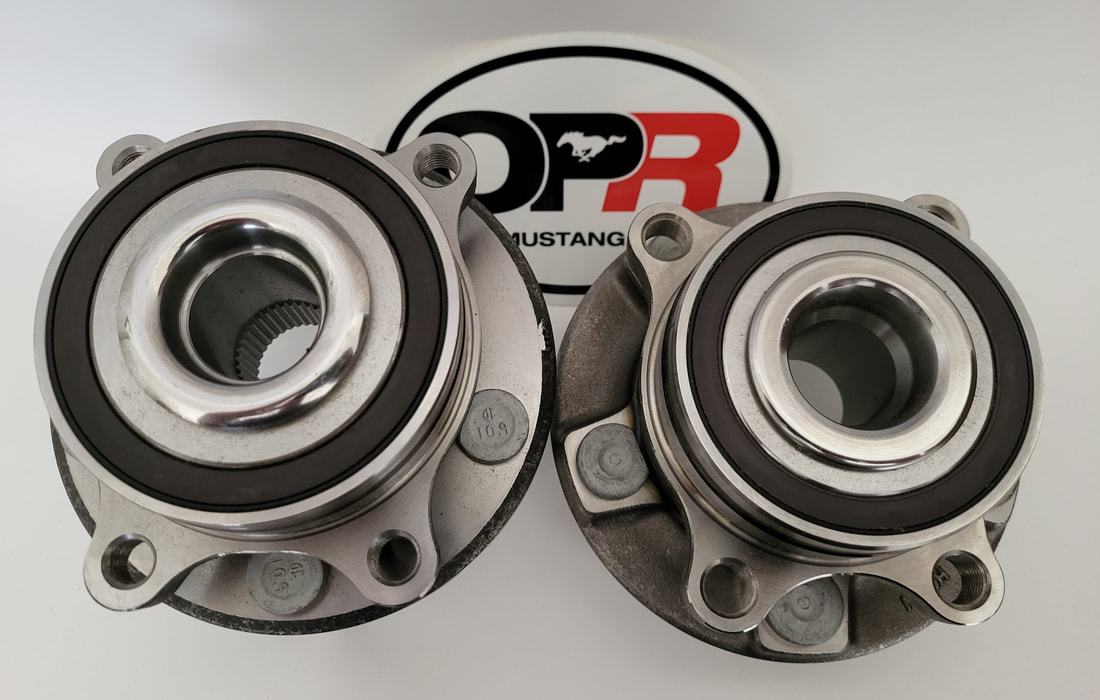
I’ve been grouping all MagnaRide cars into one group when in fact the Mach 1 had a different wheel bearing and hub, and is the same one as the 2020+ Explorer.

Here is the standard MagnaRide hub next to the Mach 1.

s550-to-s650-hub-back_orig.jpg


Being that it is used on all S650 Mustangs, seems like it should be available for some time. And isn’t a “Shelby” part.

In addition to that, I am re-thinking my idea to move the caliper to the front of the spindle. Seems like that is bad for adding brake cooling.

Not saying I am going to change directions, but it has me thinking.

Brake ducting seems much easier with rear mounted calipers.

Visually matching the mounting configuration to rear axle is a plus too.
 
I have a lot of experience with vsusp and can try tweaking your knuckle specs. I setup the chart with camber and RC movement through 4 degrees. Trade camber gain to get the RC down around 2" and stable/not moving X and Y through 4 deg roll with a longer vsa. I find a vsa pivot just outside the tires to be a good compromise. UCA 2/3rds the LCA length, uca 7 degree slope, scrub 1/2 inch or less if practical.

DionR 06252025
 
Last edited:
It's too bad the UCA pivots cannot be moved inboard a couple inches. It would solve the scrub, lower the RC around four inches, and make the RC more stable.

DionR 06252025 r1
 
It's too bad the UCA pivots cannot be moved inboard a couple inches. It would solve the scrub, lower the RC around four inches, and make the RC more stable.

DionR 06252025 r1
Yeah, very interesting to see how the characteristics change with changing different things. The only downside of this setup is the camber curve with roll. Your outside tire passes vertical at only 1.95* of roll. (~1* gain per in of bump). This isn't hard to overcome since it acts similar to a strut-style suspension. It would just require large static negative camber values to maintain a good slip angle while cornering.
 
Can someone explain why we want a low RC? Feels like the roll couple gets bigger then, unless we are talking about something that is fairly short like a Corvette or something. On a car like my Duster where I can only get it so low, seems like I want a short roll couple rather than get the RC low and make the roll couple bigger.

In regards to moving the UCA mounts, in the widebody A-Body thread @72bluNblu suggested using an early A-Body k-frame and moving the rails in so a 315 could be fit under the front fenders. I'm not sure that is a good option just because (I think) the steering box loses out, but it is kind of inline with moving the mounts. But if the LCA mount were moved on on the earlier K-frame to maintain the later TB location, it would result in the suggest move of the UCA mount. Ton of work and not sure it is the easy path, but an interesting idea to chew on.
 
Oh, and there is some slop in the UCA mount, I just centered in for my layout. Maybe a 1/4" total? Don't remember for sure.
 
Can someone explain why we want a low RC? Feels like the roll couple gets bigger then, unless we are talking about something that is fairly short like a Corvette or something. On a car like my Duster where I can only get it so low, seems like I want a short roll couple rather than get the RC low and make the roll couple bigger.

In regards to moving the UCA mounts, in the widebody A-Body thread @72bluNblu suggested using an early A-Body k-frame and moving the rails in so a 315 could be fit under the front fenders. I'm not sure that is a good option just because (I think) the steering box loses out, but it is kind of inline with moving the mounts. But if the LCA mount were moved on on the earlier K-frame to maintain the later TB location, it would result in the suggest move of the UCA mount. Ton of work and not sure it is the easy path, but an interesting idea to chew on.
I thought I did a massive exposé on this in another post, but I can't find it now. Here is an excerpt from "Advanced race car suspension development" by Steve Smith that is pretty concise:
1750980683810.png


But basically it has to do with how the forces are applied to the tire. The other important thing is the Roll axis which is the relationship between the front and rear roll centers as you don't want the rear higher than the front.
 
Yeah, very interesting to see how the characteristics change with changing different things. The only downside of this setup is the camber curve with roll. Your outside tire passes vertical at only 1.95* of roll. (~1* gain per in of bump). This isn't hard to overcome since it acts similar to a strut-style suspension. It would just require large static negative camber values to maintain a good slip angle while cornering.
True, but everything is a trade off. It can be tough to check off all the boxes even with a clean sheet of paper. This was limited to just moving the ubj and uca pivot around. Camber gain was not the number one goal.

The front RC should be lower than the rear.

Would be interesting to see this compared to the standard knuckle to see what benefit the new knuckle is.
 
Oh, and there is some slop in the UCA mount, I just centered in for my layout. Maybe a 1/4" total? Don't remember for sure.
You could start there by keeping the pivot fixed at that point in vsusp. There is no right answer, only compromises based on what you want as the priority.
 
Interesting video on roll center, jacking and roll couple.


This appears to counteract the advice from @BergmanAutoCraft that the hot ticket is the F-Body spindle and 1" longer UBJ as that appears to put the RC up at almost 8.5". Assuming my layout is correct. Based on the suggestion to get the RC as low as possible, it looks like the A-Body spindle and standard UBJ is better since the RC is only (comparatively) 5.2".

I've spent some time messing with the analyzer and playing with numbers to see if I can get the RC lower and keep some camber as the car rolls. I can't figure out how to get the RC lower than about 4" though and really not sure yet if the camber curve is good or not. This is just messing with the UBJ location, too, as I feel like the control arm pivots and LBJ locations are fixed.

Sometimes this stuff makes my head want to explode.
 
I thought I did a massive exposé on this in another post, but I can't find it now. Here is an excerpt from "Advanced race car suspension development" by Steve Smith that is pretty concise:
View attachment 1716423163

But basically it has to do with how the forces are applied to the tire. The other important thing is the Roll axis which is the relationship between the front and rear roll centers as you don't want the rear higher than the front.

This is starting to make a little more sense. Thanks.
 
Interesting video on roll center, jacking and roll couple.


This appears to counteract the advice from @BergmanAutoCraft that the hot ticket is the F-Body spindle and 1" longer UBJ as that appears to put the RC up at almost 8.5". Assuming my layout is correct. Based on the suggestion to get the RC as low as possible, it looks like the A-Body spindle and standard UBJ is better since the RC is only (comparatively) 5.2".

I've spent some time messing with the analyzer and playing with numbers to see if I can get the RC lower and keep some camber as the car rolls. I can't figure out how to get the RC lower than about 4" though and really not sure yet if the camber curve is good or not. This is just messing with the UBJ location, too, as I feel like the control arm pivots and LBJ locations are fixed.

Sometimes this stuff makes my head want to explode.

Wow that's a really good video.
 
I learned a bit from the video too. I started with your first effort, moving only the ubj and adjusting the uca length, let the RC migrate laterally (helps), which allowed me to get it down very low (helps), and it moves lower in roll but at a very low rate (helps), and reduced the scrub with those wheels in the process.

DionR07302025r1
 
Last edited:
I learned a bit from the video too. I started with your first effort, moving only the ubj and adjusting the uca length, let the RC migrate laterally (helps), which allowed me to get it down very low (helps), and it moves lower in roll but at a very low rate (helps), and reduced the scrub with those wheels in the process.

DionR07302025r1

Your link doesn't seem to work. Curious to see where you got things to.
 
Quick-ish update. I've been struggling with trying to figure out the best geometry direction and looking at a fair number of aftermarket suspensions such as Detroit Speed's and Speedway Motors' G-Comp. The issue being that the idea of a high roll center plays well with less body roll, yet all of those seem to be setup for a low roll center plus I have found multiple people saying low is better.

Found this article just recently:

Our Suspension Engineer Explains Why This One Suspension Design Parameter Has Such A Huge Effect On Ride, Handling, And Body Roll. - The Autopian

His conclusion:

We learned there are two factors that would like us to keep the roll centers low: jacking and ride. And we’ve learned there is one factor, body roll control, that would like us to have a high roll center (within reason). In reality though, the jacking concern outweighs the others. We MUST control jacking, and this means we need to keep the roll centers relatively low. This has the added benefit of helping our ride, but it does mean we may have more body roll than we really wanted. Fortunately, there are ways to control body roll without raising the roll centers, such as anti-roll bars and dampers.

My interpretation is that there really is no way to resist jacking, but there are ways to resist roll. Since jacking can't be "tuned out", it has to be designed out. On the other hand, roll can be resisted, within reason. So jacking is bad even if more roll is introduced.

Based on this, I think I am finally settled on a direction for my spindle design. I think I will keep the UBJ lower, more like the stock A-Body spindle height or maybe even a bit lower than that. Certainly more work to do, I plan to do some mapping and just general noodling. But this has been a major roadblock for me and it is nice to at least feel like I can move past it now.
 
Note that the article appears to be written by the same guy that did the video I shared in post #168. Been awhile since I watched that video, but he probably said the same things in both. If so, I guess I needed more time to digest it, or need to read it instead.
 
-
Back
Top Bottom