
Trick Flow 190 Cylinder Head Port and Chamber Touch-Up Questions

-

Fish Bite

Well-Known Member
Joined
Apr 23, 2024
Messages
78
Reaction score
97
Location
Denver
I received a set of new Trick Flow 190 CNC ported heads, and I was not expecting them to have some of the questionable spots they have. This is my first set of Trick Flow CNC heads, so keep in mind I don't know if what I have is normal or a manufacturing issue. I waited four months for them due to backorder, so I don't want to fool with a return or warranty work if these areas are not normal and I can easily correct them with burr bits and sanding drums. My purpose in this thread isn't to criticize the heads but to get helpful input from people with cylinder head porting experience on a few questions about specific spots I noticed. The heads are going on a track-only road course car, 360 LA, shifting at 7K RPM.

Combustion Chambers
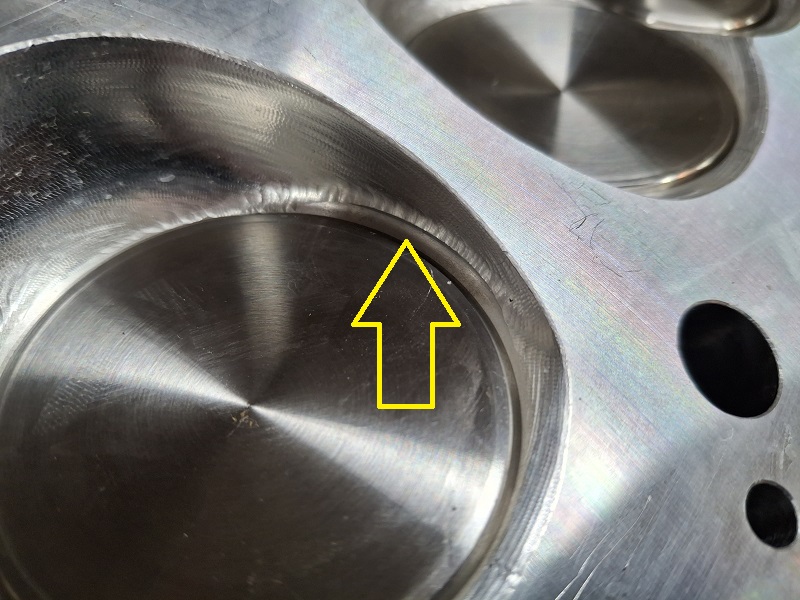
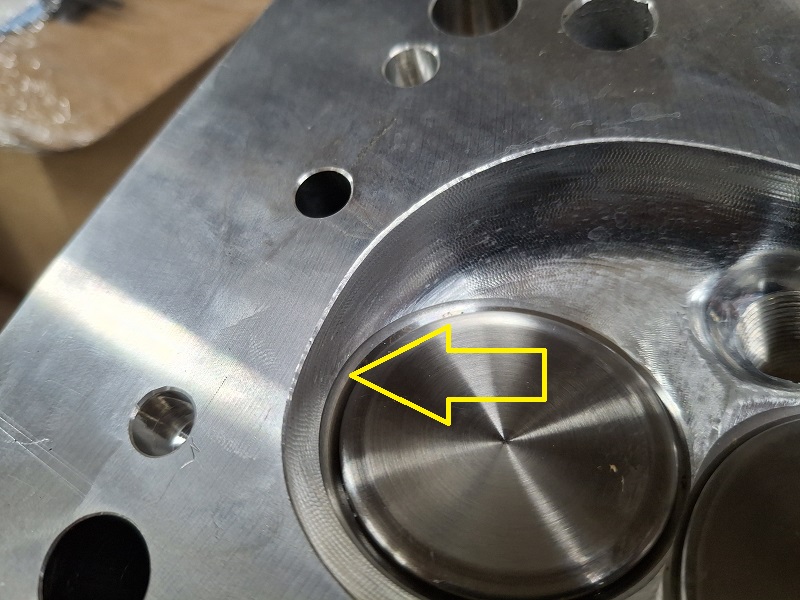
In the combustion chambers, there is a sharp machining edge around all the intake and exhaust valves that I note with arrows. I see where someone at Trick Flow touched up this edge by hand closer to the spark plug hole, so I don't know why they didn't hit these areas as well unless they don't matter. I'm worried about hot spots and the impact to the flow dynamics. Is it worth me dropping some junk valves in to protect the seats and knocking down and smoothing out the edge all the way around the valves? Or do these areas not matter?
Intake.jpg


Exhaust.jpg


Exhaust Ports
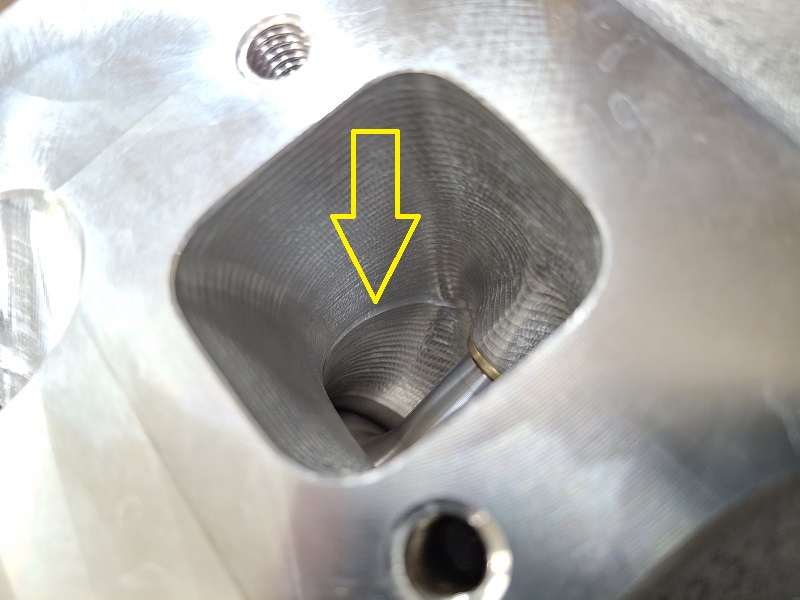
In the exhaust ports, there is a noticeable transition where the mill worked through the valve side and then where it worked from the exhaust flange side. I can easily feel this sharp peak with a finger. There are other areas in both the exhaust and intake runners with this type of rough transition where mill directions meet. Is it worth me knocking down these transitions to where they are consistent with the surrounding finish?
Exhaust2.jpg


Overall Mill Marks
Overall, the mill marks are pretty deep, creating ripples. I understand that in some areas, like in the intake runners, these ripples can be advantageous to keeping the fuel suspended, but should I be concerned about the ripples being too aggressive and knock them down some with a sanding drum? Or is it not worth the effort or would it be counterproductive?
 
Those steps in the combustion chamber are hard to get at without messing up the valve job. Also I believe the seats are done after all chamber work. Everything I see is acceptable for a mass produced head. If you want improvement you will have to have them ported.
 
I received a set of new Trick Flow 190 CNC ported heads, and I was not expecting them to have some of the questionable spots they have. This is my first set of Trick Flow CNC heads, so keep in mind I don't know if what I have is normal or a manufacturing issue. I waited four months for them due to backorder, so I don't want to fool with a return or warranty work if these areas are not normal and I can easily correct them with burr bits and sanding drums. My purpose in this thread isn't to criticize the heads but to get helpful input from people with cylinder head porting experience on a few questions about specific spots I noticed. The heads are going on a track-only road course car, 360 LA, shifting at 7K RPM.

Combustion Chambers
In the combustion chambers, there is a sharp machining edge around all the intake and exhaust valves that I note with arrows. I see where someone at Trick Flow touched up this edge by hand closer to the spark plug hole, so I don't know why they didn't hit these areas as well unless they don't matter. I'm worried about hot spots and the impact to the flow dynamics. Is it worth me dropping some junk valves in to protect the seats and knocking down and smoothing out the edge all the way around the valves? Or do these areas not matter?

View attachment 1716512191

View attachment 1716512193

Exhaust Ports
In the exhaust ports, there is a noticeable transition where the mill worked through the valve side and then where it worked from the exhaust flange side. I can easily feel this sharp peak with a finger. There are other areas in both the exhaust and intake runners with this type of rough transition where mill directions meet. Is it worth me knocking down these transitions to where they are consistent with the surrounding finish?

View attachment 1716512195

Overall Mill Marks
Overall, the mill marks are pretty deep, creating ripples. I understand that in some areas, like in the intake runners, these ripples can be advantageous to keeping the fuel suspended, but should I be concerned about the ripples being too aggressive and knock them down some with a sanding drum? Or is it not worth the effort or would it be counterproductive?
The ripples are normal for CNC machining. Some people go after it and smoth it out on the exhaust side. On the intake side, it's advantageous. It wouldn't really bother me, as the SHAPE is what's most important and not the finish.

The chambers however, I'd want corrected.
 
Now you got me curious, Ill check mine and upload a couple pictures, but Im sure there the same, Mine came in last week, I see summit is already sold out again. just checked mine are identical...I did notice there some tight real estate there. I cannot say what cleaning them up would gain.. let see what others say on that.

Had to dig.them out .. tripple boxed and sealed in a dusy garage. Lol.

20260219_204855.jpg


20260219_204918.jpg


20260219_204939.jpg
 
Last edited:
Quality vs Cost. The ripples are the end effect of the programmed step over and diameter of the cutter. To eliminate them or reduce them takes a lot more machining time and thus $$$. The ledge around the valve looks to be where the top cut stopped and they didn't go back to dress it by hand. Again, that takes time which is $$$. I'd say they look pretty good for an out of the box CNC head. Like anything in this game, if you want perfection you either pay for it up front or do it yourself. These heads make pretty good power for what they are charging for them. The other aluminum head options usually look a lot worse and aren't that much cheaper.
 
The ridge in the chamber along the perimeter of the intake valve will cause a very noticeable flow loss at low lift (2-5 cfm), a little loss at mid lift and almost none at high lift. I would want that gone. The one around the perimeter of the exhaust valve is not as important because of the air flow direction, but I would still want it gone. Any changes in the immediate vicinity of the valve seat make a flow difference. It may not make a power difference, but it makes a flow difference.

Cleaning up the ridges in any high velocity area will also add flow. The pushrod pinch and apex of the short turn are super high velocity areas on the TF head at the rpm you are turning. I would use a sanding roll in those areas, but no finer than 60 grit. That will make the boundary layer thinner in those areas, which in effect adds useful flow area. It is quite easy to pick up 5-8 cfm in some areas of the flow curve by removing ridges and ripples. There are also a couple of areas on the roof around the valve guide on the TF head that benefit from smoothing. The roof on the center of the cylinder side is intended to be a high speed area - notice that the roof is lower on that side. The transition cut on the CNC (the mating line from the CNC cutter working from the port side vs the chamber side) is usually a little abrupt. Smooth that area out. It's worth a few cfm at high lift.

Ripples in the exhaust port are of no value. I would get rid of them. Polish the exhaust as much as you like.
 
Now you got me curious, Ill check mine and upload a couple pictures, but Im sure there the same, Mine came in last week, I see summit is already sold out again. just checked mine are identical...I did notice there some tight real estate there. I cannot say what cleaning them up would gain.. let see what others say on that.

Had to dig.them out .. tripple boxed and sealed in a dusy garage. Lol.
Thanks for taking the time to photograph yours and post them. It looks like ours are similar to where I can at least rule out something out of line with what to expect.
 
The ridge in the chamber along the perimeter of the intake valve will cause a very noticeable flow loss at low lift (2-5 cfm), a little loss at mid lift and almost none at high lift. I would want that gone. The one around the perimeter of the exhaust valve is not as important because of the air flow direction, but I would still want it gone. Any changes in the immediate vicinity of the valve seat make a flow difference. It may not make a power difference, but it makes a flow difference.

Cleaning up the ridges in any high velocity area will also add flow. The pushrod pinch and apex of the short turn are super high velocity areas on the TF head at the rpm you are turning. I would use a sanding roll in those areas, but no finer than 60 grit. That will make the boundary layer thinner in those areas, which in effect adds useful flow area. It is quite easy to pick up 5-8 cfm in some areas of the flow curve by removing ridges and ripples. There are also a couple of areas on the roof around the valve guide on the TF head that benefit from smoothing. The roof on the center of the cylinder side is intended to be a high speed area - notice that the roof is lower on that side. The transition cut on the CNC (the mating line from the CNC cutter working from the port side vs the chamber side) is usually a little abrupt. Smooth that area out. It's worth a few cfm at high lift.

Ripples in the exhaust port are of no value. I would get rid of them. Polish the exhaust as much as you like.
Thanks for the specific feedback on the TF heads. I'm skilled with burr bits and sanding drums, so it should be easy for me to knock down the valve ridges with a 1/8" or 3/16" ball and touching them with sanding. I have junk valves that will protect the seats, so I'll work on the chambers. For the runners, I can smooth out any abrupt CNC transitions and sand the exhaust side to smooth out the ripples. I don't think I'll go much further since I don't have a flow bench and will be largely guessing on the exact spots to work and by how much. A question for you: for the exhaust floor, is it helpful for anti-reversion to leave the ripples to create some turbulence and help keep the air stream off the floor as it tapers toward the ceiling? I'll have an anti-reversion step-down on the floor into the header (a recommendation I came across from a Darin Morgan video), but I wonder if the floor ripples will assist in that cause or if the velocity stream won't care since it's not that low anyway. What are your thoughts?
 
Thanks for the specific feedback on the TF heads. I'm skilled with burr bits and sanding drums, so it should be easy for me to knock down the valve ridges with a 1/8" or 3/16" ball and touching them with sanding. I have junk valves that will protect the seats, so I'll work on the chambers. For the runners, I can smooth out any abrupt CNC transitions and sand the exhaust side to smooth out the ripples. I don't think I'll go much further since I don't have a flow bench and will be largely guessing on the exact spots to work and by how much. A question for you: for the exhaust floor, is it helpful for anti-reversion to leave the ripples to create some turbulence and help keep the air stream off the floor as it tapers toward the ceiling? I'll have an anti-reversion step-down on the floor into the header (a recommendation I came across from a Darin Morgan video), but I wonder if the floor ripples will assist in that cause or if the velocity stream won't care since it's not that low anyway. What are your thoughts?
Here’s a video of a TF exhaust port that has been ported a little larger for a 408, but a stock port would perform similarly. The TF exhaust port is really nice, much better than a stock LA port. There is no dead spot in the bottom center of the port. Velocity is down a little bit in that area, but still in the high 200s vs mid to high 300s for the top of the port.

For my situation, I will try to have the top of the port make a smooth transition into the headers and leave the step/misalignment in the bottom as reversion prevention. I will smooth the rest of the port, especially the short turn. Velocity is extremely high over the short turn of the exhaust.

I’m having trouble loading the video from my IPad at home. I’ll try from work tomorrow.
 

I’m no expert porter, so take that in consideration for my reply. On the exhaust side, the step you’re feeling is below the exhaust outbound flow out of the port, correct? If so, I don’t see an advantage that you’ll ever notice in smoothing that ridge out. On the ripple marks, as you mentioned, it is advantageous on the intake side. On the exhaust side, those ridges will be filled with carbon from the exhaust in no time, making it a lot of extra work, for the little gain that I think you would see. The combustion chambers, if you have a set of valves that you can put in so you don’t risk messing up the seats, it would probably be a good idea to remove any potential hotspots. Just my two cents worth.
 
Somebody tell me how to get a MOV or MP4 file to load onto a FABO post please. I can't seem to get it to work.
 
I’m no expert porter, so take that in consideration for my reply. On the exhaust side, the step you’re feeling is below the exhaust outbound flow out of the port, correct? If so, I don’t see an advantage that you’ll ever notice in smoothing that ridge out. On the ripple marks, as you mentioned, it is advantageous on the intake side. On the exhaust side, those ridges will be filled with carbon from the exhaust in no time, making it a lot of extra work, for the little gain that I think you would see. The combustion chambers, if you have a set of valves that you can put in so you don’t risk messing up the seats, it would probably be a good idea to remove any potential hotspots. Just my two cents worth.
Thanks. The ridge I feel in the exhaust runner where the machine work changes direction is a diagonal line in the wall that extends from the ceiling of the bowl to the floor in the runner. It's the third photo in my original post. All four of the exhaust have this transition with the outside two cylinders being more pronounced.
 
I'd have to take care of the combustion chamber ridge. It looks lime a good place for pre-ignition.
 
That cylinder head will flow more than the intake above it.
I doubt any additional touchup on the heads will be worth the squeeze, the intake would be where my effort would be.
 
I worked on the heads today and got the ridge around the valves smoothed, the uneven/sharp CNC transitions in the intake smoothed, and the uneven CNC transitions in the exhaust and ledge around the valve guides smoothed. I also sanded the exhaust to remove the CNC ripples. There were some larger ripples in the short turn, as Earlie A pointed out. I still need to mock up the heads and intake on the block to index things for port matching. The head ports almost perfectly match an SCE 2.275" x 1.175" gasket, whereas the intake is quite a bit smaller, so most of the work will be in porting the intake. I need to do the same for the headers, but the header ports are larger than the exhaust ports to where I'll leave the step-down for anti-reversion.

I want to give a particular thanks to @Earlie A who emailed me a nice video of him flowing the exhaust along with his tips on areas that could use work. Thanks for everyone's input.

20260222_143429.jpg


Intake2.jpg


20260222_155836.jpg


20260222_155826.jpg


20260222_182338.jpg


20260222_182436(2).jpg
 
Last edited:
Nice job. You’ve got a good eye for cleaning up those ports. No doubt in my mind you have helped the ports flow a little better. With almost no material removed, that means efficiency.

What intake manifold?
 
Nice job. You’ve got a good eye for cleaning up those ports. No doubt in my mind you have helped the ports flow a little better. With almost no material removed, that means efficiency.

What intake manifold?
Many thanks. I don't expect much from my work, but at least I have the peace of mind I took care of the questionable areas to the best of my ability. I sent you a PM about the intake.
 
-
Back
Top Bottom















