
1968 Dart cooling system & gauge Questions

-

68Dart270

Well-Known Member
Joined
Mar 4, 2026
Messages
95
Reaction score
30
Location
SoCal
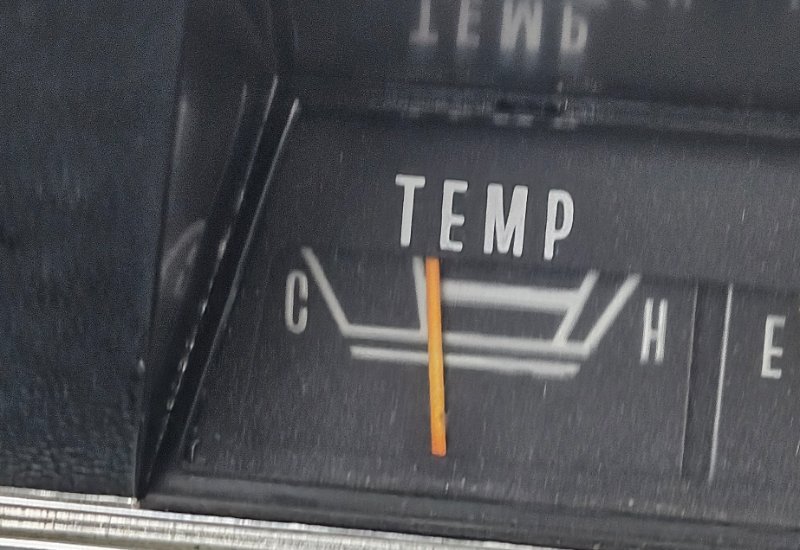
1968 Dart with 273 v8. Car runs cool,gauge nearly always reads to the left,but I noticed today when checking coolant levels that even when the car has been driven a half hour and is up to temp there is no pressure in the upper hose and the cap can be removed with no pressure. The radiator cap is brand new,16lb which is correct for ac cars. Coolant is green and clear. I did notice a 4" string of orange silicone rubber floating in the top of the tank...but nothing else out of the ordinary and again the car never overheats. No coolant leaks on the ground anywhere.
So where does your darts temp gauge rest at when it's driving at normal temperature? Is there pressure in the top of your radiator hose when the car is up to temperature? Temperature out was about 75° today
20260517_170411.jpg
 
So where does your darts temp gauge rest at when it's driving at normal temperature? Is there pressure in the top of your radiator hose when the car is up to temperature? Temperature out was about 75° today
exactly where yours is showing (about 180-190) unless I'm doing 75 + on the interstate and its 80 deg outside. Then it goes up to mid scale and that's about 200-210


ALSO note the scale on the 67 and early 68 temp gauge has the "Normal" scale shifted to the right. in later 68 and in 69 up it has been shifted back to the left being mire centered on the gauge. the reading is not changing just what the factory thought was a normal range


There are 2 types of radiator caps, one is a constant pressure and the other is a pressure on demand (Chrysler OEM uses the pressure on demand type)

the constant pressure cap will pressurize as the engine heats up to the rated presure and then keep the max pressure to that amount.

in the Pressure on demand the valve under the cap stays open till there is a rapid flow of gasses out the cap then it closes and the system pressurizes till it is below the set point then is depressurizes

good video on OEM Chrysler cooling systems

 
Where are you getting your information that a 16 pound cap is "correct for ac cars"?
 
Where are you getting your information that a 16 pound cap is "correct for ac cars"?
Someone posted that in a thread here.
"Original equipment specifications typically called for a 16-pound cap (Part No. 1686107), or a 14-pound cap for some non-A/C variants. A 16-PSI cap is the standard modern replacement and provides the correct boiling point elevation without over-stressing vintage hoses."

Have you heard something different? All the caps on Rock Auto and at the parts houses that come up for my car are also 16lbs
 
Last edited:
exactly where yours is showing (about 180-190) unless I'm doing 75 + on the interstate and its 80 deg outside. Then it goes up to mid scale and that's about 200-210


ALSO note the scale on the 67 and early 68 temp gauge has the "Normal" scale shifted to the right. in later 68 and in 69 up it has been shifted back to the left being mire centered on the gauge. the reading is not changing just what the factory thought was a normal range


There are 2 types of radiator caps, one is a constant pressure and the other is a pressure on demand (Chrysler OEM uses the pressure on demand type)

the constant pressure cap will pressurize as the engine heats up to the rated presure and then keep the max pressure to that amount.

in the Pressure on demand the valve under the cap stays open till there is a rapid flow of gasses out the cap then it closes and the system pressurizes till it is below the set point then is depressurizes

good video on OEM Chrysler cooling systems


Thats interesting. I didnt know they changed the way the gauge graphics looks in 68. Now I have to look up a 68 dart cluster to see it.
So what cap is correct for our cars then? The one I bought is a 7616 made by motorad,but sold under the duralast name. It it's also worth mentioning that the previous cap was a stant and it too did not have any pressure on the top radiator hose even when it was warm. Does your dart top hose feel hot and pressurized when its at normal operating temp? I can see coolant flow with cap off
 
Last edited:
Thats interesting. I didnt know they changed the way the gauge area looked in 68. Now I have to look up a 68 dart cluster to see it


You will see them mostly on 69 as it was a transition in 68
Screenshot_20260517-204409.png


So what cap is correct for our cars then? The only i bought is a 7616 made by motorad,but sold under the duralast name. It it's also worth mentioning that the previous cap was a stand and it too did not have any pressure on the top radiator hose even when it was warm
Both types are fine. I prefer the constant pressure because it doesn't rely on boiling coolant to start the pressure process this raising the boiling point of the coolant

I can't give you a part number only that when you hold the cap up and like at the center release valve if it hangs down it the pressure on demand type. If it is snug to the seal it's constant pressure.

The other possibility is your tank has a leak high enough not to leak or the neck where the cap is supposed to seal does not seal properly.
 
Someone posted that in a thread here.
"Original equipment specifications typically called for a 16-pound cap (Part No. 1686107), or a 14-pound cap for some non-A/C variants. A 16-PSI cap is the standard modern replacement and provides the correct boiling point elevation without over-stressing vintage hoses."

Have you heard something different? All the caps on Rock Auto and at the parts houses that come up for my car are also 16lbs
I don't know man. It may be the "correct" one by the book, but I'm of the mindset that the less pressure the cooling system is under, the better. Pressure is hard on cooling system components. On ye 64 Valiant with a slant 6 for example, I run a 13 pound cap. Is that what the book says? I don't know. But it runs cool and never opens the relief valve. A 16 pound cap won't make one run cooler, but it will put extra stress on things like hose connections, water pumps, radiator and heater core joints and everything else. I've never seen a real advantage, when you can likely get by with a lower pressure system and make things last. You may not be able to get by with it, but it's really cheap to find out.
 
Each lb of cap pressure raises the boiling point 3 degrees. So 9* difference between the 13 & 16 lb caps. If the engine runs cool, probably be ok with the 13 lb cap. Agree with less pressure.
 
Each lb of cap pressure raises the boiling point 3 degrees. So 9* difference between the 13 & 16 lb caps. If the engine runs cool, probably be ok with the 13 lb cap. Agree with less pressure.
My car isnt overheating. In fact,as I mentioned earlier,the top hose never seems to be under pressure at all and I can remove the cap even when its at operating temp,which is unusual. Like Dana said there must be a small leak somewhere. Dont see any fluid leaks though
 
In fact,as I mentioned earlier,the top hose never seems to be under pressure at all and I can remove the cap even when its at operating temp,which is unusual.
in the Pressure on demand the valve under the cap stays open till there is a rapid flow of gasses out the cap then it closes and the system pressurizes till it is below the set point then is depressurizes

good video on OEM Chrysler cooling systems
As Dana wrote and the MTSC explains, the 'leak' is in the design.
Master Technician Service Conference - Chrysler's Training for Mechanics

With the Chrysler systems at that time, they only become pressurized when there is vapor pressure.
1779108437143.png

1779108447064.png


1779108467205.png
OK, Tech. Set me straight.

1779108478483.png

1779108491847.png
 
Last edited:
Like Dana said there must be a small leak somewhere. Dont see any fluid leaks though

Keywords in what I wrote is "The other possibility..." I was not saying that you did have a leak and if you run your system like the OEM intended with a 1" air gap at the top of the tank you may never see a drop of fluid if it did have a leak. BUT I suspect its just the cap functioning as intended

You can have your cooling system pressure tested for leaks if you are worried.

I run a pressurized 16 lb cap because I don't want the coolant to ever get to the boiling point. I also run the 1" air gap in the top of the tank and I DO NOT have an overflow. I have not dropped a drop since 2017. I bracket raced the car once and got to the 3rd round. I had to have a catch can for coolant. I was assured I would puke out some coolant but NOT A DROP. Stock 7 blade fixed fan, stock no fan shroud, stock HD cooling Copper Brass radiator, 273 2bbl, automatic, 180 deg thermostat, 16 lb constant pressure rad cap.

The average person can blow between 1.5 and 3psi so the difference between 13 and 16 is nominal but the difference between 212 and 219 (9 additional degrees due to the lack of those 3 psi) is substantial

(AND yes I know the boiling point of coolant is much higher then the boiling point of water - numbers just used for the example)


As Dana wrote and the MTSC explains, the 'leak' is in the design.
Master Technician Service Conference - Chrysler's Training for Mechanics
That's where I have seen the REALLY good list of videos and booklets, Thanks Matt!
 
Back in the day, we used 8 lb caps with a 50/50 mix of antifreeze. The mix has a boiling temp of 265* plus whatever the cap increases it by. My relatively stock 340 runs at 180* all day long with no pressure in the upper hose. As a matter of fact, when I SLOWLY squeeze the top rad hose, I can hear the cap venting.
 
Depending on the cap type you want check for the valve hanging down. The numbers below were just the caps I had from my adventure in radiator caps and both were manufactured by MOTORAD, look identical and have no numbers stamped on them except the 16 lbs

THERE IS A CHANCE THAT THE CAPS HAVE GOTTEN SWITCH IN THEIR BOXES OVER TIME SO DONT QUOTE ME ON THE PART NUMBERS


This one will build pressure from the beginning of the heating of the cooling system (note the valve is closed)
(Carquest Premium Radiator Cap: 16 PSI 10231)
1779114038057.png


This one will only pressurize after some spot boiling occurs (Note the valve is open, factory style)
Murray 16 psi Radiator Cap - 7616
1779113982392.png
 
Last edited:
As Dana wrote and the MTSC explains, the 'leak' is in the design.
Master Technician Service Conference - Chrysler's Training for Mechanics

With the Chrysler systems at that time, they only become pressurized when there is vapor pressure.
View attachment 1716545073
View attachment 1716545074

View attachment 1716545075OK, Tech. Set me straight.

View attachment 1716545076
View attachment 1716545077
Thanks. I just watched the video this morning. So my system is operating normally then. And there was slight pressure this morning when I pulled over at work and checked the hose
 
Keywords in what I wrote is "The other possibility..." I was not saying that you did have a leak and if you run your system like the OEM intended with a 1" air gap at the top of the tank you may never see a drop of fluid if it did have a leak. BUT I suspect its just the cap functioning as intended

You can have your cooling system pressure tested for leaks if you are worried.

I run a pressurized 16 lb cap because I don't want the coolant to ever get to the boiling point. I also run the 1" air gap in the top of the tank and I DO NOT have an overflow. I have not dropped a drop since 2017. I bracket raced the car once and got to the 3rd round. I had to have a catch can for coolant. I was assured I would puke out some coolant but NOT A DROP. Stock 7 blade fixed fan, stock no fan shroud, stock HD cooling Copper Brass radiator, 273 2bbl, automatic, 180 deg thermostat, 16 lb constant pressure rad cap.

The average person can blow between 1.5 and 3psi so the difference between 13 and 16 is nominal but the difference between 212 and 219 (9 additional degrees due to the lack of those 3 psi) is substantial

(AND yes I know the boiling point of coolant is much higher then the boiling point of water - numbers just used for the example)


That's where I have seen the REALLY good list of videos and booklets, Thanks Matt!
Yep,1" below. Just like the older Forward Look Mopars,I leave room. I agree with you about the 16lb cap too. Chrysler designed these cars to use one with that rating for a reason. Its not going to create too much pressure in the system or blow out a hose if the the hoses are in good shape. I checked the car this morning and after I got to work and shut of the engine the top hose did have pressure.
 
Depending on the cap type you want check for the valve hanging down. The numbers below were just the caps I had from my adventure in radiator caps and both were manufactured by MOTORAD, look identical and have no numbers stamped on them except the 16 lbs


This one will build pressure from the beginning of the heating of the cooling system (note the valve is closed)
(Carquest Premium Radiator Cap: 16 PSI 10231)
View attachment 1716545107

This one will only pressurize after some spot boiling occurs (Note the valve is open, factory style)
Murray 16 psi Radiator Cap - 7616
View attachment 1716545106
My cap would appear to be the one on the top. That was the only cap they showed for my car other than a Stant LeverLock style which they didnt have. We dont even have CarQuest out here anymore.
So which of these two styles is "better" in your opinion?
 
Back in the day, we used 8 lb caps with a 50/50 mix of antifreeze. The mix has a boiling temp of 265* plus whatever the cap increases it by. My relatively stock 340 runs at 180* all day long with no pressure in the upper hose. As a matter of fact, when I SLOWLY squeeze the top rad hose, I can hear the cap venting.
Thats great! Every car i have runs toward the left,except when its summer out here. Southern California summers suck. I cant stand 90-106 degree days
 

FWIW lets see if we can shed any light on the replacement parts
from Stant's Vintage Guide
1779129922711.png

1779129974114.png

1779129994523.png

1779130017516.png

1779130042975.png

1779130070505.png


1779130111221.png

1779129873571.png


1779130139013.png

1779130195280.png


Same t-stats listed for GM and AMC vehicles so this p/n may be a constant pressure cap. ??
 
This is in the instructions with the Stant cap pressure tester
1779130778915.png

1779130824306.png
 
Man, I am really glad the OP asked this question, as I was wondering about the factory temp gauge myself in my '68 GTS. My car usually runs inside this red range (from 45 F to 90 F outside temp):
dart_temp_gauge.jpg

I assume that range is around 150-160 F to 195 F, and that is with a 180 F thermostat, aftermarket coolant temp sensor (might read different than a factory/NOS one?), and a factory radiator (part number ending in 026) that has been converted to 3 cores.

The only time I have seen my temp gauge get to where the OP's is when my car has been idling for more than 5 minutes (say to adjust timing). Using a thermal imaging camera (nothing too expensive, it plugs in to the bottom of a phone) to check temps under hood when the car is idling after driving (so my temp gauge is at the same spot as the OP's picture), the top of the radiator is around 185-190 F, the thermostat housing is around 200-205 F and the area of the intake that the coolant temp sensor is threaded into is also around 200-205 F.

Also neat to learn about the different style radiator caps, I have never seen one that doesn't allow pressure to build until boil-over.
 
-
Back
Top Bottom















