
I have a space under my carport that is separate from the main part of my basement. I need to block up the open end and frame in for a double door to keep the critters and such out. I would like to find a used set of old, school type gym double doors with or without windows. I cannot find anyplace that sells salvaged items like this or anyplace that sells them new. Anyone have any ideas where I can find these with the frame? I need to find a set of somewhat short doors due to the overhead height being low, roughly 76 inches or so.



You are using an out of date browser. It may not display this or other websites correctly.
You should upgrade or use an alternative browser.
You should upgrade or use an alternative browser.
Basement Doors
- Thread starter Cartboy67
- Start date
-

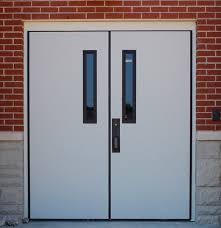
Cartboy... I have owned and operated a Commercial door business for more than a decade. The doors in your picture are called "Hollow Metal Doors".
Standard HM Doors are made of 18 gauge cold rolled stel, and a standard from is made of 16 gauge Cold rolled steel.
Understand that a unit like the only pictured is not a "kit", each and every item is sold separately, and there are a large number of alternatives.
Also understand that while you have a slight chance of finding some salvaged doors, you chance of finding a corresponding frame used frame is just about nil, as these are usually filled with cement when installed, and the frame gets destroyed in the removal process.
18 gauge steel doors cost between $250.00 and $350.00. The shortest standard size available is 80" (6'8") which is a nominal measurement. The door would actually measure 79-1/8" tall. You also need 2" clearence for the frame head.
Your 76" clearance would allow doors to be 74" (73-1/8") tall.
The width of the rough opening also needs to allow 2" on each side for the frame hinge jambs. So a pare of 36" doors would require a 76" wide opening (2 doors@ 36" each = 72", and 2 frame legs at 2" think, each = 4". total 76".
If you can give me your rough opening measurements, and the thickness of the wall it's going into, and what material the wall is going into, I can put together the measurements of everything you will need. I can probably give you a price, too.
Also, keep in mind that there are approximately 10 manufacturers of these types of doors. each manufacturer has their own hinge spacing and lock heights, so you cannot mix and match door and frame brands. If you start checking building materials salvage shops in your area, make sure that the hinge size ( usually 4-1/2") and the spacing of the hinges on the frame and doors, match. (There will be a 1/8" difference between the top of the top hinge mortise on that door, and on the frame ( example: If the top of the hinge mortise on the door measure 6-5/8" from the top of the hinge to the top of the door, on the frame that same measurement will be 6-3/4".
Give me your requirements, I'll tell you what you need to get the job done.
Standard HM Doors are made of 18 gauge cold rolled stel, and a standard from is made of 16 gauge Cold rolled steel.
Understand that a unit like the only pictured is not a "kit", each and every item is sold separately, and there are a large number of alternatives.
Also understand that while you have a slight chance of finding some salvaged doors, you chance of finding a corresponding frame used frame is just about nil, as these are usually filled with cement when installed, and the frame gets destroyed in the removal process.
18 gauge steel doors cost between $250.00 and $350.00. The shortest standard size available is 80" (6'8") which is a nominal measurement. The door would actually measure 79-1/8" tall. You also need 2" clearence for the frame head.
Your 76" clearance would allow doors to be 74" (73-1/8") tall.
The width of the rough opening also needs to allow 2" on each side for the frame hinge jambs. So a pare of 36" doors would require a 76" wide opening (2 doors@ 36" each = 72", and 2 frame legs at 2" think, each = 4". total 76".
If you can give me your rough opening measurements, and the thickness of the wall it's going into, and what material the wall is going into, I can put together the measurements of everything you will need. I can probably give you a price, too.
Also, keep in mind that there are approximately 10 manufacturers of these types of doors. each manufacturer has their own hinge spacing and lock heights, so you cannot mix and match door and frame brands. If you start checking building materials salvage shops in your area, make sure that the hinge size ( usually 4-1/2") and the spacing of the hinges on the frame and doors, match. (There will be a 1/8" difference between the top of the top hinge mortise on that door, and on the frame ( example: If the top of the hinge mortise on the door measure 6-5/8" from the top of the hinge to the top of the door, on the frame that same measurement will be 6-3/4".
Give me your requirements, I'll tell you what you need to get the job done.
Appreciate all the info Frankie. The rough opening is 81HX96W, a little higher than I recalled. The frame is cinder block sides, 8" block with slabs for top and bottom. I could actually gain a few inches at the bottom if needed, the previous owner of the house poured a ramp from the back brick deck to slab in the area I am looking to close off. It is about 6 inches tall and about 12 to 14 inches from where it starts to where it meets the slab. This ramp is actually from where the slab meets the cinder blocks outward so it sits inline with the walls if that makes sense.

WildCat
Well-Known Member
Could you put up a roll up door that would allow size you need and secure the area?
WildCat
Well-Known Member
I only have about 3 to 4 inches between the ceiling and the opening of the doorway, don't think that would allow enough room.
Roll up doors don't need a lot of room, might hang down a little but I would check on it if trying to close it up.
Really depends on your needs
Could you extend it out a little and make a canopy and mount door out a bit from the wall? Might be easier and cheaper than getting custom doors made to fit opening
Appreciate all the info Frankie. The rough opening is 81HX96W, a little higher than I recalled. The frame is cinder block sides, 8" block with slabs for top and bottom. I could actually gain a few inches at the bottom if needed, the previous owner of the house poured a ramp from the back brick deck to slab in the area I am looking to close off. It is about 6 inches tall and about 12 to 14 inches from where it starts to where it meets the slab. This ramp is actually from where the slab meets the cinder blocks outward so it sits inline with the walls if that makes sense.
Hollow metal door frames can be made to fit any opening. There is a frame profile made to fit around 8" block, It's called 8-3/4" Masonry frame.
The 81" height is not a problem if you select a frame that wraps around the wall, instead of just butting the wall. Wrapping the wall is also more secure. You can still use standard 2" face frames, and 6'8" doors.
96" is getting close to the maximum width you can get in standard doors. The widest hollow metal doors available are 45" each. Allowing for a wrapped frame you would still need one 48" wide door, which is called a "four -oh" door (or 4'-0"), and one door 46" wide, called a 3-10 ( 3'10") door. the frame being a 7-10 x 6-8 frame (7'10" x 6'8" wide) The overall (outside) dimensions of this frame would be 98" wide x 82" tall. That would allow you to wrap it around the wall by 1" all the way around.
You could add flush bolts to the inactive door, which would lock one door down when not needed to be opened. The locking bolts would come from inside the top an bottom of the door, and latch to the frame head, and to the threshold.
If I were to outfit this opening, this is what I wold order.
1 each: 8-3/4" x 710-68 Hollow metal frame Knocked down.
1 each: 4068 door, non handed, prepped for 161, deadbolt.
1 each: 310-68 door, non-handed, prepped for ansi strike, deadbolt strike to match active door, flushbolts.
1 each: 2 piece astragal ( w//FB cutouts.
6 each: 4-1/2" x 4 1/2" Hinge (finish to match lockset) NRP ( non-removable pin).
1 each: entry lock set, and dead bolt, keyed alike.
1 each: threshold 6"x 72" x 1/2"
2 each: 48" door sweep
1 each: Weather strip 72" x 80"
Recommend a closer on the active door, and I also recommend that you install the doors so that they open out, instead of in.
An installation like thins would take about a professional install with a helper about 2 hours to install. You can do it yourself with a helper in about 4 to 5 hours.
There is an alternative, and since its a block wall, it will be fairly inexpensive. You clan close the opening down to 76" wide, and have a 6' wide opening, and you can use two 3foot wide steel doors which are available at most home improvement stores.
A 3068 (3'0" x 6'8") 18 gauge door prepared for a lockset and a dead lock and 3 hinges will run about $300.00 avg. you would need two.
The frame would be about $175.00.
Home depot sells locksets and deadlocks, keyed alike ranging from about $45 and up. I would recommend that you stay away from the "Quikset" brand. Spend a few extra dollars and buy Schlage, or Sargent, or equal.
4-102" himges will cost you about $6 or $7 each plus weather strip and threashold...
If you want windows in them, like the pic in the OP, you can order those. The ones in the picture are called "Narrow Lites". they require a 5" x 35" cutout in the door, and give you a 3" x 33 " visible glass, and require 1/4" thick glass. I would recommend 1/4" Laminated glass if you do that. If security is a issue, use 1/4" thick wire glass.
That door set will work with your existing opening. secure the inactive door closed when not needed, and give one one "active" door.
Frankie,
This is a huge help, I was looking to be around $750-$1000 for this project. High security is not the main goal, just trying to keep the animals out, possums, cats, snakes, birds and mice and such. I had planned to lay block on the sides to narrow the opening so I could buy a standard set up, the information you provided is greatly appreciated. I looked on HD website and found this part number, Model # STFL_PR_72_4OLH. I think this will fit what I am looking to do, I didn't see the 8 3/4 frame that you mentioned on their website though.
This is a huge help, I was looking to be around $750-$1000 for this project. High security is not the main goal, just trying to keep the animals out, possums, cats, snakes, birds and mice and such. I had planned to lay block on the sides to narrow the opening so I could buy a standard set up, the information you provided is greatly appreciated. I looked on HD website and found this part number, Model # STFL_PR_72_4OLH. I think this will fit what I am looking to do, I didn't see the 8 3/4 frame that you mentioned on their website though.

If security is not an issue, the vinyl coil doors used on mini storage warehouses are very affordable. You may not have overhead clearance for it though.
Frankie,
This is a huge help, I was looking to be around $750-$1000 for this project. High security is not the main goal, just trying to keep the animals out, possums, cats, snakes, birds and mice and such. I had planned to lay block on the sides to narrow the opening so I could buy a standard set up, the information you provided is greatly appreciated. I looked on HD website and found this part number, Model # STFL_PR_72_4OLH. I think this will fit what I am looking to do, I didn't see the 8 3/4 frame that you mentioned on their website though.
The 8-3/4" frame material is made to wrap around the block (inside to outside) Standard frame material is available in many "depths" ( for various wall thicknesses).
If you plan on closing down the rough opening, you can use 5-3/4" material. It will not wrap around the wall thickness, but it will butt into the opening. This type of frame you can install while laying the block to reduce the opening width. It will come with either a masonry "T" anchor, and a masonry "wire" anchor. Both work equally well, and are included inthe price of the frame.
The best way to instal that type of frame is to have it welded together at the top corners, and set the frame in place. Be sure it is level, plumb, and square, and use 2x4's to hold it in position while you build the walls to it, and most importantly, cut a 2x4 to set in place at the bottom of the frame where the door goes, and a second piece at lock height to keep the frame from "hour-dlassing" or closing down from your specified width while the cement cures.
There will be a fixed anchor at the bottom of each frame leg. These is to be attacked to the floor, you can use tap-con screws for this. # 12 screw x 1-1/4" works well.
The "T" or wire anchors are used to anchor the frame to the wall as you build it, A 6.8" door will course out with the 10th course of block. I usually add the anchors to the 3rd, 6th, and 9th courses of block. You simply insert then into the back side of the frame, and let the protruding part of the anchor lay on the block. When you add your next layer of cement the anchor will be covered and embedded in it. You then simply lay the next course of block, and the anchor is encased in the wall, along with the frame.
With each course of block, remember to back fill the cavity inside the frame with cement. Doing this will make the frame become part of the wall.
Here's a little hint that will make installing the door a little easier. Install all the hinges, and the lock strike, into the frame, and drive the screws to snug, not tight. Just let them bottom out on the hinge so you cannot rattle the hinge. (this will keep the backfill cement from filling up your hinge and strike screw holes. Most masonry frames have covers over the back side of the hinge and strike gains, but they always leak. lol
Here a pdf on the anchors I mentioned. the first 3 drawings o page one illustrate what the anchors look like and how to use them. The 4th drawing (yolk and strap) will also work
[ame]http://www.cecodoor.com/Other/Ceco/Documents/Tech%20Manual/F13.pdf[/ame]
This is a pdf on the frame material, itself. It'll show you want is available.
http://www.cecodoor.com/en/site/cecodoor/products/Standard-Frames/Series-SU-Frames/
Both of these PDF are from the same manufacturer. In this case it's Ceco Door.
Other manufacturers are Steelcraft, Amweld, Mesker, and Republic. There are others, but these 5 represent more than 95% of the industry. You can go to their websites and they will lead you to a distributor nearest you.
The 8-3/4" frame material is made to wrap around the block (inside to outside) Standard frame material is available in many "depths" ( for various wall thicknesses).
If you plan on closing down the rough opening, you can use 5-3/4" material. It will not wrap around the wall thickness, but it will butt into the opening. This type of frame you can install while laying the block to reduce the opening width. It will come with either a masonry "T" anchor, and a masonry "wire" anchor. Both work equally well, and are included inthe price of the frame.
The best way to instal that type of frame is to have it welded together at the top corners, and set the frame in place. Be sure it is level, plumb, and square, and use 2x4's to hold it in position while you build the walls to it, and most importantly, cut a 2x4 to set in place at the bottom of the frame where the door goes, and a second piece at lock height to keep the frame from "hour-dlassing" or closing down from your specified width while the cement cures.
There will be a fixed anchor at the bottom of each frame leg. These is to be attacked to the floor, you can use tap-con screws for this. # 12 screw x 1-1/4" works well.
The "T" or wire anchors are used to anchor the frame to the wall as you build it, A 6.8" door will course out with the 10th course of block. I usually add the anchors to the 3rd, 6th, and 9th courses of block. You simply insert then into the back side of the frame, and let the protruding part of the anchor lay on the block. When you add your next layer of cement the anchor will be covered and embedded in it. You then simply lay the next course of block, and the anchor is encased in the wall, along with the frame.
With each course of block, remember to back fill the cavity inside the frame with cement. Doing this will make the frame become part of the wall.
Here's a little hint that will make installing the door a little easier. Install all the hinges, and the lock strike, into the frame, and drive the screws to snug, not tight. Just let them bottom out on the hinge so you cannot rattle the hinge. (this will keep the backfill cement from filling up your hinge and strike screw holes. Most masonry frames have covers over the back side of the hinge and strike gains, but they always leak. lol
Here a pdf on the anchors I mentioned. the first 3 drawings o page one illustrate what the anchors look like and how to use them. The 4th drawing (yolk and strap) will also work
http://www.cecodoor.com/Other/Ceco/Documents/Tech Manual/F13.pdf
This is a pdf on the frame material, itself. It'll show you want is available.
http://www.cecodoor.com/en/site/cecodoor/products/Standard-Frames/Series-SU-Frames/
Both of these PDF are from the same manufacturer. In this case it's Ceco Door.
Other manufacturers are Steelcraft, Amweld, Mesker, and Republic. There are others, but these 5 represent more than 95% of the industry. You can go to their websites and they will lead you to a distributor nearest you.
Frankie,
With the info you laid out above and the door I saw at Home Depot, will I need the frame or is this one good to use without the frame? This is the one I found at Home Depot: Model # STFL_PR_72_4OLH. If I still need a frame with this set, I am having a difficult time seeing how the pre-hung door set attaches or fits into the frame. Not trying to drag this out but just want to make sure what is ahead of me for this work. Thanks again.

Hey Cartboy. We have a salvage place up here in Tyrone Pa. If you want I can run up to see if they have what you want. They are a demolition company and they save the good stuff! I have bought from them before. The name is G&R Salvage. Drop me a PM if you are interested.
Model # STFL_PR_72_4OLH. IS a home depot stock number, and I have no reference for it.
It's safe to say that with the number of different mfgr's each having their own hinge and lock placement, that you'd need to find a set of doors and a frame from the same MFGR.
Prehung doors and frames are not compatible with Hollow Metal doors and frames. Hinge spacing, hinge size, and hinge type are usually very different. Lock heights are usually different too. not only in type, but in "back set" (the measurement from the edge of the door, to the centerline of the lock bore, or hole. prehung lock center libes usually measure 2-3/8", while the back set on an HM door is 2-3/4".
ALso look at door thickness. HM doors will measure 1-3/4" thick, while prehung will be either 1-3/8" or 1-3/4" thick.
My advice is to look under "doors" in the yellow pages for your area. Find a commercial steel door. Let them put together a package for you.
You will need the rough opening size, the wall thickness, the "handing" ( whick door you want to be "active" and which one you want to be "inactive"). The type of hinges you want and the finish ( for in-swing doors use "ball bearing hinges", for out swing doors use "ball bearing NRP hinges").
Finishes: Most economical is "Primer coated" which are paint grade hinges. you just paint them with the door. The most popular finish is 26D which is "Dull" or "brushed" chrome.
Don't let them talk you into "Stainless steel" (32D)hinges or locks, as the look exactly like brushed chrome, but cost 3 or 4 times as much.
The can price out the entire package for you. don't forget threshold, sweeps, weather strip, flush bolts ( or surface bolts are a little less costly, and will save you some money on the doors, as there is not need to shop prep for them), and an "astragal" (which is used to close the gap between the two doors).
The should even be able to quote installation for you.
You should be able to get a 6068 (6 ft wide x 6'8" h double door) pair of doors installed, with frame, and all the hardware for less that $1000.00, as long as you have the rough opening set to the measurements the door company gives you.
You are looking at 2 18 gauge doors and a 16 gauge frame. All cold rolled ( or hot rolled in some cases) steel. For galvanized add $20.00 for each door and for the frame.
It's safe to say that with the number of different mfgr's each having their own hinge and lock placement, that you'd need to find a set of doors and a frame from the same MFGR.
Prehung doors and frames are not compatible with Hollow Metal doors and frames. Hinge spacing, hinge size, and hinge type are usually very different. Lock heights are usually different too. not only in type, but in "back set" (the measurement from the edge of the door, to the centerline of the lock bore, or hole. prehung lock center libes usually measure 2-3/8", while the back set on an HM door is 2-3/4".
ALso look at door thickness. HM doors will measure 1-3/4" thick, while prehung will be either 1-3/8" or 1-3/4" thick.
My advice is to look under "doors" in the yellow pages for your area. Find a commercial steel door. Let them put together a package for you.
You will need the rough opening size, the wall thickness, the "handing" ( whick door you want to be "active" and which one you want to be "inactive"). The type of hinges you want and the finish ( for in-swing doors use "ball bearing hinges", for out swing doors use "ball bearing NRP hinges").
Finishes: Most economical is "Primer coated" which are paint grade hinges. you just paint them with the door. The most popular finish is 26D which is "Dull" or "brushed" chrome.
Don't let them talk you into "Stainless steel" (32D)hinges or locks, as the look exactly like brushed chrome, but cost 3 or 4 times as much.
The can price out the entire package for you. don't forget threshold, sweeps, weather strip, flush bolts ( or surface bolts are a little less costly, and will save you some money on the doors, as there is not need to shop prep for them), and an "astragal" (which is used to close the gap between the two doors).
The should even be able to quote installation for you.
You should be able to get a 6068 (6 ft wide x 6'8" h double door) pair of doors installed, with frame, and all the hardware for less that $1000.00, as long as you have the rough opening set to the measurements the door company gives you.
You are looking at 2 18 gauge doors and a 16 gauge frame. All cold rolled ( or hot rolled in some cases) steel. For galvanized add $20.00 for each door and for the frame.
-
Similar threads

- Replies
- 3
- Views
- 244


- Replies
- 3
- Views
- 217

















