Help needed !! 440 source ready to run distributor info

-

moparhunter

Well-Known Member
Joined
Oct 5, 2006
Messages
797
Reaction score
238
Hi All,
Somehow, I can’t wrap my head around this on what I should wire what to what. I have a 69 Dart originally at 3:40 swinger car with points. The car is now big block swapped with a ready to run 440 source distributor. I know I have to eliminate the ballist resistor. But apparently it’s not as easy as just jumping the two wires together. How do I go about wiring the coil so it has constant power from ignition 2 on the key . It will run if I hotwire a jumper from positive coil to the starter ( 12 volts ) I’m sure it’s an easy fix and I’m being a dead head here, but it just doesn’t seem to make sense to me. Appreciate any help on this.
 
Okay, this is relatively easy to do, but we all have brain farts once in a while.
On the FACTORY wiring, there are two ignition sources:
In START, current is fed directly to the coil (bypassing the ballast) via the IGN2 circuit (normally a brown wire).
When the key is released into the RUN position, IGN2 goes dead and current gets supplied by the IGN1 circuit (normally a blue wire) to the ballast and on to the coil.
Since your distributor requires a single voltage source in both START and RUN, the easiest way to accomplish this is to join those two circuits and use that source to feed your distributor.
You can do this one of two ways.
1.) Go to the ballast, and find the blue IGN1 wire feeding the ballast. Unplug it.
Now find the brown IGN2 wire that bypasses the ballast and goes to the coil. Cut the connectors off and solder them together, along with an extra pigtail of wire that is long enough to reach your distributor (or wherever you choose to mount the HO coil) and heat shrink or tape the connection. This pigtail is the new feed for the RTR distributor via the HO coil. Go back to the ballast, remove it, and throw it in the spare parts drawer. Tape off the lead (or remove it) that ran off the other end of the ballast. Disconnect the coil and tape off the leads, or remove them.
2.) Go to the ballast, and remove it.
Fashion a short jumper wire with male spade connectors on each end. Plug it into the 2 wires you unplugged from the ballast resistor. Tape it up securely. Disconnect the blue wire from the coil, this is now the feed for your RTR dist./HO coil.
You do have this pic, right?
1761017653985.png

The red arrow designates the wire that formerly fed your coil, or the pigtail you added to the splice depending on which method you used.
Either way, you are using the combined circuits to feed your new RTR.

Edit: Before you even begin, make SURE you have voltage in each individual circuit at the correct time: 12v in IGN1 with the key switch in Run ONLY, and 12v in IGN2 withe the key switch in Start ONLY. Any deviation from this indicates that you have additional problems elsewhere. Issues here will require further investigation and repairs before you proceed.
If it all checks out, then continue with the installation.
 
Last edited:
No,
If you are using the original coil, you need to KEEP the bal res. Notice in the drawing above it shows an E core coil. If using an E core coil, you can eliminate the bal res.
 
any coil off this page apart from the round one would work well.
ford also do one to more or less the same spec. i think it has its mounting holes in a slightly different place

1976 CHEVROLET K20 PICKUP 4.8L 292cid L6 Ignition Coil | Shop Now at RockAuto

this will chug 6-8 amps rather than the 3 of the orginal.
plug gaps 45 thou. on a small head hei dizzy.

put a wire from 1 end to the other end of the ballast. or just join the wires togther and remove it.
if its a 4 connector ballast do that job twice

ex points car so......
your coil now has 12 volts all the time the key is on. via the orginal cable that came from the ballast
connect the dizzy positive to coil positive
the dizzy negative to coil negative (the one with the tacho wire if you have one)
run the black ground to the mounting bolt for the coil bracket

job done

Dave
 
Last edited:
No,
If you are using the original coil, you need to KEEP the bal res. Notice in the drawing above it shows an E core coil. If using an E core coil, you can eliminate the bal res.
No, read the "Warning" at the bottom of 440Source's illustration (above)- the RTR distributor is NOT compatible with the stock coil.
Ballast must be deleted.
 

Professor,
I do not know what you are a 'professor' of but it is not ign threory. What an ign coil sees when providing spark is a 'switch'. A sw to turn current on & off. With points, it is a mech switch; with inductive ign, which this is, it is a transistor, SCR or some other solid state device. The original coil will work perfectly well as long as the bal res is used with it. It's spark energy will be less than the E core coil , but it will certainly work ok.
Whoever wrote the instructions shows their lack of knowledge with these words: 'must bypass bal res if applicable'. A coil designed for use with inductive ign & bal res needs to retain the bal res to limit the current & voltage to the coil. Failing to do this results in a coil running hot & probably failing.
 
Professor,
I do not know what you are a 'professor' of but it is not ign threory. What an ign coil sees when providing spark is a 'switch'. A sw to turn current on & off. With points, it is a mech switch; with inductive ign, which this is, it is a transistor, SCR or some other solid state device. The original coil will work perfectly well as long as the bal res is used with it. It's spark energy will be less than the E core coil , but it will certainly work ok.
Whoever wrote the instructions shows their lack of knowledge with these words: 'must bypass bal res if applicable'. A coil designed for use with inductive ign & bal res needs to retain the bal res to limit the current & voltage to the coil. Failing to do this results in a coil running hot & probably failing.
If I was selling these distributors I would include the same instructions. Why would you want to pair your product with a ballast resistor and a stock coil? The instructions are simpler as written and eliminates a part that can fail while at the same time includes a better coil for a stronger ignition. It makes your product look better. I would argue that rather than showing a lack of knowledge it shows the opposite. A smart plan for a better ignition.
 
Professor,
I do not know what you are a 'professor' of but it is not ign threory. What an ign coil sees when providing spark is a 'switch'. A sw to turn current on & off. With points, it is a mech switch; with inductive ign, which this is, it is a transistor, SCR or some other solid state device. The original coil will work perfectly well as long as the bal res is used with it. It's spark energy will be less than the E core coil , but it will certainly work ok.
Whoever wrote the instructions shows their lack of knowledge with these words: 'must bypass bal res if applicable'. A coil designed for use with inductive ign & bal res needs to retain the bal res to limit the current & voltage to the coil. Failing to do this results in a coil running hot & probably failing.
I may not be a "professor of ignition theory", but I do know if the RTR module requires constant 12v, the ballast needs to be eliminated, otherwise the module will only see ~6v in "run" (instead of the full 12v it was designed for) and may only work erratically, if at all. So if the factory ballast needs to go, so does the factory coil.
 
Yes, according to MSD it is compatible I don’t have the number in front of me.
 
I have a ready to run in my Dart.
I just jumped the 2 at the ignition switch and ran 1 wire to the distributor/coil.

20250912_193456.jpg
 
Of course it is a good idea to run a better coil!!!!!!!!!!!!!!!!!!!! I always use an E core coil if the ign system is compatible. That way, you get max spark energy that the system can provide.
Some may want to use the stock coil...or coil that requires a bal res. In that case, you need to retain the bal res.
 
Prof,
You are still not 'getting' it. If a bal res is reqd, it should be used, but the RTR dist needs to get the full 12v to the red wire. So: full [ direct ] 12v to red wire of the dis; one end of bal res connected to this red wire. Other end of bal res connected to coil.
 
Of course it is a good idea to run a better coil!!!!!!!!!!!!!!!!!!!! I always use an E core coil if the ign system is compatible. That way, you get max spark energy that the system can provide.
Some may want to use the stock coil...or coil that requires a bal res. In that case, you need to retain the bal res.
Can you draw up a diagram that shows the correct places to hook up the wires of the ready to run distributor, coil and ballast resistor in case someone would want to hook it up that way? 69 dart v8 with points.
 
Prof,
You are still not 'getting' it. If a bal res is reqd, it should be used, but the RTR dist needs to get the full 12v to the red wire. So: full [ direct ] 12v to red wire of the dis; one end of bal res connected to this red wire. Other end of bal res connected to coil.
If you hook the RTR to the feed into the ballast as your 12v source as you just stated, it'll only get power in "run". No power to the module in "start". You still need to combine IGN1 and IGN2 in order to get constant 12v to the module in both "start" and "run". At that point you've defeated the ballast.
 
here is how i did my msd rtr dist..

tied all the ballast wires together, connected a wire from there to the the + coil. the rest is self explanitory.. also running a blaster 2 coil. no need for a ballast on my application.. been there since like 2015 like that and never had any issues.
 
Bewy, if you want to know what he's a professor of and what the button Max is always pushing even when he shouldn't, you need to watch "The Great Race."

As for inductive ignition and ballast resistors: You need a ballast resistor if the system is not able to actively control dwell and the coil is not designed to have current continuously run through it. If the coil's resistance is so high it is effectively its own ballast, it doesn't use more ballast. If the ignition module will not lock the current one and holds dwell time to a few milliseconds, the coil's inductance prevents it from reaching and excessive current draw and all a ballast resistor will do is limit spark energy.
 
Nope.
Take a points system, with coil & bal res. In simple terms, the current limiting in this circuit is the combined resistance [ series resistance ] of the coil res + bal res [ often, commonly 0.5 ohm ]. With a typical points ign coil that has a 1.5 ohm primary resistance, that is 2 ohms with the bal res in cct, which means max current with 12v system is 6 amps through the coil [ & bal res ]. The voltage divider network of 1.5/0.5 resistances means the coil is operating on 7-8 volts. The system is designed that way to:
- provide adequate spark energy
- keep the coil cool
- not burn the points.

The instructions say you must use a high output coil. I presume that is so the RTR produces the max spark energy that it is capable of, & that would make sense. Buuuuuuuut, if somebody wants to use their factory coil, that used a bal res, then the bal res should be kept......to maintain 7-8v across the coil as it was designed. The MSD HEI module passes 7.5 amps. If this RTR uses the MSD cct [ why re-invent the wheel?] but laid out on a printed cct board, then omitting the bal res could overheat the coil & cause internal arcing.
 
You're treating this as a straight DC resistance problem and ignoring the coil's inductance. And the inductance is what makes a coil spark, so it's going to factor into this, a lot.

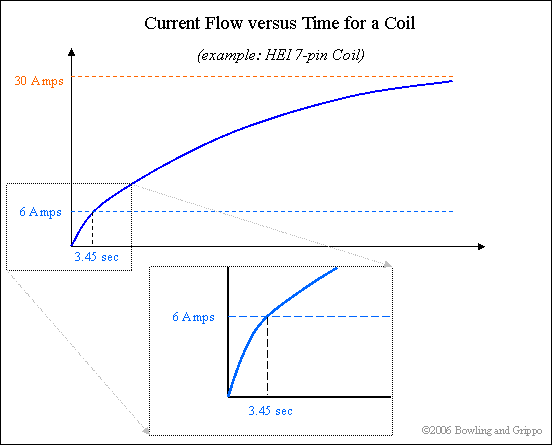
A device with high inductance will resist change in current. The current in a coil won't surge to 6 amps the instant you apply voltage. Instead, it ramps up.

coil_charge.gif

In the graph shown here, this coil's resistance is so low that it would hit 30 amps of current if you let it dwell forever. But the ignition it's used with doesn't; it cuts off power after 3.45 milliseconds (the curve is mistakenly labeled seconds for some reason - it's not one I drew). So the coil never draws the full 30 amps.

Limiting the dwell time can limit coil current just as effectively as a ballast resistor.
 
Yeah agreed.. the (for want of a better word) Impedance of the coil when pulsed at a specific frequency and with a specific current will change. but thats is catered for in the design.
which is why at low rpm you need a coil with low Primary resistance so a higher current can flow and you can therefore have a lot of dwell limiting applied

The module in that distributor will have dwell limiting on at low rpm and much less of it at higher rpms

with no dwell limiting it will be depending on the signal from the trigger as the limit
but i don't think they ever "run free" as it were

the longest dwell allowed will be set to allow you to achieve a consistent spark at the designated maximum rpm.

it will be limited an awful lot at all lower rpms to retain an appropriate spark without overheating the coil.

if you run a standard 12 volt coil with 2-3 ohm primary or a combination of 9v coil and ballast that looks nominally the same. The modules dwell limiting doesn't work properly and you never achieve any of the benefits of the system. its expects the coil to have higher current flowing in the primary lots more than what is flowing. It will work but not to specifications.

the dwell configuration is dictated by the peak voltage produce by the pickup coil
the spark trigger is a point on that signal just above zero Volts on the upswing.
two useful pieces of data can be gained from 1 pickup, when to fire off a spark and how fast is my motor running.

the pickup provides switching to trigger the spark, and data about engine speed. namely size in volts of the peaks of the pickup signal
both are used to allow the module to set the dwell.
and it will set it expecting to be connected to a low primary resistance 12 volt coil.
if its connected to a higher primary resistance combination I'd expect it to to get it wrong

The MSD coil is more than likely OK

the dwell limiting is dictated by a bunch of support components that used to sit around the motorola chip, originally used in the module, their values were set by the specification of the pickup coil and the specification of the ignition coil at the point of manufacture. mismatch in either with the module is the driver for "HEI can't maintain spark beyond 4500 rpm", that is constantly repeated internet wide.

when the dwell control can't do its job properly the ignition system doesn't perform to specification

440 source drop in 2 wire street distributor looks like its based on a chinese variation of an australian bosch GM centric design. using copies of australian Bosch caps and rotors and one presume hidden out of view in the pictures a Bosch BIM024 module which is just a 4 pin HEI with a different shape and name


Dave
 
Last edited:
A lot of red herrings creeping into this thread....
Let's clear up one thing. For the purposes of determining primary coil current, ohm's law is used. See below. That page is part of 60+ pages of research into ign systems by Dr. Hugh Holden.
My input in this thread is that the info in post #2 is incorrect. You can use a stock points coil if you want to; if the coil used a bal res, the bal res must be retained to avoid possible coil failure. Using a stock coil will result in less spark energy....but it will work.

img036.jpg
 
i agree, you can, ive done it used a bosch "blue" 12 volt coil off a VW bug, but it may be detrimental to performance of the ignition system.

Bosch blue coil specifications vary depending on the specific model, but the 12V version typically has a primary resistance of 3.2 to 3.4 Ohms and is designed for non-ballasted ignition systems. It is a high-performance coil intended to produce a stronger, hotter spark for smoother engine operation and reliable cold starts


works but not ideal as miles out of spec for the module.

Dave
 
Last edited:
Someday, some poor soul is going to read all the irrelevant drivel in this thread and actually try to run his ignition this way, only to discover that mopar 2-circuit ignition wiring won't allow you to actually hook it up like that.
OP- for the RTR combine IGN1 and IGN2, toss the ballast, run a full 12v rated coil, and be done with it. Move on to your next project.
 
-
Back
Top Bottom