The 360 build that has more turns than Willow Springs

-
I started a thread on the gallery plugs…. And like it often goes, there was debate.
I asked about it because I simply don’t know. When I don’t know, I rely on common sense and it rarely fails me.
I’ve torn down a few LA engines but don’t recall seeing others with the plugs in the galleries. It seems that the thrust plate would block off the galleries on its own but only if the right plate is used. I have plates here that look like this:

IMG_0711.jpeg


To me, this looks like the oil flow dead ends right there.
I also have thrust plates like this:

IMG_0712.jpeg


This would allow oil to hit the plate and let just one side turn down and flow down the front of the block. My 360 had this plate. My friend’s 2001 5.9/360 had the same plate.
A few books I’ve read state to plug the block….

IMG_0733.jpeg


This same book showed the use of a hollow bolt though. That seemed to be an older feature that I have not seen on the engines I’ve seen.

IMG_0735.jpeg
 
I started a thread on the gallery plugs…. And like it often goes, there was debate.
I asked about it because I simply don’t know. When I don’t know, I rely on common sense and it rarely fails me.
I’ve torn down a few LA engines but don’t recall seeing others with the plugs in the galleries. It seems that the thrust plate would block off the galleries on its own but only if the right plate is used. I have plates here that look like this:

View attachment 1716402887

To me, this looks like the oil flow dead ends right there.
I also have thrust plates like this:

View attachment 1716402886

This would allow oil to hit the plate and let just one side turn down and flow down the front of the block. My 360 had this plate. My friend’s 2001 5.9/360 had the same plate.
A few books I’ve read state to plug the block….

View attachment 1716402888


This same book showed the use of a hollow bolt though. That seemed to be an older feature that I have not seen on the engines I’ve seen.

View attachment 1716402889

Were you going to use this?
img_9688-jpeg.1716367880


If I recall the oil slinger doesn't fit with this tensioner either. (I'd just buy a better chain and skip the tensioner but :popcorn: )
img_4336-jpg.1716120783


s-l1600.webp

Rollmaster Timing Chain Set Double Roller Chrysler Mopar LA 318 340 360 V8 | eBay
 
If you use that second plate, there'd be an unnecessary pressure leak in the oiling system. I always install the plugs. At the very least, I'd use the top plate in your photos to avoid that useless leak.
 
Were you going to use this?
img_9688-jpeg.1716367880


If I recall the oil slinger doesn't fit with this tensioner either. (I'd just buy a better chain and skip the tensioner but :popcorn: )

Great points. I'm still unsure of how I'm going to proceed. Oddly, I momentarily forgot about the tensioner that I bought awhile back. I was stuck thinking of how these standard thrust plates are configured. I do want to use the oil slinger as it sure seems to help reduce leaks at the front seal.

If you use that second plate, there'd be an unnecessary pressure leak in the oiling system. I always install the plugs. At the very least, I'd use the top plate in your photos to avoid that useless leak.

This is why I'm having trouble wrapping my head around all of this. That turndown diverts oil flow down the front of the block. The more I think of it, the more it confuses me as to why it was there given that there were no plugs in the galleys.
The prior owner of this engine had a habit of sometimes making mistakes when building engines. It is entirely possible that he screwed this up but it didn't lead to the head gaskets blowing out. Who the heck knows...maybe he didn't torque the head bolts correctly.
 
The drag/friction is so minimal, you wont loose any power. But you will gian power by keeping the timing of the cam and dist more stable. For the money, its a great item.

If you use a slash sheild for the front seal, you may have to trim a corner of the tensioner to clear it, no big deal.
Evidently you can trim the tensioner to clear the oil slinger, been awhile since I've read an MRL post.....
 
Oh crap. Now I’ll have to take another look at it. I used a thrust plate from another engine…

IMG_0747.jpeg


I’d be glad to be able to use the tensioner.
On another note…. Camshaft fore/aft movement. That is a subject that I never dealt with before today. Like so many other things, I may have just been lucky in the past. In the LA series and the big blocks, I’ve driven in the cam plug at the back with no knowledge of any actual specification. The plug is knocked in and then the center has been dented in a bit to seat the plug. I have seen no information as to how the plug needed to be driven in to a specific number.

IMG_0740.jpeg


Why does it matter?
Well… the lifter bores all seem to sit slightly off center of the lobes so if the fore/aft position of the cam is not limited, the lifters don’t make adequate contact to the cam lobes. The thrust plate keeps the cam from moving forward, the plug keeps the cam from moving to the rear. Roller cams have no taper on the lobes but flat tappet cams do. The bore taper supposedly pushes the cam forward or rearward depending on the angle of the taper.

IMG_0741.jpeg


These pictures show proper placement of the cam since the snout is up against the thrust plate. I was able to pry it rearward though by at least 5/16” and the roller wheels were hanging off the edges of the lobes. Not good.
This is yet another instance of learning as I go. I moved the cam forward to touch the thrust plate then further dented the cam plug until the fore/aft movement was approximately .015.
The cam spins freely and has some slight fore/aft movement. I don’t know of a published spec for this for LA series engines but the retro-roller cams for big blocks call for no more than .010 and to get there, a semi-custom thrust button has to be fitted.

IMG_0742.jpeg
 
What type of plug did you end up using on the rear cam tunnel? I think there's a couple different types. 5/16" seems like a crazy amount of movement. Great catch!
 
The cam plug was one of those concave/convex discs like a large contact lens or small snow saucer!
This was an interesting thing to discover since it never occurred to me before. It got me thinking of how many engines I've built or worked on that may have had excessive fore/aft movement while still not posing any problems. I never checked fore/aft movement before.
Rich is also in the shop here with his 5/9/408, his cam was pushed to the rear of the block at one point today and he asked me about lifter wheel contact with the lobes. His were way off the mark....which got me curious.
This catch was a team effort.
 
The plug doesn't control cam location at all... Drive it in to the step & your done.. Thrust in both directions os controlled by the plate... Bolt the gear to the cam without the chain to confirm the thrust meets spec... To much play & it will knock especially at idle...
 
That is an excellent point...The cam cannot go rearward much with the cam sprocket in place.
I thought I stumbled onto some new discovery.
Ah....at least I'm out there doing stuff instead of spending all my time on the couch getting fat.

01 A8.gif
 
That is an excellent point...The cam cannot go rearward much with the cam sprocket in place.
I thought I stumbled onto some new discovery.
Ah....at least I'm out there doing stuff instead of spending all my time on the couch getting fat.

View attachment 1716403205
You and I both. The cam in my 5.9 had a lot of fore/aft movement and the lifter rollers were hanging off the end of the cam lobes. But, I hadn't torqued down the cam bolt yet.
 
Just a little tinkering and mock up today. I liked the idea of using the chain tensioner so I fiddled around with it a bit.

IMG_0755.jpeg


It is spring loaded to press against the loose side of the chain

IMG_0756.jpeg


Plastic coated spring on the one side.

IMG_0757.jpeg


This one is Cloyes, a copy of the OEM design

IMG_0761.jpeg


It has a built in drip pointer and is secured by three 5/16” bolts.

IMG_0762.jpeg


I had to grind away a little of the plastic at the lower corner to fit the oil slinger.

IMG_0763.jpeg
 
Plenty of clearance now.

IMG_0767.jpeg


IMG_0768.jpeg


IMG_0769.jpeg


The tension side also has a plastic coated guide.

IMG_0771.jpeg


IMG_0772.jpeg


This is similar in principle to what is used on the 2003 and up 3G Hemi engines. When was the last time you heard of a timing chain replacement on a newer Hemi?

IMG_0770.jpeg


Again, this is a test fit/mock up. This is a short snout cam and I am waiting on the snout extension from Hughes. I lost the Woodruff key when I tore the motor down and didn’t know how unique that key is. I had to buy a $38 adapter set to get the special key. Until I have it, I can’t install the chain for good. I ordered Cometic head gaskets in the .086 thickness to bring my compression down to a comfortable level.
Keep in mind, THIS engine is completely UNnecessary! The car that it is going into is my beater 67 Dart.

IMG_6065.jpeg


It has a re-ringed 1977 360 from A Cordoba with #308 heads, a mild 280/474 MP cam and maybe has 8 to 1 compression. It runs great for being such a mild engine. This 1990 360 will be a huge leap over it in terms of compression, cam specs, intake and exhaust.
The existing 360 has exhaust manifolds and 2 1/4” pipes, I’ll be using 1 5/8” headers from FABO member @MidnightSwinger and 2 1/2” pipes with…..Flowmaster mufflers!
The Dart has a 904 and a 4.10 geared 8 3/4 axle. It already runs pretty strong but this ought to be a big upgrade. If I ever get around to fixing up the car, it could be an impressive performer.
This engine is another example of what I call The Snowball effect.
Some call it Mission Creep. I didn’t need the engine but a friend wanted to sell it. I figured I’d replace the two blown head gaskets and just stow it until I needed it. Water sitting in it became a rebore job, my mistakes with calculating resulted in a $300 set of head gaskets instead of $50 a pair Fel Pros…
 
Last edited:
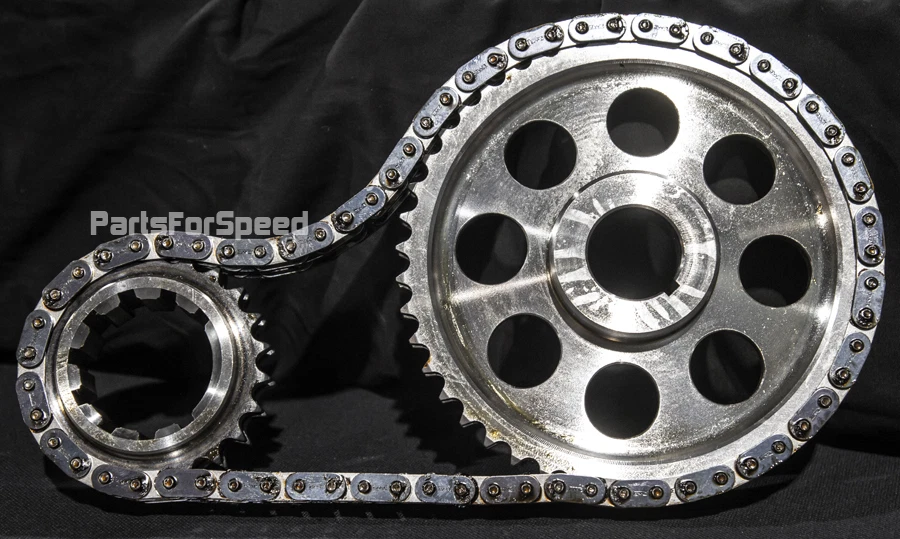
Some people will say the dogbone-shaped links of that chain may dig excessively into the plastic guide on the tensioner and that those should only be used with chains that are flat-sided like this:

1746998667449.png
 
That is a point worth considering.
I bought this tensioner because it was cheaper than a new timing set and I figured all chains eventually stretch anyway.
 
In keeping with the theme of trying to keep costs down, I’m reusing the chain that was on it. This engine had less than 4000 miles over several years. The rod bearings I took out were dated 3-12 and the engine sat for about 3 years before I got it. Not many miles on the guts of it. It was a shame to replace pistons but the corrosion from sitting water required going from .020 to .040.
Sometimes being frugal bites you in the ***. Maybe I should have just bought another timing chain but I’ve reused low mileage timing sets with no troubles before.
The chain is not sloppy but isn’t brand new either. I could just install it with no tensioner and probably never see a problem with it. I’m not firm on using it but I do like the idea of its function.
It is a Band Aid to use a head gasket to bring compression down but it does work. With the 8553 Fel Pro gaskets, here is where I’d be:

IMG_0774.jpeg


Now that is too dang much for even 91 octane. My goals were low to mid 9s. The thicker Cometics get me there.

IMG_0773.jpeg
 
Last edited:
In keeping with the theme of trying to keep costs down, I’m reusing the chain that was on it. This engine had less than 4000 miles over several years. The rod bearings I took out were dated 3-12 and the engine sat for about 3 years before I got it. Not many miles on the guts of it. It was a shame to replace pistons but the corrosion from sitting water required going from .020 to .040.
Sometimes being frugal bites you in the ***. Maybe I should have just bought another timing chain but I’ve reused low mileage timing sets with no troubles before.
The chain is not sloppy but isn’t brand new either. I could just install it with no tensioner and probably never see a problem with it. I’m not firm on using it but I do like the idea of its function.
It is a Band Aid to use a head gasket to bring compression down but it does work. With the 8553 Fel Pro gaskets, here is where I’d be:

View attachment 1716404044

Now that is too dang much for even 91 octane. My goals were low to mid 9s. The thicker Cometics get me there.

View attachment 1716404045
Did the old chain have a tensioner on it? If so, I'm curious what the wear pattern looked like on it with that chain.
 
No tensioner before. The prior owner did use a tensioner in another engine but I don’t know if it ever posed a problem. That engine was a stroked 340/416 in a car that he sold.
 
Back at it. I am at a sort of stand still since certain aspects of the build make it so I can’t use the parts I have at hand. The screw up with the compression ratio estimate meant either thicker head gaskets or 100 octane fuel. I found I have a short snout cam which requires the adapter to mount a fuel pump eccentric. Now the water pump I have makes rotational noise so I don’t trust it to use. I’ll address the fuel pump eccentric adapter first though….

IMG_0827.jpeg


I bought the Hughes adapter because when I tore this engine down, I lost that special key that is part of the kit.

IMG_0828.jpeg


I had the spacer, the cupped washer and longer bolt but didn’t have that special key.

IMG_0829.jpeg


The key on the left is a generic from ACE hardware. The Hughes key is on the right. It looks like the Hughes key is an add-on to use after the timing set is already in place. I may have it wrong but it looked like to use the Hughes key, I had to already have the original key in place first. I decided to grind and reshape the new key…

IMG_0832.jpeg


IMG_0835.jpeg


IMG_0834.jpeg
 
The reshaped key now sits in the groove in the snout but also sticks out to properly position the spacer and eccentric.

IMG_0837.jpeg


IMG_0836.jpeg


IMG_0840.jpeg


There isn’t a lot of key there but there is enough.

IMG_0843.jpeg


IMG_0842.jpeg


Knowing that it will work, I pulled it all off and installed the tensioner.

IMG_0845.jpeg


IMG_0847.jpeg


The oil slinger clears the tensioner after a little clearancing.

IMG_0848.jpeg


IMG_0849.jpeg
 
The prior owner had an electric fuel pump, a weird alternator setup and no power steering so the bolts I had as I took the engine apart are different sizes than what I need for this car. I test fitted some bolts from the stash and as I spun the water pump, it made a scratching noise.
Since this engine was pulled due to blown head gaskets, I’m not taking chances. I’ll get a new pump. I noticed a few things on this one…

IMG_0850.jpeg


It has a Pentastar on the inlet neck. I noticed the holes in the casting around the center shaft and remembered that there were two types of water pumps used on the LA engines. Is this the standard one?

IMG_0851.jpeg


The impeller is small, measuring maybe 3 1/2”.

IMG_0852.jpeg


Rich’s 5.9/408 original pump here looks similar until I looked closer.

IMG_0853.jpeg


The casting around the center shaft tapers in and has no holes. I looked at water pumps on two other cars here and they look like Rich’s pump. Then….

IMG_0854.jpeg


That impeller looks bigger. 8 blades versus 6 and it measures 4 3/8”, almost an inch bigger.

IMG_0855.jpeg


Side by side, it is immediately obvious.

IMG_0856.jpeg


Given the choice, which pump would you rather have?
Yeah, me too. I’m going to go out and buy a new pump.
More to come….
 
I think the 6 blade fan was for A/C cars and had small diameter w/p pulleys to spin the pump (and fan) faster.

I'd use the 8-blade one for more flow, but that's just me. I'm curious what others say.
 

Gotta stop you. DO NOT use a tensioner with a double roller chain. The chain will wear the guides horribly and you’ll end up with that material in the oil pick up tube. The tensioners were designed to be used with stock link belt type chains.
 
I think the 6 blade fan was for A/C cars and had small diameter w/p pulleys to spin the pump (and fan) faster.

I'd use the 8-blade one for more flow, but that's just me. I'm curious what others say.
I'm reusing the water pump that Greg showed. The Magnum has always run cool, even before I installed the aluminum radiator.
 
-
Back
Top Bottom