Zinc

-
Spot on, including the Isky roller lifter fiasco. 540Rats a dick.
I just don't see how difficult this is for some people.. Just buy a good oil with zinc in it.. simple..
If you can't manage to do a simple task like that, then you deserve every cam failure you ever get..
I haven't heard that one. Interesting....
 
Synthetic can stop the lifters from rotating.. simple as that. Bushed roller are the go for street duty and they are not cheap. Also roller cams are not set and forget...
 
Madscientist, I've read a lot online about 540rat but not too much that is negative. If you have a link, post it. I would like to read it. I try to gather as much info as I can when I'm researching. I know that any testing done by anyone is only as good as the equipment and the unbiased opinion of the person doing it.

540RAT wrote so much crap that it would be impossible to link to it. I know he was on may sites. I ran into him on speedtalk.com. If you go there and search you will find thread after thread after thread after thread of his nonsense and it finally got him booted. speedtalk.com has some of the smartest guys I know on the web posting there, so 540RAT was exposed. You can look it up.

I'll throw you a couple of bones to think about.

Engine oil testing is some of the most cost prohibitive, labor intensive, counter productive testing I have ever done. I almost never post results for several reasons, the first being cost. It takes a MINIMUM of 9 (NINE) test pulls per oil in an A-B-A test format, other wise your numbers are 100% pure bull crap. Since I didn't personally pay for the testing, it's not mine to post.
The second reason is that way too many variables are in play to make the test results actually VALID to anyone other than who the testing was completed for. It can be as simple as bearing clearance to something such as bore finish geometry, ring tension, windage tray configuration, number and location of crank scrapers (I'm already saying too much). So the testing may not translate well from a full tilt race engine (running 140* water temp and 160* oil temp) to a street car runiing 190* water and 220-240 oil temp* (we all monitor our working oil temps don't we?).

So with that I will give you some generals:
1. Lower grade oils (mistakenly call weight) don't always make better power when tested for application.
2. Lower pressure almost NEVER gains more than 5 HP EVER. You gain more HP in dropping a grade than lowering oil pressure i.e. going from a 50 to a 40 grade oil, but you better damn sure know why you are dropping a grade.
3. In a post WWII world never EVER run a single grade oil. EVER. Don't do it. NEVER.
4. The first number in an oils grade is it's WINTER grade, and only has an effect when the oil temp is ambient.
5. All multigrade oils start as a base oil in it's winter grade (for example, a 10w30 oil starts out as a 10 grade oil) and they (the guys who design the oil) add Viscosity Index IMprovers to make the oil thicken when hot.
6. Cheap oils are cheap and most are crap for anything but a honda or your minivan.
7. QUALITY synthetics ALWAYS outperform cheap synthetics and mineral based oils, no matter what name is on the bottle.
8. The chances of you being able to get the same oil ASSCAR and Pro Stock guys run is not probable, unless you are at $20.00 USD per quart MINIMUM.
9. It is a known FACT that just because an oil company has a sticker on a car, that car probably doesn't run that oil. Several well know Pro Stock guys caught hell for running brand "P" oil stickers while knowing using brand "T" oil.
10. I've already said too much and my life may be in danger.


OK, so #10 is total crap but it makes for a good story.:blob:

 
All this is with respect to camshaft and lobe interaction, but is there any effect on the rest of the engine lubrication with lower zinc oils? It seems like at some point you would start to wear pistons and things, too, more with the newer oils.
 

5. All multigrade oils start as a base oil in it's winter grade (for example, a 10w30 oil starts out as a 10 grade oil) and they (the guys who design the oil) add Viscosity Index IMprovers to make the oil thicken when hot.


So the wider the viscosity indices, the less oil you get. Run the most narrow band you can.
That's what was suggested to me by someone who was doing oil analysis at work years ago.

It seems obvious that different engines are under different demands.
I've run synthetic in an 86 factory 318 for hundreds of thousand of miles with no additives.
I don't think it even needs oil.
But I stated adding STP to it when I heard it had zinc in it.
 
I just don't see how difficult this is for some people.. Just buy a good oil with zinc in it.. simple..
If you can't manage to do a simple task like that, then you deserve every cam failure you ever get..

Okay, that's a little harsh... but whatever.
 
Okay, that's a little harsh... but whatever.

Sometimes you have to be harsh to get people to do the right thing..Especially the tight *** ones.
The trend these days seems to be, make a poor decision and then cry about it when it all goes wrong.
 
Synthetic can stop the lifters from rotating.. simple as that. Bushed roller are the go for street duty and they are not cheap. Also roller cams are not set and forget...
That's what lunati said to me. The only thing in your engine that cares about zinc is your flat tappet cam. From what I understand, zinc does not coat, it works with heat. It doesn't build up on parts either. Madscientist, I don't think thin oils make more power. Slicker surfaces do. Thanks for your input. I got the feeling that's your take too.I think my issue with my engine is clearance is too much for a thin oil. Not saying I put it together too loose just too loose for me to feel comfortable with what I had. My top number didn't bother me it was lower pressure at idle. It doubled with the thicker oil. I think the results would be the same with a straight 30w
 
So the wider the viscosity indices, the less oil you get. Run the most narrow band you can.
That's what was suggested to me by someone who was doing oil analysis at work years ago.

It seems obvious that different engines are under different demands.
I've run synthetic in an 86 factory 318 for hundreds of thousand of miles with no additives.
I don't think it even needs oil.
But I stated adding STP to it when I heard it had zinc in it.

Makes sense, I think 85+ 318s had roller cams. No zinc needed.
 
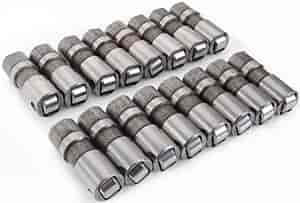
Ironically, the best solution to the zddp problem isn't more zinc, it's more steel:
312-P5249862_2.jpg

And also ironically, rollers need zinc too.
 
Synthetic can stop the lifters from rotating.. simple as that. Bushed roller are the go for street duty and they are not cheap. Also roller cams are not set and forget...

I agree. It's a no brainer really.
 
Sometimes you have to be harsh to get people to do the right thing..Especially the tight *** ones.
The trend these days seems to be, make a poor decision and then cry about it when it all goes wrong.

These are things we can agree on.
 
Sometimes you have to be harsh to get people to do the right thing..Especially the tight *** ones.
The trend these days seems to be, make a poor decision and then cry about it when it all goes wrong, and then blame someone else.


There, I fixed it for you.
 
That's what lunati said to me. The only thing in your engine that cares about zinc is your flat tappet cam. From what I understand, zinc does not coat, it works with heat. It doesn't build up on parts either. Madscientist, I don't think thin oils make more power. Slicker surfaces do. Thanks for your input. I got the feeling that's your take too.I think my issue with my engine is clearance is too much for a thin oil. Not saying I put it together too loose just too loose for me to feel comfortable with what I had. My top number didn't bother me it was lower pressure at idle. It doubled with the thicker oil. I think the results would be the same with a straight 30w


"Slicker" oils do make more power, just not s much as you might think.

You are correct in that bearing clearance makes a big difference in working pressure. When I started building engines (I'm an old guy now) the minimum clearance for a performance/race engine was .0025 and .003 was better (some big bearing engines still require these clearances) where today, .0025 would be the high side and some stuff goes out at .0018! If you ran a 50 grade oil with .0018, you would have way too much pressure and no flow. So now, you have comp a Pro Stock guys (and some crazy bracket guys) running super thin oil with next to nothing clearances. So clearance and oil grade go together.

One other thing guys miss is how long valve springs last with super thin oils. Spring life goes down the toilet.
 
I used the STP oil additive with zinc. I'll let you know how that goes

Ditto on the STP. !!! and I also you Pennzoil 10W-40 and have done this for years on end and have NEVER had any problems. I guess old school still prevails....:cheers:
 
-
Back
Top Bottom