Strange timing issue - '68 318

-

videoword

Member
Joined
Apr 30, 2013
Messages
18
Reaction score
0
Location
new york
This is an odd one. I posted earlier about trying to tune my 68' 318 due to some poor hot idle performance and occasional stalls.

I decided to get the timing right first before going crazy with the carb.

With vac advance connected, at idle, I'm at 800rpm and approx 10* BTC.

With vac advance disconnected, I'm at 250rpm and I can't see the timing mark - it just disappears (I have marked it with a bright white grease pencil to make it clear and bright). Not sure if it is on the opposite side of the wheel, or if the rpms are too low to register. I tried adjusting the timing to bring the mark into view and didn't have any luck despite turning the distributor significantly.

I checked that the mark on the wheel matched actual TDC, thinking maybe the chain slipped or something and the TDC marker on the wheel is right where it should be.

What does this mean? I've got an electronic ignition that I want to put in there, but if TDC is nowhere to be found I'm hesitant to go messing with it.

Thanks for the advice.
 
The very first thing I recommend on any old car is to use a piston stop and VERIFY that the timing mark is actually accurate. This may come from my days when I used to find a fair number (mainly Ford FE engines) that were not.

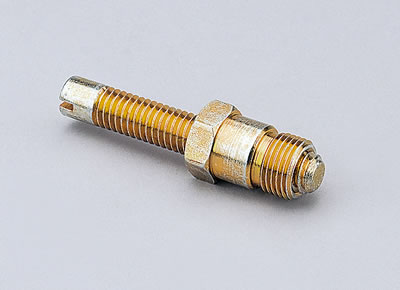
Get yourself, or make, a piston stop


Piston stop

You can buy or make one. Here's one I made a LONG time ago:

attachment.php


attachment.php


Remove the no1 plug and make sure the piston is down quite a ways. Remove the battery ground for safety. With a wrench, rotate the engine until rotation stops. With a commercial, or adjustable stop, you may need to adjust the length. You are not trying to stop the piston at TDC but rather down in the bore some amount.

With the engine stopped against the device, carefally make an accurate temporary mark under TDC on the timing tab onto the balancer.

Now do the same thing, rotating CCW.

You will have two temporary marks some distance apart. True TDC will be halfway in between, and if the original is correct that is where it will be.


Next, all of these cars in the time era of your car use what is called ported vacuum for distributor advance. This means that at idle, there is NO vacuum, therefore you have the distributor hooked to the wrong carburetor port.

Also, you should endeavor to be sure that the advance mechanisms, both mechanical and vacuum, are actually working. Mechanical advance can get rusty, stuck, worn, springs broken, or debri wedged in the mechanism. Vacuum advance can leak, thus not working.

You can easily measure around the outside of your dampener and figure how many "degrees per inch" to mark it so you can measure what the advance is doing, or borrow/ buy a "dial up" timing light.
 
The very first thing I recommend on any old car is to use a piston stop and VERIFY that the timing mark is actually accurate. This may come from my days when I used to find a fair number (mainly Ford FE engines) that were not.

Get yourself, or make, a piston stop

What I did to check piston position is place a wooden stick (not from a tree) into the cylinder and marked how far it came up and marked that position on the wheel. Then I turned the engine over just a little bit. Checked with the stick, marked it, marked the wheel. I did this until it advanced up to the top of the cylinder and then back down. That allowed me to know whereabouts TDC was and it certainly matches the timing mark.

Next, all of these cars in the time era of your car use what is called ported vacuum for distributor advance. This means that at idle, there is NO vacuum, therefore you have the distributor hooked to the wrong carburetor port.

That is interesting. My vacuum is connected to the port on the very left of this image (not the choke in the back, the port with no hose on it in this picture): http://www.carbkitsource.com/carbs/images/carbsnapshots/carterBBD-68Dodge-large.jpg

It definitely is creating vacuum at idle, which is maybe a problem? Let me know if this is the wrong port.

Also, you should endeavor to be sure that the advance mechanisms, both mechanical and vacuum, are actually working. Mechanical advance can get rusty, stuck, worn, springs broken, or debri wedged in the mechanism. Vacuum advance can leak, thus not working.

I know vac advance works decently enough because there is a significant effect on the engine when I connect it via the hose mentioned above (from 250rpm to 800rpm).

Any more thoughts?
 
I'm not sure. What is the carb no? It might be that early model carbs, IE 64, earlier, etc, had different internal porting.
 
If your at 10 with vacume advance connected turn it up to about 25. Than disconnect it to see what you have. I would not check mine with vacume hooked up in fact you really dont need it block it off and get rid of it. It causes more trouble than good. After you turn it up you will have to back down your idle speed and adjust carb.
 
Wow...Your getting some misleading information !

Running your street car without the vacuum advance is costing you performance,drivability,and fuel economy. If your car runs better without it is a signal that you need some diagnosis and adjustment or repair.
It isn't something you simply disconnect to solve a problem.
Also Always disconnect and plug the VA when setting the timing. Why someone would do it any different is a mystery to me.

Or you could just block it off and throw money down the drain.

Check that your distributor and vacuum advance pod are both in order. After you set your timing,connect it to a ported vacuum (no vacuum at idle) and get back with your results.
 
If your at 10 with vacume advance connected turn it up to about 25. Than disconnect it to see what you have. I would not check mine with vacume hooked up in fact you really dont need it block it off and get rid of it. It causes more trouble than good. After you turn it up you will have to back down your idle speed and adjust carb.

Sorry, cannot agree with this at all on a street engine. A properly configured distributor on a street engine not only works well, it helps mileage and even may promote cooler running at cruise
 
cooling usually isnt a issue on a street engine alot of built engines dont run VA without problems, Ive tried both on mine if a 1/2 a gallon better makes you feel better than leave it hooked up. He originally checked timing with 10 degree with advance hooked up, Im saying thats too low thats why I said crank it up to check it but not with vacume advance connected, sorry for any misunderstanding.
 
What I did to check piston position is place a wooden stick (not from a tree) into the cylinder and marked how far it came up and marked that position on the wheel. Then I turned the engine over just a little bit. Checked with the stick, marked it, marked the wheel. I did this until it advanced up to the top of the cylinder and then back down. That allowed me to know whereabouts TDC was and it certainly matches the timing mark.


That is interesting. My vacuum is connected to the port on the very left of this image (not the choke in the back, the port with no hose on it in this picture): http://www.carbkitsource.com/carbs/images/carbsnapshots/carterBBD-68Dodge-large.jpg

It definitely is creating vacuum at idle, which is maybe a problem? Let me know if this is the wrong port.


I know vac advance works decently enough because there is a significant effect on the engine when I connect it via the hose mentioned above (from 250rpm to 800rpm).

Any more thoughts?

You are connected to the correct vacuum port.
Disconnect the vacuum line from the distributor, and plug the vacuum line going to the carb.
Set the timing.
Also check for vacuum leaks on everything.
 
Per the factory manual, timing should be set with the vacuum advance disconnected, and the vacuum port on the carb plugged (although if everything is reasonably correct there should be no vacuum coming from this port, a good crosscheck).

Since you have vacuum coming from the "timed" or "ported" vacuum port on the carb, your throttle plates are slightly open at idle. Also, if you are at 10 BTDC with the vacuum advance connected, and vacuum applied to it, you are probably more like 10-15 ATDC static. This is why your idle drops drastically and the mark moves off scale when you disconnect the vacuum advance. You've confirmed that your vacuum advance works!

So what you need to do is set the timing to 10 BTDC with the vacuum disconnected and capped. When you do this, you'll have to set the idle speed back down some, as I bet it ends up about 1500. Then, as you drop the idle back down, the throttle plates should close just enough that vacuum is no longer present at the timed port. This is how a stock 318 should work.

So, there are a couple of other things to check. You want to make sure your mechanical advance is free and working right. To do this twist the rotor arm clockwise and release. It should turn 3/8 to 1/2 inch at the tip and spring back all the way when released. Also, as a quick reality check, the nipple of the vacuum advance should point more or less to the top shock bolt, or slightly behind (or #6 plug). If you have to rotate the distributor (counter-clockwise) more than this the intermediate shaft is either a tooth or two off, or the wires are not in the right spots in the cap. With the timing mark lined up at TDC, the rotor should point to the throttle return spring bracket (left forward most intake bolt). If it does, the intermediate shaft is installed correctly, if not, it isn't (it happens). Either way, the quick fix is to shift all the wires over one socket in the cap. Big picture here is with the engine at TDC, the #1 wire should be in whatever socket allows you to clock the distributor such that you have a reasonable range of motion to adjust the timing. Looking straight down at the distributor, assuming the rotor points in the normal direction, the #1 wire should be at about 5 o'clock, and the vacuum advance nipple should be about 8 o'clock.

I can't agree that the vacuum advance should be left disconnected. There is no advantage to doing so and many disadvantages. BTW this 318 doesn't have the original timing chain in it does it?!?
 
I must have missed your original post about hot idle problems, and stalling. At the risk of repeating something that has already been done here are a couple thoughts. Did you replace the plugs? Are they gapped right? Is the cap in good condition with no moisture or carbon tracking, etc.? Rotor ok? Did you check for any vacuum leaks. I would at least start with big leaks like carb gasket, vacuum lines, brake booster, you know. Plug wires need to be in good condition and not cross firing. Set the carb float level. Also, just wondering, even though I have seen dizzys do strange things, after the first reading of ten degrees BTDC did you disconnect the timing light and maybe re-connect improperly? One other thing, probably not your problem, but costs nothing to try. My brothers 340 Demon refused to run. I took the distributor out of my 318 'Cuda, dropped it in and it started instantly and ran like a raped ape. The distributor shaft was bent just a little. Also at that low idle there should be no vacuum to the advance, so make sure you connect to the right port.
 
Per the factory manual, timing should be set with the vacuum advance disconnected, and the vacuum port on the carb plugged (although if everything is reasonably correct there should be no vacuum coming from this port, a good crosscheck).

For those saying I should not set my timing with the vac advance connected. I hear you and I'm not. The only reason I have it connected is because I cannot seem to get the timing mark into view with it disconnected. I wanted to report what it looked like with the vac advance connected as part of the diagnosis, since there is nothing to report with it disconnected.

Since you have vacuum coming from the "timed" or "ported" vacuum port on the carb, your throttle plates are slightly open at idle. Also, if you are at 10 BTDC with the vacuum advance connected, and vacuum applied to it, you are probably more like 10-15 ATDC static. This is why your idle drops drastically and the mark moves off scale when you disconnect the vacuum advance. You've confirmed that your vacuum advance works!

Cool, so I will try again to get that mark into view with vac disconnected. Maybe I wasn't brave enough and just needed to keep turning.

So what you need to do is set the timing to 10 BTDC with the vacuum disconnected and capped. When you do this, you'll have to set the idle speed back down some, as I bet it ends up about 1500. Then, as you drop the idle back down, the throttle plates should close just enough that vacuum is no longer present at the timed port. This is how a stock 318 should work.

Thank you for this breakdown. I am hoping this is where the problem lies and that now makes mechanical sense to me. My intuition is that the fact that I'm idling at 250 reveals a significant defect somewhere and that my idle setting with the vac connected is overcompensating for it. Regarding my idle setting, I noticed while trying to dial in the carb that there is a sort of breaking point where my idle is either 700-900 or 200-300. With your explanation, I would now guess that this is due to the throttle being open far enough to the point of engaging the advance. I reckon I'll need to get that low idle up without the idle screw.

So, there are a couple of other things to check. You want to make sure your mechanical advance is free and working right. To do this twist the rotor arm clockwise and release. It should turn 3/8 to 1/2 inch at the tip and spring back all the way when released. Also, as a quick reality check, the nipple of the vacuum advance should point more or less to the top shock bolt, or slightly behind (or #6 plug). If you have to rotate the distributor (counter-clockwise) more than this the intermediate shaft is either a tooth or two off, or the wires are not in the right spots in the cap. With the timing mark lined up at TDC, the rotor should point to the throttle return spring bracket (left forward most intake bolt). If it does, the intermediate shaft is installed correctly, if not, it isn't (it happens). Either way, the quick fix is to shift all the wires over one socket in the cap. Big picture here is with the engine at TDC, the #1 wire should be in whatever socket allows you to clock the distributor such that you have a reasonable range of motion to adjust the timing. Looking straight down at the distributor, assuming the rotor points in the normal direction, the #1 wire should be at about 5 o'clock, and the vacuum advance nipple should be about 8 o'clock.

I will check this tomorrow. I have a hunch that this is where the problem lies. The distributor has been through the hands of a few mechanics for various reasons and now that I am trying to do this work myself, it seems likely something could have gotten installed slightly off or wired incorrectly. I'll check that the wires are going to the correct plugs and that everything is oriented roughly as you describe.

I can't agree that the vacuum advance should be left disconnected. There is no advantage to doing so and many disadvantages. BTW this 318 doesn't have the original timing chain in it does it?!?

My dad and I had the engine rebuilt about 8 years ago, when I was young and inexperienced both the cars and with people. I wouldn't choose the same garage to rebuild the engine again if I had another shot at it. In their favor, they did get it running again after the head gasket blew. Unfortunately, I have no idea whether or not they replaced the chain. I wouldn't be surprised if they didn't.

Thanks again to everyone for all of your help.
 
You can get a good idea of how sloppy the chain is simply by putting a socket on the front crank bolt, pull the dist. cap, and turn the engine a small amount until the rotor "just doesn't" start to turn. This is outlined in the shop manual, and by the way do you have one?

There's some free factory shop manuals you can download, here's a 69

[ame]http://www.abodyjoe.com/pictures/Misc.%20car%20info/69%20dodge%20service%20manual.pdf[/ame]
 
So, there are a couple of other things to check. You want to make sure your mechanical advance is free and working right. To do this twist the rotor arm clockwise and release. It should turn 3/8 to 1/2 inch at the tip and spring back all the way when released. Also, as a quick reality check, the nipple of the vacuum advance should point more or less to the top shock bolt, or slightly behind (or #6 plug). If you have to rotate the distributor (counter-clockwise) more than this the intermediate shaft is either a tooth or two off, or the wires are not in the right spots in the cap. With the timing mark lined up at TDC, the rotor should point to the throttle return spring bracket (left forward most intake bolt). If it does, the intermediate shaft is installed correctly, if not, it isn't (it happens). Either way, the quick fix is to shift all the wires over one socket in the cap. Big picture here is with the engine at TDC, the #1 wire should be in whatever socket allows you to clock the distributor such that you have a reasonable range of motion to adjust the timing. Looking straight down at the distributor, assuming the rotor points in the normal direction, the #1 wire should be at about 5 o'clock, and the vacuum advance nipple should be about 8 o'clock.

OK, so before I get to twisting and moving wires around I want to report back what I saw in the distributor:

Overall - the nipple of the vac advance is pointed at 9 oclock. Looks like I have some room to advance the timing a bit (though the coil will start to get in the way, but I can work around that)

At TDC - The rotor is pointed at 3 oclock. You've stated that it should be at 7 oclock (left forwardmost intake bolt, correct?). I reckon that means that when they replaced the dizzy shaft (which broke) they installed it off by a few notches.

You also say that the #1 wire should be at 5 oclock, it is at 6.

So here's what I imagine will happen when I adjust to roughly what you described:

Vacuum nipple to 8 oclock will also move the 1st plug to 5 oclock, but will move rotor even further back to 2 oclock. In order to have things oriented to what you've described, I'll need to move the 1st spark plug position to 1 oclock...

Or shoot, you know what I just thought - what if the rotor is on backwards? Can I flip it around and put it at 9 oclock, so when I turn the dizzy so that 1 is in the 5 spot the rotor is at 7 oclock? If that will work that is the problem. They just put the darn thing on backwards.

Let me know what you think!
 
The rotor button will go on only one way but the dist' may be dropped in with the rotor positioned 180 degrees wrong
 
I'm going to move the spark plug wires 180 degrees to try and offset this. If it works and I can dial everything in I'm going to take it back to the mechanics who did this and ask them to flip it around. Let me know if this is insanity.
 
Don't over think this!!! With the timing marks lined up, put the #1 wire in the cap terminal closest to where the rotor points.
 
WAIT!!! So, this is a 68 engine, and it has been rebuilt??? Are you using the early or late style front cover? Or more specifically, where is the timing mark? Between the alternator and water pump (right side) or on the drivers (left) side of the engine? If the damper was replaced during the rebuild (common practice) it was quite possibly replaced with the 1970 and later style. The marks are 90 degrees off. This might explain why the rotor is at 3 o'clock with the timing marks lined up. Hook the timing light to #3 or #2 (as opposed to the normal #1 or #6) and see if it is easier to time!
 
OK, so I think I made an amateur error in my earlier calculations. I think the rotor was pointed to 3 oclock at TDC during the exhaust stroke, not the compression stroke. So during the compression stroke it would be at 9 oclock instead, which is where it should be since my distributor is advanced a bit too far anyway.

Don't over think this!!! With the timing marks lined up, put the #1 wire in the cap terminal closest to where the rotor points.

I'm trying not to overthink, but I'm on the verge of a breakthrough in understanding this so humor me just a minute longer.

I know that the orientation you mentioned earlier is not the hard and fast truth, but it is a really useful reference point for me so I'm going to use it to describe what I'm seeing.

I've got my vac advance nipple pointed at 9 oclock. The #1 spark wire is at 6 oclock. And the rotor at TDC is at 9 oclock. If I adjust to get things as you described earlier (twisting the dizzy approx 45*), I get vac at 7 oclock. Rotor at 7 oclock. Spark plug wire at 5 oclock. Precisely as you described above.

I have one quick question though. You said both:

the rotor should point to the throttle return spring bracket (left forward most intake bolt)...the #1 wire should be at about 5 o'clock

Which seems to me to mean rotor at 7 oclock, #1 wire at 5 oclock.

And:

With the timing marks lined up, put the #1 wire in the cap terminal closest to where the rotor points.

Which would mean #1 wire should be at 7 oclock with the rotor.

Am I mis-reading something or are these two different recommendations?

Thanks for the clarification.
 
..........As I said.........earlier..........get or make a pistons stop.

1--Check the timing marks. CHECK them. This does not include using spoons, straws, or sticks of wood

2---Set the distributor in when the engine is on no1 compression, with the timing marks "coming up" to TDC but not ON TDC. You want them, instead, set where you want initial timing.

3--As one of our other members said, the rotor can point to China so long as it points to wherever the no1 plug is with conditions above in "2"

4--If the intermediate shaft (distributor gear) is not in properly, the dist. will not point to "where the book says" in order to run. Not a big deal. Either move the gear, or just plug no1 wire into wherever the rotor points.

http://www.forabodiesonly.com/mopar/showthread.php?t=230216

http://www.forabodiesonly.com/mopar/showthread.php?t=210714&page=2

"The thing" about timing traditional V8 engines. This does NOT apply to some V6s (even/odd fire) and some 4 bangers.

"The book" shows how to insert the intermediate shaft, that is the drive gear/ oil pump drive, and if done properly, everything comes out "OK"

THE REASON it is originally done that way is

so the assembly line folk can wrench, repeat

so the plug wires "lay" nice

so the tune up guys "see" what they expect.

The TRUTH is you can close your eyes and drop the drive gear in ANYPLACE, plug the distributor in "any" old way, and and then bring the timing marks up on no1 ready to fire, and plug the no1 wire in wherever the rotor points, and it will run just fine.

If the vacuum can is off interfering with something, you can simply turn it where you want, bring no1 up to fire, and plug the no1 wire into where the rotor is pointing.

HERE IS the steps to setting up an engine dist.

1---It is important to realize, that when the cam timing marks are set "by the book" that is cam at 6 o'clock, crank at 12 o' clock, this is NOT no1 ready to fire, but rather no6 ready to fire.

So you either have to plug in the dist. pointing to no6, or rotate the engine 1 turn

2---After the cam is timed, with the timing marks on TDC, the "book" shows how to insert the intermediate shaft. if yours is incorrect and you want to correct it, you can simply use a large screwdriver and "walk" the gear up out of the helix and move it whichever way it needs

The gear on a small block should have the slot pointing nearly straight inline with the crank, just a tad to the driver side pointing at the front most manifold bolt

A B/RB gear the slot should be essentially inline with the crank

3---With this in place, now bring up the no1 cylinder ready to fire NOT on TDC but rather WHERE you want initial timing to be. There are two ways to do that

A---If either valve cover is off, bring the timing marks up to where you want initial time, IE 10BTC or so for a bone stocker, 15-20 for a "cam" or maybe even a little more for a real hot cam
Look at either the no1 or no6 valves. Whichever set of valves is CLOSED indicates which cylinder is ready to fire. If no 6 are closed, you can either plug the dist. in with rotor pointing to rear (no6) or rotate the crank one turn, and plug the dist in for no1 (rotor pointing forward)

B---If the valve covers are on, pull the no1 plug, stick your finger in the hole, and bump the engine around. When you START to feel compression, watch the timing marks, and bring them up to initial time, IE 10-12 BTC

Now plug the dist. in, rotor pointing forward, and put the vacuum can approximately where it should be.

I always mark the dist. upper rim directly under the no1 tower so I don't have to argue with teh cap.

Rotate the dist RETARD (cw for small block, ccw for B/RB) to "get the slack" out of the drive, then slowly ease the housing back advanced until

the points open if you are using points

or until the reluctor tip is centered in the pickup coil core.

This procedure should get you close enough that the engine will start and run with no fuss. Then of course just take your timing light and adjust from there

An aside.

I'm a HUGE believer in checking actual TDC with a piston stop, which you can make or buy

cca-4795.jpg


Small block intermediate shaft below. The slot lines up with the front left intake manifold bolt. You can walk the gear up and around with a screwdriver

attachment.php


B, RB, 426 hemi:

attachment.php
 
Thank you all for your help. I fixed it this morning.

I want to post this as a conclusion in case anyone else finds this thread in the future they will know how it wrapped up.

So after verifying TDC and making sure wire 1 corresponded closely with the direction the rotor was pointed, there was still no change in my ability to tune the car.

Adjusting the timing further advanced didn't seem to do anything meaningful either.

The more I tried to tune things, the worse the signal to my timing light would get and I noticed a lot of skipping in the flashes. I was trying to use the light as a diagnostic to see that each of the plugs was receiving signal, but the light was coming through so sporadically I couldn't tell where the problem was.

So I decided to do all new (and nicer) plugs and wires - to improve the signal before replacing the points with electric ones.

After doing this, the car ran slightly better - but idle was still rough and none of the major issues were resolved. The worn old plugs and crappy old wires were no longer a problem though.

I replaced the points with electric Pertronix ones, but then the car wouldn't start at all. I thought maybe the ballast resistor might be the problem, so I tried bypassing that with a hot-wire from the battery with still no response. I ordered the hotter coil also by Pertronix to match the new points. To my surprise the car started.

There was a mean knocking. I took a look at the signal coming from the timing light - it was steady as a drumbeat with no misses. I took a look at the timing mark even though the vac advance was still attached and the car was still not to temperature. It looked a bit too far advanced, even with those two elements still being in place, so I retarded it just a bit until it seemed to be in a reasonable range.

I let the car come to temperature. The idle did not drop to 250 when the choke let out. It stayed at about 1200. I dialed it down to 800. It was a significant distance to get it down to 800 actually. The idle setting before was definitely a crazy overcompensation for a bigger issue. After getting down to 800 rpm, I disconnected the vac advance and plugged the port. This time there was no change in engine performance - there was no longer any vacuum - the rpms did not drop to 250. I checked the timing - it was too far advanced after all the tinkering from the past week. I dialed it in to 12*B (I might tale it to 15-20 soon, it seemed to like it better a bit earlier, but I didn't want to push it at this point).

Then I dialed the rpms down to 700 and started to mess with the mixture. I got a steady reading from the tach while playing with my idle screws. I maximized the performance and dialed the idle back again.

I turned her off, turned her on. And had to literally pause and ask my girlfriend, "Is it on?" It wasn't shaking, wasn't making a bunch of noise. she runs like a charm.

Next up I'd like need to try to bypass the ballast resistor for some extra voltage - I tried building a bypass wire with 2 1/4" flat male leads (I don't remember what they were called) - crimped with a 10 gauge wire. I don't think the 1/4' were the right size. So I'm still running with the ballast.

Thanks again for all the help. I learned a ton. If any of you ever has a question about Avid or Final Cut (something I know a lot about), just send me a message!
 
So moral of the story is the Coil was bad............

You also said there was a mean Knocking? What was that sound? Timing too far advanced at Idle? Never heard a car knock at idle........Maybe I have just not advanced the timing far enough so it would!:D

Nice job on the fix.
 

I would check what voltage range the coil likes to run before altering any of your supply wiring system.
 
-
Back
Top Bottom