Seeking insight on this front disc conversion kit

-

Jimbo_74_Duster

Active Member
Joined
Apr 6, 2022
Messages
43
Reaction score
19
Location
Chicago, Illinois
Hey All,

I am rebuilding the front suspension on my 1974 Plymouth Duster. I have it all torn down now and while I was at it, I thought I'd look into converting the front drum brakes to disc brakes.(I want to keep the manual brake system tho)

I found this kit, and wanted to see if anyone has used it and also have some questions posted below the link.

https://www.classicindustries.com/p...tHLeN0E_HkeBv-qZG6hoCOlQQAvD_BwE&gclsrc=aw.ds

Does anyone see problems with me using my stock lower control arms with this kit?

And is my only option for bolt matching to get new front tires? Or could I just buy 5x4 pattern front discs separately to swap into this kit.(Would that work or would they mismatch with the calipers?)

Thanks for the help and let me know if I'm going about this the right way.
 
that's pretty much standard 73~76 re-pop factory disc setup.

your upper control arms are big bolt pattern and you can re-use your lower control arms (they're all the same-- save for sway bar tab locations but you'll need to change the ball joints. then all you need are the knuckles and assorted brake bits.

if you want to retain small bolt pattern you can get the 73~76 discs in small bolt

and yeah, you can keep it manual.

doctor diff has all the bits you'll need and excellent customer service

 
that's pretty much standard 73~76 re-pop factory disc setup.

your upper control arms are big bolt pattern and you can re-use your lower control arms (they're all the same-- save for sway bar tab locations but you'll need to change the ball joints. then all you need are the knuckles and assorted brake bits.

if you want to retain small bolt pattern you can get the 73~76 discs in small bolt

and yeah, you can keep it manual.

doctor diff has all the bits you'll need and excellent customer service

[/URL][/URL]
Hey thanks a lot for the info. I am planning on reusing the steering knuckles, unless that's a mismatch with the disc package?

Either way it sounds like this kit is a good start.
 
Looks like that kit has everything you need except for the master cylinder and proportioning valve. Mount the calipers towards the front. There is no sway bar interference on 73 and up A bodies, so no need to mount them to the rear.
 
Looks like that kit has everything you need except for the master cylinder and proportioning valve. Mount the calipers towards the front. There is no sway bar interference on 73 and up A bodies, so no need to mount them to the rear.
Hey thank you. I was planning on using my current master cylinder. Is that a no no? And I still need to research the proportioning valve
 
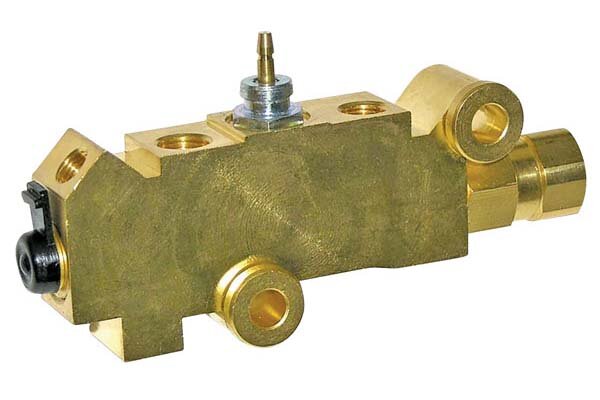
You could use your existing master cylinder, but you'd need to do minor surgery on it to get it to work....and then it would still have a small reservoir for the front brakes. Just get one for a 74 Valiant/Duster with manual front disc brakes. Try to buy a used proportioning valve if you can. The new reproduction ones don't have a very good reputation. @RAT ROD AL has parted a few cars that would have had the right one, if he didn't sell it with the disc brakes.
 
Other than the vendor you chose, all the rest is ok. I'd choose another vendor. Dr. Diff as mentioned is a good choice.
 
I realized that I never took the sway bar off but when I went back I couldn't find the sway bar. Am I crazy or is it supposed to be running through this area I circled in red in this photo?

Am I way off? Or did the previous owner take the sway bar off and never put it back on........

SWAY BAR LOCATION.jpg
 
You could use your existing master cylinder, but you'd need to do minor surgery on it to get it to work....and then it would still have a small reservoir for the front brakes. Just get one for a 74 Valiant/Duster with manual front disc brakes. Try to buy a used proportioning valve if you can. The new reproduction ones don't have a very good reputation. @RAT ROD AL has parted a few cars that would have had the right one, if he didn't sell it with the disc brakes.

at least for my '76 duster, the MC was the same between manual discs and manual drums. note, my 48 year old master cylinder did fail about 6 months after the conversion, unsure if the change in pedal travel going from disc to drum ended up cutting an internal seal due to wear , or if it was just time....

also, show us what your drum brake splitter block looks like. on my '76, it was different than the older cars, to where the typical aftermarket mopar proportioning valve would have caused a lot of headache to adapt, but a GM style one matched up exactly, other than changing one fitting on the hard lines from the master cylinder
 

Attachments

  • proportioning-valve-disc-drum-1971-77-gm-vehicles-BC19836.jpg
    proportioning-valve-disc-drum-1971-77-gm-vehicles-BC19836.jpg
    38.6 KB · Views: 34
oh yeah man, it'll be a totally different car.
my duster didn't have one, adding a 1.125" front bar was a game changer. I also upgraded from the stock .87" to .92" t-bars and 5 leaf to 6 leaf springs, strongly recommend that as well....

also, another option to get the bolt pattern the same is to buy some billet bolt on wheel adapters. that's what I did, they're 6061 aluminum and 1" thick. depending on your rear tire & wheel combo, it can definitely help the proportions of the car to alleviate the "hippo in stilettos" look these cars have and make the F/R track look better in proportion with the added width, especially if you're running the same size tires all the way around or are going fairly modest in width.

here's my car with the spacers, 195/70R14 in front and 225/70R14 in back. eventually I will be replacing the rear axle, probably an 8.8" out of a ford ranger.

duster.jpg
 
Last edited:
Hey All,

I am rebuilding the front suspension on my 1974 Plymouth Duster. I have it all torn down now and while I was at it, I thought I'd look into converting the front drum brakes to disc brakes.(I want to keep the manual brake system tho)

I found this kit, and wanted to see if anyone has used it and also have some questions posted below the link.

https://www.classicindustries.com/p...tHLeN0E_HkeBv-qZG6hoCOlQQAvD_BwE&gclsrc=aw.ds

Does anyone see problems with me using my stock lower control arms with this kit?

And is my only option for bolt matching to get new front tires? Or could I just buy 5x4 pattern front discs separately to swap into this kit.(Would that work or would they mismatch with the calipers?)

Thanks for the help and let me know if I'm going about this the right way.
I took the easy way out. I have a 69 Valiant. I used the spindles and rotors from a Chrysler Le Baron, early 80s v8 model, I can’t remember exactly. Then I used the callipers from a 74 A body with disc brakes. I set it up with the callipers on the back side of the rotor so I could use the front sway bar in its original position. New longer flexible brake lines are required when putting the calipers to the rear. I works great. I must mention the you will need a new non power disc brake master cylinder. I used one from a 74 manual disc brake A body. This way the most inexpensive way to get disc brakes on an A body. I would suggest replacing the distribution block as well.

IMG_0868.jpeg
 
When installing the lower control arm, I found that when tightening the nut on the lower control arm shaft, the shaft just begins to spin inside of the bushing. Which seems so "yeah no duh." How does anyone tighten this without it spinning inside of the rubber bushing?

It's not even greased or anything. Still need to check the torque specs but hopefully it doesn't require much cus the physics of tightening this doesn't make much sense to me. I HAVE TO be missing something here.

Here's a picture just to clarify where it spins, once it's mounted

Thanks

Screenshot 2025-08-02 at 2.14.07 PM.png
 
the inside of the K is tapered and it catches the taper on the pin to lock it and allow it to be torqued up.

depending on what kind of nuts you're using, this borderlines on near impossible.

you can use a large prying apparatus to jam the units together whilst applying the twisty force, or set the vehicle down and allow the weight to add some clamp to the pin that should help in running the nut on.

air (or bat-tree) tools help immensely here. the key is also making sure the arm is fully seated forward as far as possible, and that the socket in the K isn't blowed out.
 
Are the bushings in the control arm rubber or polyurethane? If they are rubber, they are junk, because the pin shouldn't spin in those. It is not uncommon for that to happen in polyurethane bushings, but the rubber ones act entirely different. Someone else had that problem a while back, but I cannot remember who.
 
Are the bushings in the control arm rubber or polyurethane? If they are rubber, they are junk, because the pin shouldn't spin in those. It is not uncommon for that to happen in polyurethane bushings, but the rubber ones act entirely different. Someone else had that problem a while back, but I cannot remember who.
the ones pictured are poly. rubber look entirely different.
 
the inside of the K is tapered and it catches the taper on the pin to lock it and allow it to be torqued up.

depending on what kind of nuts you're using, this borderlines on near impossible.

you can use a large prying apparatus to jam the units together whilst applying the twisty force, or set the vehicle down and allow the weight to add some clamp to the pin that should help in running the nut on.

air (or bat-tree) tools help immensely here. the key is also making sure the arm is fully seated forward as far as possible, and that the socket in the K isn't blowed out.
Ok sounds good regarding the K frame being tapered. I must not have had it in all the way. I'll check this out asap
 
Are the bushings in the control arm rubber or polyurethane? If they are rubber, they are junk, because the pin shouldn't spin in those. It is not uncommon for that to happen in polyurethane bushings, but the rubber ones act entirely different. Someone else had that problem a while back, but I cannot remember who.
Yeah poly ones
 
the inside of the K is tapered and it catches the taper on the pin to lock it and allow it to be torqued up.

depending on what kind of nuts you're using, this borderlines on near impossible.

you can use a large prying apparatus to jam the units together whilst applying the twisty force, or set the vehicle down and allow the weight to add some clamp to the pin that should help in running the nut on.

air (or bat-tree) tools help immensely here. the key is also making sure the arm is fully seated forward as far as possible, and that the socket in the K isn't blowed out.
I'm going to get a c-clamp or what you mentioned, to bring the pin's ridge, flush with the k-frame.

In the photo, you can see there's space still when i was mounting it. But you're saying that once it's flush, it will not spin and the nut can tighten? Because when I put just the shaft alone into the tapered k-frame spot, it still spun freely in the hole and nothing stopped it. Is it just the weight once lowered to the ground(tire, spindles etc) that is supposed to keep this from spinning? I don't want to assemble everything only to find that when I lower it to the ground I can't tighten this correctly.

Just wanna make sure I'm going about this the right way

Screenshot 2025-08-02 at 5.08.06 PM.png
 

-
Back
Top Bottom