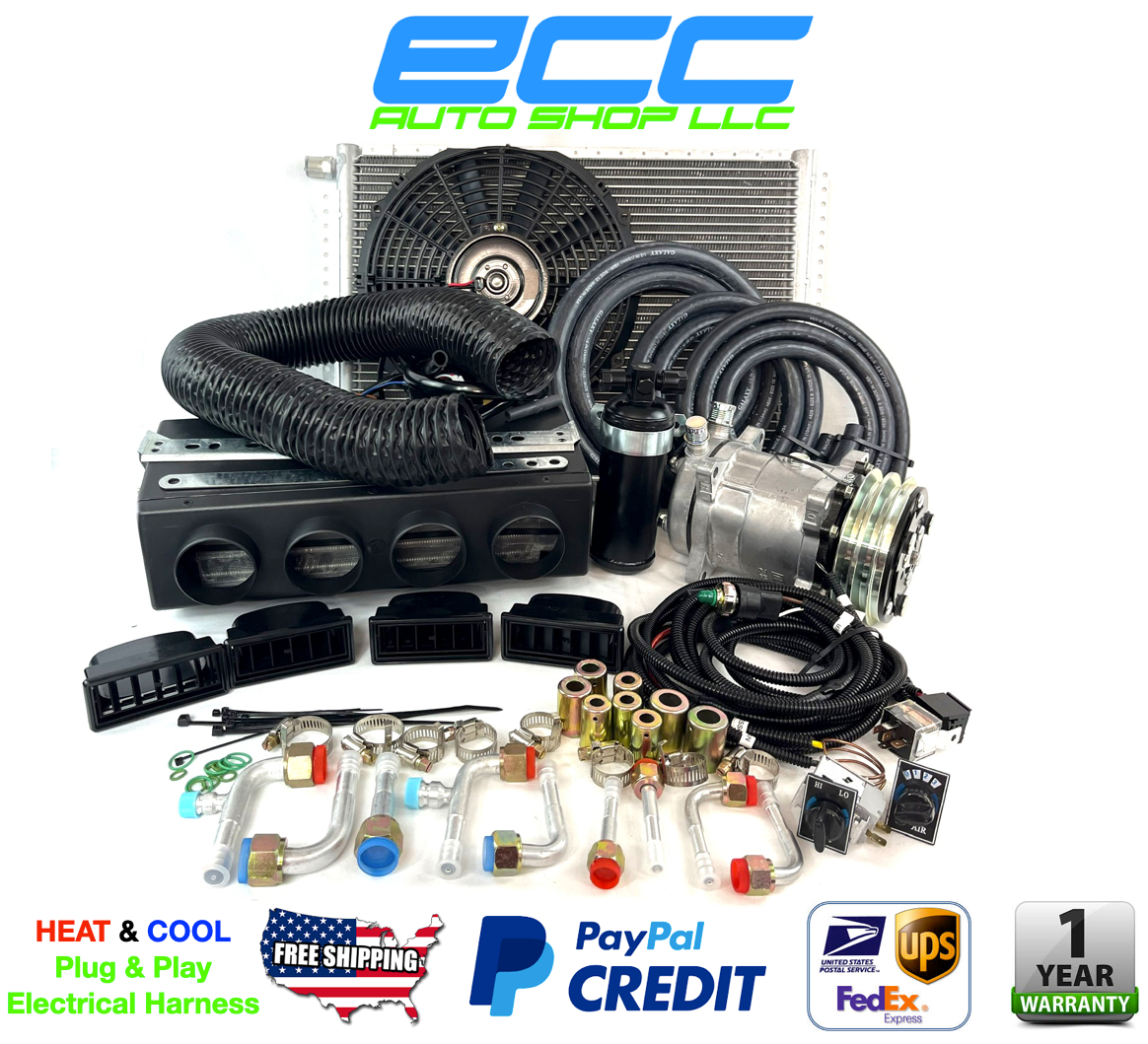
Classic Auto Air Install Experience

-
@Map63Vette - So it looks like the blower motor doesn't fit flush to the firewall with the expansion valve in the way? Did you have to cut extra holes into the firewall? Did they give you a template? Getting concerned before I pull the trigger here on the purchase. My original AC lines went through the firewall down at the bottom on passenger side. Thanks again for your write up.

View attachment 1716411071

I'll see if I can get some pictures now that stuff is all together. Harder to see all the "fun" now that the covers and stuff are on, but I'll get what I can. As for the mounting, it might be a little different for you. It sounds like you have a factory A/C car already, which I believe has a different firewall, so not sure how much help I might be as my car was factory heater only. In the end it did bolt up to the original blower motor holes and in theory no modification was required. I did have to trim my blower motor hole on the bottom for the tubes to not sit hard on the edge though as there was little chance I was getting the holes lined up without either bending the tubes or cutting the firewall. In the end I had to do a bit of both, though in retrospect I think I would have tried harder to just bend the tubes more to start with to keep from having to do any metal cutting.

The HVAC box doesn't sit flush to the firewall. What you don't see in that picture is that the bracket at the top with the two clip nuts sticks out a good 1-2". A side view shows it much better, but that bracket should fit flush on the firewall, which would give the expansion valve clearance. I didn't really have any trouble with the front to back fitment of stuff, or the left to right for that matter. For me it was all the up and down and getting the rotation right to get the holes lined up. You might be careful on the drain tube location as well, though that one is more or less a "drill to fit" anyway, so no hard and fast location for the placement. I altered mine to put the 90 degree inside the cabin so I could put the hole a little lower to clear the back of my cylinder heads.
 

Great write-up by OP - Map63Vette - Thanks for posting. I've read a number of articles and posts about the "Big 3" aftermarket kits all saying the same thing a lot of money for a kit that does NOT fit without some major modifications - engine compressor brackets don't fit or pulleys don't line up - ie: remove / cut glove box - cut new holes in firewall - blocking off passenger side fresh air vent -etc. etc.

I've installed AC i a couple of my A bodies over the years starting with a Sears under dash unit in my new 1973 Dart Sport 340 back in the day. With every one I had to do some type of "bench" engineering to make everything work. I'm just finishing up adding AC to my 1969 Dart GTS. I decided to go in a different direction because spending $2K plus for a complete system that still needs a lot of work to fit / work is not for me. I've decided to use a kit from the outfit below at less than 1/2 the cost. I'm able to fit everything under the dash. I made a modified factory heater control panel with an aftermarket radio face-plate. I'm using a B body fresh air vent for the passenger side. I'm keeping all the original parts so if I ever want to go back to original I can. I have not had to make any new cuts in the firewall or dash to make this work. I'll post more details and photos as I finish up. I also decided to go with the electric AC compressor option to avoid all the "fun" in engine bay with brackets and pulleys. I had upgraded my alternator to a new 150 amp MoPar unit for my after market sound system. You will need to if you want to run the electric AC compressor - they can draw a lot of current that a stock 40 amp alternator won't handle. The car was restored so all the engine and dash wiring is new. I'm keeping everything in the factory wire harnesses original just adding a few extra wires, fuses and relays again with minimal changes under hood. I purchased the below kit that has both AC and a heater core - but I'm not using heat as I live in Florida. If you need to run heater hoses you may have to drill holes in the firewall to fit them through. FWIW.


IMG_E8208.JPG


IMG_E8210.JPG
 
Last edited:
I saw those electric kits a while back and kind of wondered about them. I never really considered the under dash style for my car for a couple of reasons though. First and foremost was because I had my digital dash / infotainment system mounted there, so it was kind of a no-go to start with. Second was because I wasn't really using my original heater box all that well. The passenger side fresh air door pretty much never got opened because it always managed to spray petrified organic matter on me from some kind of decaying vegetation or something, no matter how long I left it open or how good I tried to vacuum everything out. I have also been missing a passenger defrost tube for years since my original fell apart, so winter was a bit interesting with only the driver side. The last one I only really found after putting the new box in, and that's that it's kind of nice to have vents blow heat on you directly. I had to modify my tunnel for my T56 and the original floor vent only just cleared it, though might have been partially compressed. It would get the car plenty warm enough eventually and I almost never ran it at full heat with the fan going as well, but having direct heat blowing on me sounds like it will be nice next winter.
 
Regarding using the CAA kit with a car that originally had AC: Yes the firewalls are substantially different. I got a template from somebody here for a plate to bolt to original AC mounting holes in the AC firewall with a correctly located hole like in a non-AC firewall. I still have the template if anyone needs a cardboard copy to make their own plate. Looks like this:
DSC04778.JPG
DSC04779.JPG

IMG_4568.JPG
 
So I think I may have found a good way to route the left driver side vent ducting to get around the steering column and wiper linkage, but there's a bit of a caveat to it. I think it will route above the instrument cluster in the space in the dash pad. There are even some holes in the dash structure I can tie it off to to make sure it doesn't fall forward into the wipers. The issue is that the hose provided in the kit isn't quite long enough to reach, so I've still got a little figuring to do. I have more than enough hose from the other vents I could probably cut and section, or I might see about making a rigid piece to go in that space above the instrument cluster and cut the hose to go on either side.
 
It looks like a TXV style system, so the valve itself should be what is throttling refrigerant flow compared to an orifice tube style, so I don't think compressor cycling is needed.
This is a misunderstanding.

TXV and clutch cycling aren't either/or, they're both-and. On its own, the TXV will keep right on doing its thing to (and past) the point where the evaporator is encased in a solid block of ice.

Every A/C system Chrysler (among many other automakers) ever put in a car had a TXV. All of them also had either a thermostatic clutch-cycling switch sensing evaporator temp, or an EPR valve (= evaporator pressure regulator, which was Chrysler's name for what's generally called an STV, suction-throttling valve).

Either thing — clutch cycling or EPR — is intended to keep the evaporator just above 32°F so water condensed from the air doesn't freeze and block the evaporator fins. An adjustable clutch-cycling switch, as used on systems that don't blend heated + cooled air in response to the temperature slider or dial, lets the driver change the cycling switch's setpoint higher than ~33°F as they move the control towards Warm. There are adjustable switches with built-in knobs for those who want driver-adjustability. Some switches that have no provision for adjustability from the driver's seat have cut-in/cut-out setscrews on the switch itself, so you can dial in the switch's performance optimally for your setup (carefully, because with two adjustments it's really easy to get off in the tall grass and way outta the ballpark). And even a non-adjustable cycling switch with no setscrews can be jiggered to nudge the effective setpoint downward for colder air in arid climates where evap frost-up is less of a concern.

And when changing a system with an EPR valve from R12 to R134a, it's smart for maximum system performance to delete the EPR valve and install a clutch cycling switch instead, because the EPR valve, calibrated for the particulars of R12, will leave several degrees of outlet air temp on the table (air won't get as cold as with a cycling switch).

All to say: if your system doesn't have a clutch cycling switch lookin' at the evap coil temp…add one. Info and switch options here (real old post; some links may be dead/some switches NLA) and here.
 
Last edited:
Okay. I think I was confusing it with the POA valve used on my 71 Vette. I think it's some variety of EPR valve on the Vette because my understanding was that it essentially bypassed refrigerant around the evaporator based on the temp, so if the evaporator was cold enough, it would limit the flow through it and I thought flow around it, but I could be wrong.

There is a thermostat switch on the CAA system. I actually heard it cycling the other day when I had the system on while idling and it was fairly cool out still, so I think I should be covered there.

I converted my Vette over to R134 and was looking for the orifice tube since people always talk about changing that when you convert, but never saw any mention of it in the parts breakdowns. That's where I learned about the POA setup. What also struck me as odd is that people convert away from the POA to an orifice tube setup, which is sort of an "inferior" design from an efficiency standpoint, though simpler in operation. You can apparently adjust the POA valve to run with R134 better, but I can't break the connections on my car to get to it and it's not worth potentially breaking it for me to get a little better performance from it.
 
Last edited:
Can do an end-run around the 'inferiority' of an orifice tube with a SmartVOV, which is more or less a TXV configured to drop in place of an orifice tube.
 
Ah, yeah. I have heard about the variable orifice tubes as another option, but never dug into it that much since I didn't have one in the Vette to begin with. That does seem like a nice option.
 
Regarding using the CAA kit with a car that originally had AC: Yes the firewalls are substantially different. I got a template from somebody here for a plate to bolt to original AC mounting holes in the AC firewall with a correctly located hole like in a non-AC firewall. I still have the template if anyone needs a cardboard copy to make their own plate. Looks like this:
View attachment 1716412225View attachment 1716412226
View attachment 1716412227
Thanks for these pics! My car is a factory AC car, so I assume I just need to make a round adapter like the one you show here for the CAA kit? Thanks again for these pics!
 
the adapter went in from the inside with two studs that used the original AC mounting holes, with a new hole in the same place as a factory non-AC blower motor. The plate on the engine side has the same 4 hole configuration as the crappy plastic one that CAA sent and covers up the firewall hole conversion. I have a template for the conversion plate if you want me to trace it out for you. Someone here did all the endless measurements to figure out how to get the new hole in the right place and sent me one for next to nothing.
 
the adapter went in from the inside with two studs that used the original AC mounting holes, with a new hole in the same place as a factory non-AC blower motor. The plate on the engine side has the same 4 hole configuration as the crappy plastic one that CAA sent and covers up the firewall hole conversion. I have a template for the conversion plate if you want me to trace it out for you. Someone here did all the endless measurements to figure out how to get the new hole in the right place and sent me one for next to nothing.
I would REALLY appreciate that. I will gladly pay shipping and whatever else. Please send me a PM. Thanks Again!
 
Send PM with your address and other contact information. I'll dig that stuff out this weekend
 
So I think I may have found a good way to route the left driver side vent ducting to get around the steering column and wiper linkage, but there's a bit of a caveat to it. I think it will route above the instrument cluster in the space in the dash pad. There are even some holes in the dash structure I can tie it off to to make sure it doesn't fall forward into the wipers. The issue is that the hose provided in the kit isn't quite long enough to reach, so I've still got a little figuring to do. I have more than enough hose from the other vents I could probably cut and section, or I might see about making a rigid piece to go in that space above the instrument cluster and cut the hose to go on either side.

A shop vac hose kit from Home Depot solved some hose issues I have had before.
It even worked for defroster hose.
A heat gun for shaping bends helps.
 
My dad had some PVC pipe laying around, and as it turns out, 1.5" pipe is pretty much just the right size for the hose to slip on to. So my plan at the moment is to cut a section of the pipe and tie it to the dash and then route hose to either side of it. I might get fancy and 3D print some 90 degree adapters on either end to make the routing a little easier yet. I'm also tempted to make those oval shaped instead of round as it is a bit tight between the side of the cluster and the heater controls, so it would save me a little space. Need to mock it up and see what it looks like.

I've been happy enough with the system so far though. Haven't had much hot weather around here yet to really stress it, but did have one day that was 85-90 for the drive home and it did pretty good. It's a bit slow to start and would probably benefit from some better baffling up at the radiator to control airflow better, but once you're moving it's nice and cold air coming out. I have one of my electric fans set to run below ~35 mph to try to help it out, but I'm not sure if it makes a ton of difference. Could also be that my idle is sagging too much and not getting enough compressor speed. I'm still working on the idle in general as it does some funny bouncing around and weird dips and surges. You can hear the thermostat cycle the system on the lowest fan speed. On the medium speed it seems to keep enough airflow to keep it from cycling. I do need to get the other vent installed though as I only really have the one blowing on me, and even though it's pretty cold, it's only so much. It was kind of nice to actually get home and be dry for a change though, lol.
 
Mostly finished out my install yesterday, aside from the work I still need to do on the center vents and controls. But at least everything is functional and in its place now. I got my glovebox reinstalled, which was a lot more work than I thought it was going to be. I didn't actually end up having to modify it at all though, so not sure if something has changed or what. They don't ship a new one anymore though, and I don't think I recall seeing anything in the instructions about it, so maybe they updated something. That lead me to a new issue though, which is that the vent hose routing that I had wasn't going to work anymore. If you route it under the glovebox, the left side hinge either catches the hose and keeps it from opening all the way, or sits under it and keeps it from closing all the way. So I had to pull the ducting out and fish it over the top of the glovebox to get it to work. Fiddly and tiring, but not awful otherwise. On the driver's side I made up my little PVC bridge tube. I cut a ~14" section and wrapped it in some foam I had laying around to keep it from rattling. I also drilled two small holes on the edge of the dash opening for the instrument cluster to tie it to. Apologies in advance for my terrible camera skills (or lack thereof). It all tucks up behind the dash pad super nice though.

20250607_125444.JPG

20250607_125503.JPG
20250607_125457.JPG

20250607_130422.JPG

20250607_130858.JPG
 
Splitting this up into a few posts since I was trying to limit pictures per post. Here are some pictures of the final install on the interior side, at least as much as I could get with everything in the way. I'll see if I can get some of the engine side the next time I have the car out of the garage. It's parked too close at the front to open the hood and get a look.

Here is my solution for the vents. I drilled some holes part way into the flanges and pressed in some neodymium magnets. They don't hold quite as well as I would have liked, but they get the job done and allow for repositioning or removing if I need to get to something behind them, like the fresh air door. Actually, with the PVC pipe routing setup, I can still open the fresh air door about halfway without having to even touch the vent, so that worked out even better than I had hoped.

20250607_133808.JPG


Not sure these pictures are going to show much or work very well, but here's the box as it's installed in my car as well as a general overall interior shot showing my center vents and the controls. I got a new bezel with the radio loop still intact that I'm planning to modify to look a little nicer and seat the vents like they should be. I also need to rework my control panel. I was originally looking into changing to longer travel potentiometers, but I think the next size up is going to be too long and there's not really anything in the middle. These appear to be ~60mm travel and the 100mm travel, while nearly perfect for the slot opening itself, wouldn't work with some of the alignment posts on the bezel. I also need to make some extensions for the levels so I can put the knobs back on the ends.

20250607_133715.JPG
20250607_133724.JPG
20250607_133732.JPG
 
Thanks for the hose routing idea and the great pictures of it! Please continue to let us know how your install turns out.
 
Little bit of an update now that the whole setup has been in the car for a while and I've gotten some miles on it. The outside vents are a little weak when it comes to airflow, but the ducting for them is probably a good 3-4x longer if not more than the center ones that are basically direct out of the box, so not much I can do about that. Still nicer than not having any at all, but I wish they were a little more even between airflow. I also learned that you better hope you passenger doesn't have hot/cold feet because the "floor vent" setup on the box does pretty much nothing to divert any airflow to the passenger side. Realistically not a big deal for me, and I might see if I can make some kind of duct that could slip on the CAA box to direct the airflow a little more like the original heater box, but it's not high priority. Along those lines, it's a shame the controls aren't a little more open ended in the sense of vent selection. The order goes "vents -> defrost -> floor" on the slider, so you can blend between vents and defrost and defrost and floor, but not vents and floor, which pretty much any remotely modern car will do. I might be able to mod that if I really wanted to get into the weeds, but in all likelihood I won't worry about it. If I actually got to that point I would have essentially no use for the CAA controller itself as I would be controlling the actuators and compressor myself. The only thing it would have left is the fan, which would probably be easy enough to make up a control circuit for. That one is also kind of tempting in its own right as the fan speeds leave a little to be desired. The lowest speed is pretty useless, at least for A/C. Might be okay for the heater though. Medium is generally where I leave it. High definitely moves the air, though is fairly noisy. It's not awful, but I do wish there was a setting between medium and high. I'm tempted to put a meter on the connector and see what it's doing. I think it's using PWM to change the fan speed since there aren't any big power resistors on the fan circuit like a lot of cars use, so would be interesting to see what duty cycle they are running for the speeds and if it's as simple as 33%, 66% and 100%.

As for system performance and comfort, I'm still reasonably happy. I can hear the thermostat cycling and haven't noticed any kind of issues with the evaporator freezing up or anything like that, though I also haven't run it super long. On the low fan speed the thermostat cycles a lot. On medium it depends on the heat load in the car and whether I'm moving or not. On high it pretty much never cycles, though it does blow a little bit less cold than I might like. I do have some issues with the cooling at idle. When I'm not moving it will definitely get a bit warmer, though it's still far better than the car used to be where it because an instant oven the second you hit a stop sign. I have a dual electric fan setup and I run one whenever the A/C is on, but I think my shroud (or lack thereof) is probably to blame here. Once you get moving the vent temps drop noticeably, so I'm working on updating my fan mounting and seeing if I can better seal them to the radiator and the radiator to the core support to force it to draw air through the condenser a little better. I suppose I could also be off on my refrigerant charge, but I haven't really dug into that one yet. The instructions called for 24 oz and I just dumped two 12 oz cans in as best I could. Entirely possible I could be 1-2 oz low or something if the cans didn't fully empty. I've had the car out running errands in temps from 80-95 or so (if you can believe the random temperature displays around town) and was never "uncomfortable" like I would have been in the past. It wasn't like sitting in a refrigerator or anything like that, but it's significantly more pleasant to be in than it was before. I still need to work on my idle tune as I have some stability issues there, but overall I'm still happy enough with the system and glad I finally pulled the trigger on it. I've got some engine bay pictures I'll post up as well showing the final install once I get them off my phone.
 
Here are some quick pictures I grabbed from the engine bay the other day. Unfortunately they don't show a lot as it's hard to get a camera in some of the places without taking parts off. Will hopefully at least give a general idea of my setup at least.

Overall engine bay:
20250614_155215.JPG


The absolute mess of hoses at the firewall, lol:
20250614_155220.JPG


Receiver/dryer mounting:
20250614_155225.JPG


Then a couple of my condenser mounting and what plumbing you can see:
20250614_155232.JPG

20250614_155247.JPG
20250614_155237.JPG


You can kind of see where my condenser is bolted on the inside of the radiator hardware. The shiny bolts hold the condenser, the rusty ones outside those are for the radiator. So I can actually pull my radiator and leave my condenser in place if I needed. I wrapped several edges and sections of the hard-line in rubber hose to try to protect again rubbing through.
 
Wow, lots of information to read through.
I've been considering adding a/c to my 67.
Just priced it for a bb at $2,500, ouch!
I hear they also sell universal kits.

Met a guy on Power Tour from California that added it to his 67.
Not satisfied with the supplied control valve on only 1 heater hose, he added a manual ball valve to the other heater hose, said it dropped the a/c temp 10+ degrees.

20250613_120026.jpg


20250613_120333.jpg


20250613_120213.jpg


20250613_120206.jpg


20250613_120008.jpg
 
That's interesting on the second valve. It shouldn't really make any difference if the one valve is working correctly as you would think it would prevent flow either way. You would get some conductive heat transfer through the fluid, but you would probably get that through a closed valve as well. I wonder if his valve was leaky or something and letting flow through.

I messed with my center vent output some more this week and finally cut down the center trim bezel I bought a while back to get things closer to being mounted for real. I think moving those vents from under the dash to where the radio would normally go was probably one of my better decisions as it really does help get the air on you and up into your face when it's really hot out. If they were all down low I would think it would struggle to get more flow on your upper torso, and that's where a lot of sunlight hits you to warm you up. Will try to get some pictures once I get it mounted for good. I also redesigned a heater control plate to mount like the original one behind the bezel. Ordered it this weekend from SendCutSend, so will hopefully see it in a week or two to get the interior fully buttoned up. This setup would get rid of all the original levers so you just operate the CAA slider controls directly. The main downside is that you don't get the full travel of the slot anymore, but it also means you don't have to modify the original parts either, so I consider that a win.
 
There is so much good info in this thread I'd have to take notes and study to install a/c in my car.

I never thought even a specific make/model Mopar kit would be bolt in and done, but I just priced it for my 67 bb and it's $2,499!

I'm looking at my 1988 S10 and wondering if it would be easier/cheaper to rip the a/c out of it and put it in my 67.
 
I'm looking at my 1988 S10 and wondering if it would be easier/cheaper to rip the a/c out of it and put it in my 67.

I have a box out of '98 (or similar) Ram that I plan to mock up at some point. It's been done in an A-Body once or twice, but I don't yet have a clear idea if it impinges on the throttle pedal. But it is another idea.

Here's a thread, but you will have to read through it, I don't have specific posts that would help.


I could see me going aftermarket in the end, but not until I see how this one fits. And it is a someday project right now, for me.
 
There is so much good info in this thread I'd have to take notes and study to install a/c in my car.

I never thought even a specific make/model Mopar kit would be bolt in and done, but I just priced it for my 67 bb and it's $2,499!

I'm looking at my 1988 S10 and wondering if it would be easier/cheaper to rip the a/c out of it and put it in my 67.

I think the main compelling reason I had to use the CAA kit was that I really liked the way they set up the tubes to go through the old blower motor hole in the firewall. That didn't work out quite as nicely as I would have hoped, but it does still at least limit the amount of connections you have to make. You could potentially make any number of boxes fit under the dash I would guess, but you might have to do a short hose from the box to a bulkhead fitting on the firewall and then another hose from that bulkhead to wherever it needs to go in the engine bay. Not necessarily difficult by any means, just more stuff. It could be quite interesting to try to tighten a short jumper hose like that when it's all up under the dash and against the firewall, but it would all come down to where the attachment points on the box are to start with. Otherwise you might have to attach the hoses while the box is loose, then try to mount it up.

I at least had the advantage of a modern engine that was designed to have a compressor on it from the get-go at least. A lot of the issues I've read about with the CAA stuff tends to revolve around pulley, belt, and bracket issues and not so much the cabin side. I pretty much dodged all of that because the compressor mounts directly to the timing cover and it's a single serpentine belt, so no alignment problems to worry about. My engine partially covers the blower motor hole though since the heads are so wide in the bay, so that was my bigger challenge. If I really wanted to, I could move my coils under the intake and run wires to give me some more clearance. The ModMan intake I have is actually set up to run them that way, but I'd have to source some wires to make it work and the valve covers would look a bit funny with the coil mounting stubs on there and nothing mounted to them. I could go aftermarket covers and get back to having a real oil fill hole though, which is a bit tempting now that I think about it. I do kind of like the look of the direct mounted coils though.
 
-
Back
Top Bottom