Hi, what gauge wire is on the capacitor that goes to the positive terminal on the coil? I had to relocate the coil on my 72 Valiant to a more accessible spot. Need to splice and solder a new extension wire to original to reach it.



You are using an out of date browser. It may not display this or other websites correctly.
You should upgrade or use an alternative browser.
You should upgrade or use an alternative browser.
Gauge wire on 2884870 noise suppression capacitor
- Thread starter Maddog55
- Start date
-

4spdragtop
Well-Known Member
I believe its 16.

Many of those noise caps had a small gauge steel or tin wire under the casing. The cap can be relocated. Some models would have it mounting with ecm on their firewall.

Vaanth
Well-Known Member
Hi, what gauge wire is on the capacitor that goes to the positive terminal on the coil? I had to relocate the coil on my 72 Valiant to a more accessible spot. Need to splice and solder a new extension wire to original to reach it.
View attachment 1716461107
View attachment 1716461108
The original wire size for the radio suppression capacitor is 18 gauge.
The capacitor can be mounted next to the new coil location if possible to retain the original connection as long as the body remains grounded, or connected anywhere convenient in the Ignition Run circuit.
In the latter 1970s, the capacitor was integrated into the wiring harness and mounted to the firewall.
As an example, the following image shows the capacitor mounted with the voltage regulator on my 1977 Fury. The tan wire connects to the Ignition Run blue wire in the molded connector.
Another connection method at the auxiliary resistor for the power feed to the electronic control unit (ECU) is shown with the capacitor in the following image:
Last edited:

You can just ditch it with no consequences. Is it even functional after 50 years?
I was thinking along the same lines.You can just ditch it with no consequences. Is it even functional after 50 years?

For the cap to be effective, AKA radio noise supression, the wire should be short. Mount it by the coil. You relocated the coil, mount it under one of the coil bracket bolts. You can buy generic replacements, if you can find a parts guy who knows "anything."
The longer the wire, the more it acts like an antenna. It's called inductance. At VHF/UHF equipment, a bypass cap lead length of almost nothing is too long
Also believe it or not, it may have SOME effect on the spark, as it provides a somewhat low Z (impedance) path to hold the coil positive at pulse ground potential. That is part of the reason it's necessary for the radio---the ignition run wire itself becomes an antenna to radiate ignition pulses
The longer the wire, the more it acts like an antenna. It's called inductance. At VHF/UHF equipment, a bypass cap lead length of almost nothing is too long
Also believe it or not, it may have SOME effect on the spark, as it provides a somewhat low Z (impedance) path to hold the coil positive at pulse ground potential. That is part of the reason it's necessary for the radio---the ignition run wire itself becomes an antenna to radiate ignition pulses

Get a multimeter with capacitance testing, you would be surprised how many test good.
As for wire size... 18 or 20 awg should do fine.
If you have a section you can do this with....
One strand measures 0.010" OD
In the chart 0.010"OD wire equates to 30 AWG solid (S)

Then look for AWGs around where I you think it is
You strand count was 16
16 strands of 30 AWG, equates to 18AWG

Sometimes it does not come out exactly but let's say you have 17 strands of 30 AWG I would call it 18 AWG as well.
As for wire size... 18 or 20 awg should do fine.
If you have a section you can do this with....
- Pull out ALL of the strands from a short section. Count the number of strands
- Then with a caliper or micrometer measure the OD of the wire.
- Go to Wire Gauge Table | Calmont Wire & Cable and look up what your single strands AWG is
- Next look at various AWGs for the single strand AWG and the number of strands.
One strand measures 0.010" OD
In the chart 0.010"OD wire equates to 30 AWG solid (S)
Then look for AWGs around where I you think it is
You strand count was 16
16 strands of 30 AWG, equates to 18AWG
Sometimes it does not come out exactly but let's say you have 17 strands of 30 AWG I would call it 18 AWG as well.
"Get a multimeter with capacitance testing, you would be surprised how many test good."
I actually try to discourage this, unless you know EXACTLY what you are up against. YOU CAN NOT TEST caps with a multimeter, and the ones which read capacitance value ARE NOT ACCURATE unless the cap has been first tested for leakage. Leakage is a dead end issue, and worst, it tends to cause the capacitance value to falsely read high. Of the old outboards I get into, I would guess I garbage 80% or more of the caps because of leakage.
This old military ignition tester I scored electronically drives coils so you can test and evaluate them, performs a high voltage capacitor leakage test, and measures cap value
Arguing with Egag over outboard mag coils
Merc-o-Tronic testers are very much sought after. This one is an oddball, a Bruno 403. Wish I could find another for "backup."
I also have an old Eico cap tester as well as an early Heathkit one. I re-capped one or the other, don't remember. They use a "bridge" and null circuit for value, and that is not terribly accurate. BUT THEY have a variable voltage leakage test and that is the main reason I keep them around.
The other issue, nowadays, is quality automotive caps. china. crap. yup.
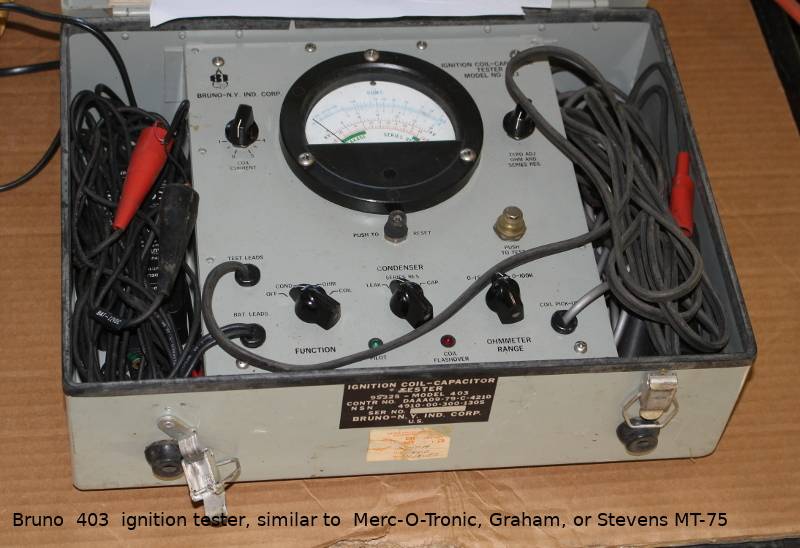
I actually try to discourage this, unless you know EXACTLY what you are up against. YOU CAN NOT TEST caps with a multimeter, and the ones which read capacitance value ARE NOT ACCURATE unless the cap has been first tested for leakage. Leakage is a dead end issue, and worst, it tends to cause the capacitance value to falsely read high. Of the old outboards I get into, I would guess I garbage 80% or more of the caps because of leakage.
This old military ignition tester I scored electronically drives coils so you can test and evaluate them, performs a high voltage capacitor leakage test, and measures cap value
Arguing with Egag over outboard mag coils
Merc-o-Tronic testers are very much sought after. This one is an oddball, a Bruno 403. Wish I could find another for "backup."
I also have an old Eico cap tester as well as an early Heathkit one. I re-capped one or the other, don't remember. They use a "bridge" and null circuit for value, and that is not terribly accurate. BUT THEY have a variable voltage leakage test and that is the main reason I keep them around.
The other issue, nowadays, is quality automotive caps. china. crap. yup.
Last edited:
The capacitors were probably more important in the days of AM radio……

Mattax
Just the facts, ma'am
Now find an SAE wire gage chart.Get a multimeter with capacitance testing, you would be surprised how many test good.
As for wire size... 18 or 20 awg should do fine.
If you have a section you can do this with....
Example...
- Pull out ALL of the strands from a short section. Count the number of strands
- Then with a caliper or micrometer measure the OD of the wire.
- Go to Wire Gauge Table | Calmont Wire & Cable and look up what your single strands AWG is
- Next look at various AWGs for the single strand AWG and the number of strands.
One strand measures 0.010" OD
In the chart 0.010"OD wire equates to 30 AWG solid (S)
View attachment 1716461164
Then look for AWGs around where I you think it is
You strand count was 16
16 strands of 30 AWG, equates to 18AWG
View attachment 1716461169
Sometimes it does not come out exactly but let's say you have 17 strands of 30 AWG I would call it 18 AWG as well.
IIRC SAE wire uses less but larger strands for the same diameter as stranded AWG resulting in slightly less density. Or maybe its just over all slightly smaller diameter. Maybe close enough for most purposes but either way its a hair smaller when crimping.
Last edited:
LOL you guys are acting like the wire gauge is important. The larger the wire, the less the inductance, and as the RFI frequencies go up, larger wire will be better. But in this application, I bet you can't MEASURE the difference between 20 and 16
-
Similar threads


- Replies
- 1
- Views
- 288

- Replies
- 6
- Views
- 494

















