Getting Dad his <12.99

-
Sorry I went silent, I had a little setback:

20250623_124447.jpg


Apparently I was wrong when I said I got the car to dead hook once before. I found a good piece of asphalt and the car hooked for real this time, picked up pretty good, and took off harder than ever... then ~50' later the all too familiar sound of parts breaking came! Oops!

I'll chalk this up to $4!+ happens. My dad had bought this 3rd member used and I just put new bearings, seals, and clutches in it, double checked the pattern, set the bearing preload, and all *seemed* well (I've set up a few dozen ring & pinions before.) For all I know, it could have come out of a bazillion horsepower car.

Since I'm buying new gears anyway, I'll go to 4.30's since that's what my dad really wanted. It should help a tiny bit with reducing wheelspin off the line (which may not be a problem afterall!) and it'll give a little more wiggle room with rpm if the car ends up running faster than I've been planning for.
 

Sorry I went silent, I had a little setback:

View attachment 1716421961

Apparently I was wrong when I said I got the car to dead hook once before. I found a good piece of asphalt and the car hooked for real this time, picked up pretty good, and took off harder than ever... then ~50' later the all too familiar sound of parts breaking came! Oops!

I'll chalk this up to $4!+ happens. My dad had bought this 3rd member used and I just put new bearings, seals, and clutches in it, double checked the pattern, set the bearing preload, and all *seemed* well (I've set up a few dozen ring & pinions before.) For all I know, it could have come out of a bazillion horsepower car.

Since I'm buying new gears anyway, I'll go to 4.30's since that's what my dad really wanted. It should help a tiny bit with reducing wheelspin off the line (which may not be a problem afterall!) and it'll give a little more wiggle room with rpm if the car ends up running faster than I've been planning for.

If that happened in 1st, pull the trans and check the sprag.
 
Sorry I went silent, I had a little setback:

View attachment 1716421961

Apparently I was wrong when I said I got the car to dead hook once before. I found a good piece of asphalt and the car hooked for real this time, picked up pretty good, and took off harder than ever... then ~50' later the all too familiar sound of parts breaking came! Oops!

I'll chalk this up to $4!+ happens. My dad had bought this 3rd member used and I just put new bearings, seals, and clutches in it, double checked the pattern, set the bearing preload, and all *seemed* well (I've set up a few dozen ring & pinions before.) For all I know, it could have come out of a bazillion horsepower car.

Since I'm buying new gears anyway, I'll go to 4.30's since that's what my dad really wanted. It should help a tiny bit with reducing wheelspin off the line (which may not be a problem afterall!) and it'll give a little more wiggle room with rpm if the car ends up running faster than I've been planning for.
Don't forget to at least consider 4.10's. I swapped from a 4.56 to a 4.10 and make the same 60' with faster 1/4 mile times. You want to look at shift points and the average time spent at the highest hp levels.
 
If that happened in 1st, pull the trans and check the sprag.

It did happen in 1st. I wouldn't have even considered doing that before, but now that I've looked into it, you've got me spooked. How exactly does the rearend failure damage the sprag, and is there any way to inspect/test/verify for damage without pulling the trans?

If nothing else, you've got me thinking that a trans blanket needs to be on my short list.
 
It did happen in 1st. I wouldn't have even considered doing that before, but now that I've looked into it, you've got me spooked. How exactly does the rearend failure damage the sprag, and is there any way to inspect/test/verify for damage without pulling the trans?

If nothing else, you've got me thinking that a trans blanket needs to be on my short list.
How does a sprag work
 
It did happen in 1st. I wouldn't have even considered doing that before, but now that I've looked into it, you've got me spooked. How exactly does the rearend failure damage the sprag, and is there any way to inspect/test/verify for damage without pulling the trans?

If nothing else, you've got me thinking that a trans blanket needs to be on my short list.

A blanket won't likely contain the mess if the drum goes. There are a lot of pictures of cars messed up that had blankets that didn't exactly work great.

If it broke in first and the engine revved, take the trans out and inspect it. PERIOD Nice car that I wouldn't risk the alternative detrimental outcome.
 
If it broke in first and the engine revved, take the trans out and inspect it.
What about if the engine did not rev, would there be any reason to suspect an issue?

The engine did not freely rev when it happened, I heard/felt crunchiness and immediately lifted off the throttle and got in the brakes (still had my left foot hovering over the brake pedal.) I quickly brought it to a complete stop and gave a brief damage assessment (engine idling, no trail of parts/oil, driveshaft not hanging down, car shifted to drive and reverse, etc.) Even with that much damage to the gears, the car was still able to drive to get me to the side of the road (where I then got more clunking and popping), and back into the garage (with some more clunking and popping) after the tow truck set it down in my driveway, so all of that carnage wasn't from one "kaboom" moment. Total distance traveled was less than 100' after breakage and I'd wager that the majority of the broken teeth happened just from circulating whatever broke initially, while on the brakes and/or during the 2 short distances that I moved it under (minimal) power.

From what I'm reading, the risk of sprag damage is mostly due to high revving in gear with no load (from a broken driveshaft, axleshafts, completely stripped gears, etc.) and may not apply to this specific scenario?
 
First post in the racer's forum. Sorry, I'm kinda long winded... some backstory first:


The last conversation I had with my dad before he passed, he asked me to get him a "...12 second time slip, gotta be a 12.98 or better (because a 12.99 could be a flickering 13.00!)... no nitrous!" in his '71 Demon. I took it to the car show he'd been working towards getting ready for while it was still stock appearing and I've been picking away at getting it track ready ever since.

My goal has been to set the car up the way I think he'd want it and use the engine as he built it, so I've been trying to get the converter/gears/tires/suspension to work the best that I can around it. He wanted it to go down the track at least *looking* like it would have if it were a daily driver/family car.

Some basics:
1971 Demon
340 with ~1,000miles on it
.030" overbore w/JE forged pistons 10.5:1 c.r.
MP 292/.508 cam
OEM iron heads w/2.02 intake valves, "gasket matched" and minor bowl work
6 pack from a TA Challenger
TTI stepped headers w/3" collectors and 18" collector extensions
MP electronic ignition, 35° total advance
TF727 w/B&M shift kit (will be manually shifted at ~5800-6000rpm)
Dynamic 9.5" ~4,000 stall torque converter
8 3/4 rear with 4.56 gears and a Suregrip with all thick clutches

275/60/15 Mickey Thompson ET Street R on 15x8 rally wheels
Dr. Diff inboarded spring hangers
Calvert split mono leafs mounted in the upper hole along with 3/4" lowering block
Caltracs bars mounted in the upper hole with 1/6 turn preload
Viking double adjustable shocks front & rear
Slant 6 torsion bars
front swaybar removed

I have not weighed the car but if the factory weight of ~3200lbs was accurate, it should still be right about there. I'm ~190lbs

I've never run on a drag strip. I'd like to get as dialed in as I can before taking it to Famoso as I'd *really* like to hit his time on the first outing... ideally the first pass. I'm still playing with rear shock settings, tire pressure, and what rpm it leaves from the best. I'm still having trouble getting it to hook, while I have access to flat farm roads with good asphalt... they're dusty. Does it sound like my combination should hit the desired 12.98 (or better) assuming I don't screw it all up as a driver? The time and expense of taking it to the track doesn't come easy for us, does it sound like I've reached a point that I just need to take it and see what it'll do? Any glaring issues you feel I need to address first?

View attachment 1716414322

View attachment 1716414323
Yeah should run in the 12s easy enough. Good luck and keep us updated.
 
The rapid loading and unloading of the sprag is what can hurt them. There is no true way to tell without pulling it out. I rolled a sprag. It cracked the case in boss where the sprag sits. It crushed all the springs and posts and broke two rollers in half lengthwise. I had to press the drum out because the rollers were jammed tight. If it would have released, it would have exploded. I back off the line because it was acting funny. It the drum is allowed to freewheel, it will spin approx 2 1/2 times engine rpm. Don’t play around, pull it out and check it. It is NOT hard to pull the guts out and look at it. Dont be intimidated by a 727. To access the sprag you will only disturb two settings. The bands, which are easy to adjust. Everything else comes out as components that can go right back. Pictures pictures pictures as it is before you pull parts out.
 
There are a ton of tear down videos on youtube for a 727.

Better safe than sorry.
 
4.10s would be my choice.You don't need a lot of gear with that converter. Better be ready to grab second quickly either way. Love the car and please take John up on his offer at the track.
 
Actually mine would probably not have exploded. It has low band apply.
 
I've been reading up and watching videos on the potential issues of the 727, especially after a downstream drivetrain failure. As much as it feels like a stick in my spokes when I was *so close* to being ready for the track, I'm conviced that a tear down would be in my best interest.

The bummer is that means I won't likely be able to meet up with John at Famoso in September. I'm not the most able bodied person anymore, so things that used to be a weekend project are now more like a months long project. Pulling the trans out of the car will definitely be a time consuming challenge for me, I think I had the car down for a couple months when I changed the converter. With the amount of physical effort it will take me just to r&r, it makes sense to go ahead and make any other worthwhile changes while it's out, in the name of future-proofing.

A billet steel front drum and 16 roller bolt in sprag are on the short list, along with a RMVB with low band apply and I might as well go with a trans brake at that point. I know that probably seems unnecessary for a 12 second car, but making those changes all at once is more time/cost effective than adding them later. What are the other must-do's while it's apart? Being limited on workspace, and to an extent time, there's a high likelihood that I'll have someone build a transmission for me. I see CRT and A&A transmission talked about on this forum, is there a shop that's considered the go-to for a 727 build?

I understand where you guys are coming from with the suggestion for 4.10 gears and I would mostly agree that they would have minimal change in 60' times vs 4.30 or 4.56, but I think 4.10 will have the engine revving below its sweet spot in 3rd at what I've been anticipating my ballpark mph to be which would be leaving some on the table. I've been crunching numbers to see what different ratios would look like with and without a low ratio 1st gear, and while I think that would be nice for street driving (3.91 with low 1st) it likely won't help at the big end of the track at my *current* hp level... but once again, would it be worth considering (cost aside) in the name of future proofing?
 
I got the rearend back together yesterday. Besides the obvious ring & pinion failure, I found a broken cross shaft in the SureGrip. I replaced all the bearings and ALL the guts of the SureGrip and used the normal thinner outer clutch discs this time. The new style one piece side gears made assembly much easier than the old 2 piece. I used new LH case bolts this time too.

I don't know what it is about 4.30 gears, but the 2 sets I've installed (this axle and a Dana 60) have required more pinion depth shims than what I'd consider normal. It took me 7 setups to get one I liked, but everything looks acceptable now.

I needed to get the car turned around in my garage to get started on the tranny, so after much contemplation, I started it up and drove it around the block. Images of holes in the floor, fires, and bits scattered everywhere from an exploding front drum were running through my head for the entire 1/3 mile trip, but the car made it back in the garage in one piece. :p

I've had plenty of time to think about it and weigh my options, so with the rear axle done, I made another call to A&A and finalized my order this morning. They'll be building me a complete "Super Competition" 727 with (almost) all the bells and whistles. http://www.aandatrans.com/Products/Super-Competition-727-Small-Block-Steel-High-(1966-Up)__22003ABS.aspx I decided against the low first gear set, but am sticking with the billet steel drums, 16 roller sprag, RMVB with trans brake, everything on bearings, and several other niceties. This should hopefully last under anything I can throw at it with my current horsepower, and any amount of power I could ever see this car having.

As far as my current transmission, I'll hang onto it for future tear down... who knows? It could be fine!
 
Last edited:
From other guys and what I've read there is NO WAY, from that damage, that I would NOT inspect the trans, the sprag. You don't need all that much to get to the sprag in tools. Biggest thing is a pair of flat nose external ring plier for the big ring in the tail housing. That is the one under the small external cover. Sometimes you need something to work the pump loose. Some guys just loosen the pump bolts and then bang the guts against the pump or prying against the drum inside from the pan opening.

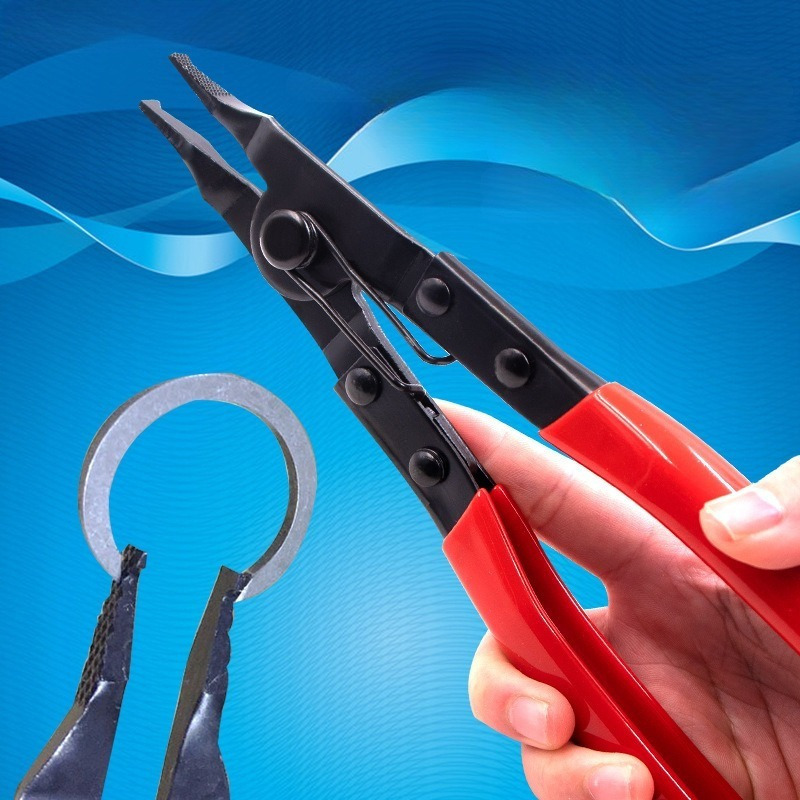
Make sure you get a pair of pliers with enough opening range, I have one that "don't." Sorry, I don't remember what those were.

1726713526809-8693f8bd86194e7cb07f893c88d4b0a4-goods.jpeg


There are lots of Yewtoobe vids, and several good books.

Start with the service manual. If you don't have one, they are free over at MyMopar.com.

The old book I got is great,

Torqueflite A-727 Transmission Handbook HP1399: How to Rebuild or Modify Chrysler's A-727 Torqueflite for All Applications|eBook

Torqueflite A-727 Transmission Handbook HP1399: How to Rebuild or Modify Chrysler's A-727 Torqueflite for All Applications by Munroe​


More lately an excellent book by a member here,

How-To Rebuild Trans Book, Chrysler TorqueFlite​


by Tom Hand
 
Last edited:
Draining it. I do things different. I didn't have a pan plug, so pull the thing with an old slip yoke to avoid a mess. then when you get the assembly off the engine, pull the converter, then just hoist it to vertical, tail down, with a big pan under it, and at some point yank the yoke out, drain as much as you an from out of the tail


-
Back
Top Bottom