
Head Issues, Scrap them? Save them? Thoughts?

-

superdart360

Well-Known Member
Joined
May 9, 2007
Messages
72
Reaction score
6
Location
Washington State
So it's been about a year of fighting with these heads. Had them on and off the car 3 times. At this point i'm not sure what to do with them. Need some advise here.

So the deal is I bought these heads a year ago. Took them to a engine shop to check them out and assemble them. they are 71J Heads for my small block 360. 1st time installing everything went well. Engine fired up, ran smooth no valve noise or anything to be concerned about. Then I took it for a drive pulling a hill the car down shifted RPM's hit about 3500 and instantly vave noise.

Towed it home had a bent / stuck valve no other damage. So I brought the heads back to the shop for them to check it out. And they found that they head the wrong springs on the heads..... So I paid for new springs and pushrods and they took care of the labor and paid for all new valves, valve guides, retainers, keepers. So I thought that because of the low spring pressure the valves started to float and that one got whacked.

So just recently I got the heads all fresh all new hardware ready to go. put it all together. Fired right up, ran great. ran it around town just fine. Took it for a longer ride and same thing soon as I hit 4000rpms same sound, same exact valve bent. I originally had the heads built to fit the cam spec. 540 lift. I am not a engine guru I trust people at the shops to help me out in that area. But at this point I am up for some advise.

Also financially at this point I can't keep dumping tons of money into a complete new set up heads. I still have the stock heads but I would also need to put the stock cam back in.

Anyways so Same valve both times. Also have Harland and Sharp roller rockers on them. Maybe just bad luck?

Thanks for any help.
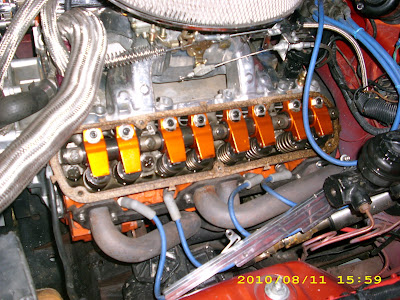
DSCI0057.JPG


Damaged valve is 5th one from the left.
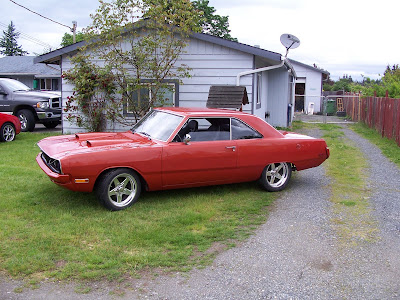
larry%20134.jpg
 
The guilds are too tight, nothing about the springs being weak...unless the camshaft is install like one tooth off.

Hard to believe the shop messed up the same guild, I would look in to the cam timing.
 
Valve to piston clearances were evedently not ck'd or ck'd incorrectly.....after the 1st go around a thicker head gasket would have fixed the problem IMHO. Who was responsible for putting the motor together and ck'ing clearances....??????

Rickster
 
I was just told it would not be a problem with the stock bottom end because the factory pistons had plenty of clearance. And if that was the problem wouldn't it happen to other valves as well? I am learning this stuff the hard way.

And as far as cam timing I will look into that. That would make sense to me as it is happening to the exact same valve.

Thanks for the help.
 
That's not true. The stock 360 pistons sit what is it yall....like .080" in the hole at TDC? somethin like that. You got a .540 lift cam. withno valve reliefs....do the math. Does seem strange that it was the same valve.....lends some believability to the tight guide.
 
need more info before you say the valve hit the piston...

like duration at .050....lobe separation angle...? ....was it advanced or retard or straight up?

also...if he pulled the head for repairs ..and the valve hit the head...there would be a nice eyebrow on the piston to look at...

is it a hydraulic or solid cam?
 
That's not true. The stock 360 pistons sit what is it yall....like .080" in the hole at TDC? somethin like that. You got a .540 lift cam. withno valve reliefs....do the math. Does seem strange that it was the same valve.....lends some believability to the tight guide.

it is a 1990 block, lower compression block than 70's 80's.

When I had the heads off and brought one of the pistons to TDC it was near 1/2 inch from the top of the cylinder. It is not a magnum block though. that didn't happen I think until 92 for the 360's.

I would guess guide as well but its hard to believe that after I just had a new set put in. The new springs are 220 lbs springs. They should not be having a issue pulling the valve back up quickly.

Thanks.
 
need more info before you say the valve hit the piston...

like duration at .050....lobe separation angle...? ....was it advanced or retard or straight up?

also...if he pulled the head for repairs ..and the valve hit the head...there would be a nice eyebrow on the piston to look at...

is it a hydraulic or solid cam?

cam specs .520-.544 lift 222*-228* @.050.
Hydraulic roller cam
Last time this happened the piston had a very small eyebrow in it.
Timing was 14 advanced.
 
yeah... thats the issue. I drove the car marbe 20-30 miles the first time before it happened, and this time about 5 miles. There was no issues until higher RPM. So either the valve is getting bound up in the guide and the piston is smacking it.

Also another note to make is that this only happens under a load. I was able to rev the car 5500 with no issues.
 
Have you checked your rocker to valve contact at full lift? Do your rockers clear the retainers/springs
 
Don't see why load makes a difference , unless its very very close to making contact.

When I asked about timing, I meant camshaft timing.The more advance the cam is, the more likely the valves will hit the pistons.

As for the ignition timing, you should be checking the total timing, not at idle. You want around 35 degrees without vacuum advance.
 
If the cam timing is correct, or even close, you should not have the valves anywhere near those pistons. IMO, the heads were screwed up the first time and it wasnt the springs. Was it an intake of exh valve that stuck? What needs to happen is another shop (because this one is a gamble) needs to disassemble the heads, checking stem to guice clearance, retainer to guide clearance, spring seat depth/installed height, and seat concentricity. What was done to the guides when the heads were first done?
 
it is a 1990 block, lower compression block than 70's 80's.

When I had the heads off and brought one of the pistons to TDC it was near 1/2 inch from the top of the cylinder. It is not a magnum block though. that didn't happen I think until 92 for the 360's.

I would guess guide as well but its hard to believe that after I just had a new set put in. The new springs are 220 lbs springs. They should not be having a issue pulling the valve back up quickly.

Thanks.

My apologies. Didn't pay attention to the year model.
 
This almost has to be that guide seizing up. If it was a timing issue, you'd see eight bent valves and eight eyebrows. You've only got one eyebrow and it's on an exhaust valve. Evidently, they just didn't get that guide right.....twice. stranger things have happened.
 

it is a 1990 block, lower compression block than 70's 80's.

When I had the heads off and brought one of the pistons to TDC it was near 1/2 inch from the top of the cylinder.


Not that it will help with your problem but are you sure about the "1/2" for the piston in the hole?

That would make for about a 5:1 static compression ratio and it sounds like the cam you have is pretty big making for a real low dynamic ratio. Can't imagine how the engine would make any power.
 
Tight guide \\\ exhaust valve sticking when under load because of the heat.
 
I wanted to follow up with this thread to post that the problem was finally resolved after 4 different shops worked on the heads. This is how the shop explained it to me, I am posting this hoping it will help someone that ever may be in a similar situation.

The 71J Heads were designed for a flat tappet cam. My block has a roller cam in addition to that it has a 540 lift with 1.6 ratio rockers putting it around 570. So the biggest difference between the two cam styles is the angle of the lobe. Flat tappet have a nice rounded top and the roller has more of a point, triangular. So when I originally had the heads built they put 220lb springs that would have been great for a flat tappet style cam. This continued to get overlooked until the last shop.

They did the math and said that the factory spring pressure for the stock heads was in the 300lb range and that with this more aggressive cam it needed to be around 335 - 350lbs.

They called it lofting the valve. Meaning where the roller comes up one side and almost jumps of the tip of the cam and lands back down.

The possible reason it was consistent to one area on the head was do to the machine work done previously where the heads where shaved slightly lower on one end and the valves where not even also.

So anyway this took about a year to figure out and lots of money. So I hope it helps someone.

Car runs great now!
 
So the biggest difference between the two cam styles is the angle of the lobe. Flat tappet have a nice rounded top and the roller has more of a point, triangular.

If this is the way the shop explained it, they are dead backwards. The roller has the rounded lobe and the flat tappet has the peak. Glad you got the car running good, though.
 
............Wow, but i'm glad u got it figured out.......but u have the lobe info backwards....did each machine shop have all the info from u or only bits and pieces along the way, cause they cant set up the heads right with out it....kim........
 
I wanted to follow up with this thread to post that the problem was finally resolved after 4 different shops worked on the heads. This is how the shop explained it to me, I am posting this hoping it will help someone that ever may be in a similar situation.

The 71J Heads were designed for a flat tappet cam. My block has a roller cam in addition to that it has a 540 lift with 1.6 ratio rockers putting it around 570. So the biggest difference between the two cam styles is the angle of the lobe. Flat tappet have a nice rounded top and the roller has more of a point, triangular. So when I originally had the heads built they put 220lb springs that would have been great for a flat tappet style cam. This continued to get overlooked until the last shop.

They did the math and said that the factory spring pressure for the stock heads was in the 300lb range and that with this more aggressive cam it needed to be around 335 - 350lbs.

They called it lofting the valve. Meaning where the roller comes up one side and almost jumps of the tip of the cam and lands back down.

The possible reason it was consistent to one area on the head was do to the machine work done previously where the heads where shaved slightly lower on one end and the valves where not even also.

So anyway this took about a year to figure out and lots of money. So I hope it helps someone.

Car runs great now!
This i some great news :cheers: It did and will :happy2::happy1:
 
Id like to see the push rod hole to push rod clearence.
Early heads arent opened up for the amount of travel/angularity that the roller cam puts the push rod at.
Its not bad with a hyd roller because of the cup height , but with a solid roller ...u will need to grind the push rods holes larger.
 
It aint cam timing because the same cam operates ALL the valves, so you'd likely have it in multiple cylinders if that were the case. I'd take a good hard look at the piston/ valve clearance as wellas the rest of the valve geometry.
 
-
Back
Top Bottom















