Help me improve my brakes

-

Dodgeboy68

Active Member
Joined
May 22, 2011
Messages
29
Reaction score
39
Location
Benbrook, Texas
This is about the 68 dart in the avatar. This was a slant six car i bought in 2007 and did a partial restoration on it. Put a 440 in it and converted all the drive line to heavy duty v8 stuff. Converted the light duty slant six brakes to a set of disc brakes that came out of a 73 dart. The car has just 73 dart manual disk brakes with no upgrades.

What I am dissatisfied with is that it takes a lot of pedal pressure if you want to stop the car quickly. It has a hard high brake pedal but I cannot apply enough pedal pressure to make the tires even slip a little bit. It has the dual master cylinder that was stock on a 68 disk brake car. The installation of power brake booster is pretty much not possible because the car is equipped with the hooker fenderwell headers.

Any suggestions to improve the brake performance good enough for a daily street driver would be appreciated.
 
A smaller bore master cylinder would help. I’m running a 15/16” and the pedal is pretty damn soft, maybe too much so. If your master is over 1” bore that’s for sure part of the issue.
 
The manual disk brakes do take a lot of pedal pressure, especially if you are used to a modern car. You could try a master cylinder with a smaller bore — this reduces the pedal effort by increasing the stroke required.
 

What do you mean by "light duty slant six brakes?" Did you convert front drums to front disc? or 4-piston disc to 1-piston disc?
 
Smaller master
Check on pad composition/ material
Are rotors new or turned? Or are they worn, grooved, etc?
 
I switched to the 15/16 drdiff aluminum MC kit and it helped a TON.. i just wish he had a 7/8 one.. but i used the older cast iron one like you have first and it was pretty horrible.
 
Get a 15/16“ master cylinder from DoctorDiff, it will help with the pedal pressure and give you a slightly longer pedal stroke which helps with braking control as well especially you’ve got an 1-1/32” MC in there now.

If you’re running 15” wheels you can also get 11.75” rotors and caliper brackets for those 73+ disks. You can use the same calipers, so you don’t even have to bleed the brakes again. DoctorDiff has the 11.75” caliper brackets and rotors.
 
i'll echo what others have said upthread: smaller alum. master and better pads should sort you out.

if you're rolling 11" brakes you could upgrade to the 11.75's if your rims will allow it, and super aggressive pads.
 
I put EBC yellow stuff on mine.. they aren't bedded yet so no real opinion... sadly
 
Another thing that maybe possible is to re-drill the m/c pushrod hole in the brake pedal. I have done this as few times. This way to keep your current m/c. If you decide that say the increased pressure output of a 15/16" m/c over that of a 1" m/c will improve the braking enough for you, then all you need to do is drill a new hole in the pedal closer to the pedal pivot. You first need to calculate the difference in area of 15/16" & 1". Then you measure your brake pedal: centre of the pivot to the centre of the p'rod hole. The new hole needs to be closer to the pivot by the difference calculated in the m/c areas.
 
Thanks for all that replied with suggestions. I went to the garage this morning and removed the current master cylinder so I could measure the piston diameter. It turns out it has a 1 and 1/32 diameter piston. It looks like I may be able to source a master cylinder with a 15/16 diameter piston. I am going to try this and I will get back on the board in 2 or 3 days and let everyone know how it works out.

Roger
 
Get '76 calipers, with their larger 2.75" bore (versus '73-'75 2.6"). That way you get to keep your existing master cylinder and you get greater stopping power.

Pay attention to what pads you're running; if they're too hard of a compound (which a lot of them are these days), yeah, the pedal will be hard.

Spare a thought for the rear brakes; lookit here.
 
Last edited:
Installed the 15/16 bore master cylinder and this improved the braking. Increased pedal travel and now has a slightly softer pedal as expected. I will continue to evaluate and consider some additional improvements.

Thanks for all the replys with good advice.

Later
Roger
 
Like someone else said above you can go to 2.75 inch calipers instead of the 2.6 inch to gain more clamping force on the pads. If you have 15 inch wheels can upgrade to 11.75 inch rotors too.
 
Dumb question, did you change the proportioning valve?

Just for fun I didn't in my swap and man the brakes sucked, but it sure could lock up the rears!

RGAZ
 
The bigger calipers would be next choice after small bore m/c as mentioned.

Lotta cars I build don't have enuff vacuum to use power booster.
I regularly toss the booster and big m/c, and use 15/16 bore
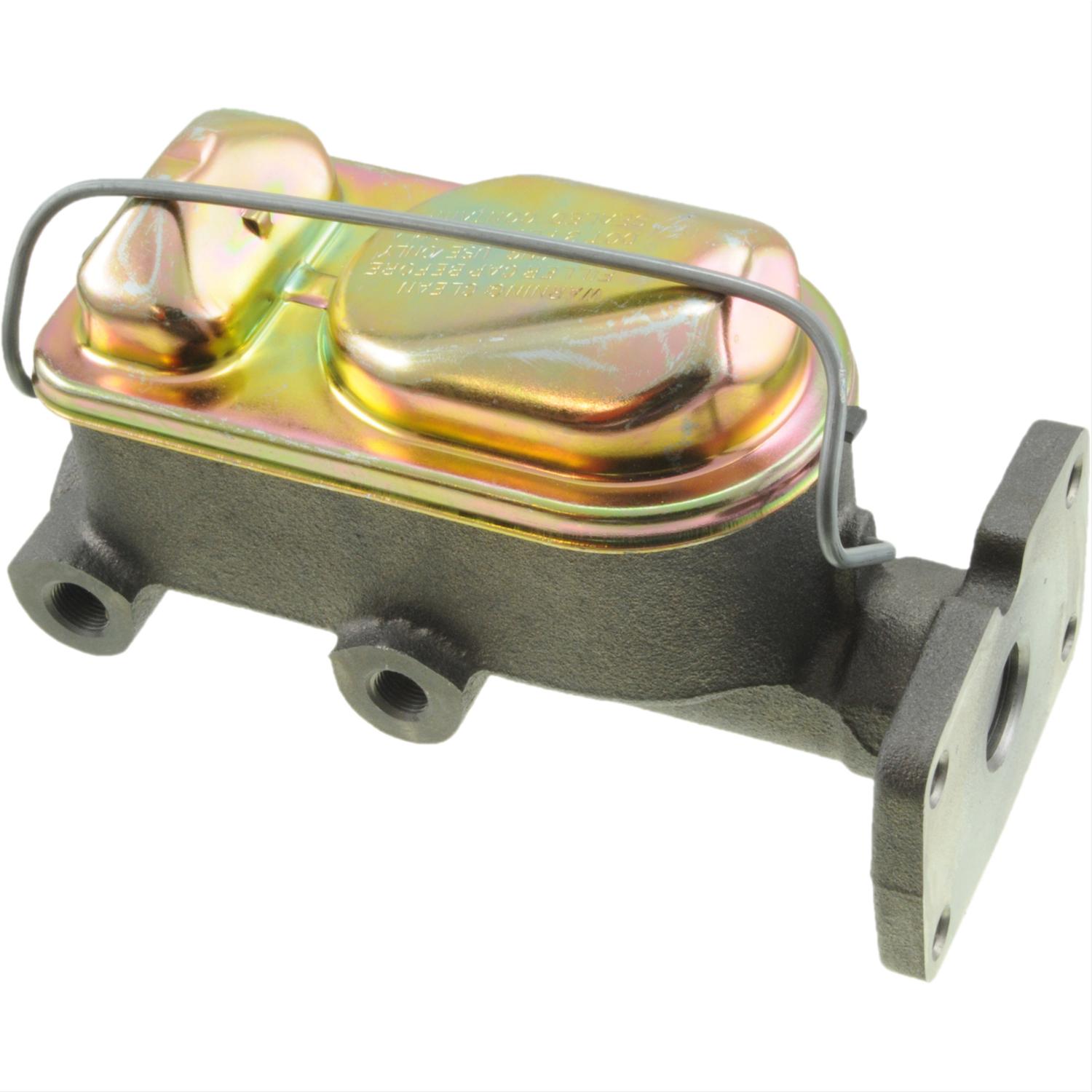
Raybestos 36406 or Dorman 80266
It's a straight bolt on, no fuss .


Good luck
 
Last edited:
If you go to larger calipers, you need to make sure your m/c has the volume displacement for the larger piston size.
 
Dumb question, did you change the proportioning valve?

RGAZ

I don't know if you are asking me the question but I did not add a proportioning valve. My car has a what I think is a distribution block with the warning light sensor built in it. Just a ball that moves over to a set of contacts if there is an imbalance of pressure between the front and rear brakes. But the brakes work fine with no skidding issues.
 
I don't know if you are asking me the question but I did not add a proportioning valve. My car has a what I think is a distribution block with the warning light sensor built in it. Just a ball that moves over to a set of contacts if there is an imbalance of pressure between the front and rear brakes. But the brakes work fine with no skidding issues.

I am asking you the question. A standard distribution block will not work properly with a Disc/Drum combo. Your Disc brakes will not get enough pressure and your brakes will be poor. Swap in a proportioning valve from a 73 and up A body that has the warning light too and you will see a noticeable improvement.

I believe this will solve your problem.

RGAZ
 
If you go to larger calipers, you need to make sure your m/c has the volume displacement for the larger piston size.

The calipers with 2.75” pistons are a factory caliper and were used on everything but A-bodies. Any factory disk brake master cylinder should be fine for volume displacement.

Further, I have personally run the 2.75" calipers with factory A-body master cylinders that originally had 2.6" calipers and with DoctorDiff's 15/16" master cylinder, volume displacement is not an issue.

I am asking you the question. A standard distribution block will not work properly with a Disc/Drum combo. Your Disc brakes will not get enough pressure and your brakes will be poor. Swap in a proportioning valve from a 73 and up A body that has the warning light too and you will see a noticeable improvement.

I believe this will solve your problem.

RGAZ

So, this isn't entirely true.

None of the systems - distribution block or factory proportioning/combination valve, reduce the pressure to the front brakes. So, the disks will get the same amount of pressure with either system, and that is determined by the master cylinder bore. So the disks will function the same.

Now, the distribution blocks were for drum/drum cars, and they don't proportion. So the pressure sent to the rear drums may not be what you need with disks up front, because the only front/rear brake bias on the drum cars came from the wheel cylinder and drum size. The factory proportioning/combo valve reduces pressure to the rear drums.

So if you have converted to a disk/drum brake set up and still have the factory distribution block the danger is that your rear brakes will lock up first. That may actually not be the case, because not everyone runs the same size front and rear tires and if you have a substantial stagger you may not notice the rears locking up first. If they do, you can also just plumb an adjustable valve into the rear brake line behind the distribution block to reduce the pressure to the rears. That's what the factory combination valve does, but even on factory disk/drum cars having the rear brakes lock up first isn't unusual at all so having an adjustable valve is an improvement anyway (as long as you do the work to set it properly).
 
-
Back
Top Bottom