Low compression 340 VS high compression...

-

Kern Dog

Build your car to handle.
FABO Gold Member
Joined
May 23, 2010
Messages
13,547
Reaction score
39,737
Location
Granite Bay CA
A few years back, I built a 383 for my Jigsaw Charger. Normally I would have just defaulted to a 440 but this was the original engine to the car so I thought that it would be cool to do. I found back then how hard it is to build a decent compression ratio in a short stroke engine. The 383 has a 3.38" stroke if I recall. I have flat tops with no valve reliefs sitting something like .012 below deck and still am barely over 9 to 1 with it.
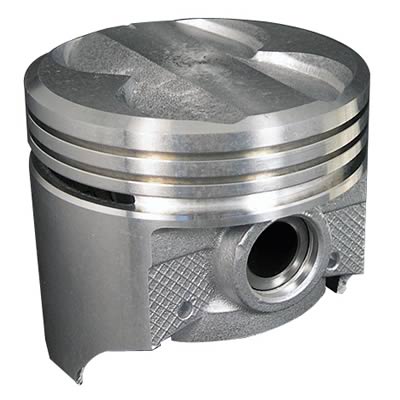
Here I am today with a 340 that I got maybe 15-16 years ago. I got it with a spun rod bearing so the the rods were resized, the crank turned and the cylinders honed since it was already .030 over. The pistons have valve reliefs but no recognizable marks to identify them. I wanted to know the compression ratio since long ago, I bought a cam and lifter set and was curious how it would all work out.
The pistons do sit to zero deck but after checking the volume of the valve reliefs and how the tops taper at the edges toward the rings, I came up with 23 ccs of volume.
Using a #308 head that has 72 cc chambers, a .051 Fel Pro head gasket puts this 340 at an abysmally low 7.67 to 1. If this engine had a 3.58" stroke like a 360, it would be 8.22. The shorter stroke has a difference of over half a point of compression. A 4.0" stroke, the go-to that most guys use, moves the ratio to 9.06 with no other changes.
It sure seems that The short stroke and heavily dished pistons just kill the compression ratio. Juggling the numbers, a zero deck flat top with no valve reliefs still only get to 9.52 to 1.
Were the 68-71 engines built with pistons that had positive deck height? How could they even get over 10 to 1 without that?
 
Never sacrifice flow for compression.

Care to elaborate?

Are you 100% sure you're calculating compression right?

I always use the compression ratio calculator posted on the Summit Racing site.

1763614700601.png


I have two sets of head gaskets, both are .051 from the box. The 23 ccs that I measured could be off a cc either side of 23 but that makes so little difference here from what I can tell.
 
I'll have to post a picture but I did it twice. The first time I got about 15-17 ccs in and had to start over because the liquid I used wasn't flowing everywhere like I wanted.
These are not optimal conditions here....I have the engine on a stand that does not put the engine level front to rear. I can level it side to side. I was looking for a ballpark estimate here just for my own information.
I have the plexiglas on the deck. It has two holes, one to fill, the other to let air out. Being out of level, I had to tape over one hole. This was my first time doing this, I'm sure the more skilled members would know a better way.
 
I'll have to post a picture but I did it twice. The first time I got about 15-17 ccs in and had to start over because the liquid I used wasn't flowing everywhere like I wanted.
These are not optimal conditions here....I have the engine on a stand that does not put the engine level front to rear. I can level it side to side. I was looking for a ballpark estimate here just for my own information.
I have the plexiglas on the deck. It has two holes, one to fill, the other to let air out. Being out of level, I had to tape over one hole. This was my first time doing this, I'm sure the more skilled members would know a better way.
The deck must be level. NO exceptions. Also, you really need to use the .500" down fill method to figure piston volume. I think your measurements are skewed somehow.
 
I see your issue. Those pistons are not zero deck height. They are positive deck height. This is them right here. You cannot do this without a dial indicator and piston stop to find true TDC. You're below deck.

 
The deck must be level. NO exceptions. Also, you really need to use the .500" down fill method to figure piston volume. I think your measurements are skewed somehow.

Oh, I'm sure that there are some errors but by how much?
Much of the piston is at zero deck so that is what I put in the "deck clearance" category. The "Effective deck volume" is where I am right now. I figured that is I checked the ccs to fill all the voids and entered the number, the calculation would be correct.
I have heard the term "Downfill" but never looked further to understand the meaning. Wouldn't lowering the piston 1/2" to measure volume be redundant if at zero deck I can still get liquid into the top of the piston?
 
I see your issue. Those pistons are not zero deck height. They are positive deck height. This is them right here. You cannot do this without a dial indicator and piston stop to find true TDC. You're below deck.

[/URL][/URL]

Those do look like what I have. I put a straightedge across the deck with the piston at TDC and it sure looked like zero deck to me. It wasn't like the straightedge sat above deck either while resting on the piston.
I'm in the house now, the engine is out back in the shop. I usually do post up pictures for stuff like this, sorry if I am making it harder to help.
 
I've had heads milled before and been able to make things work. In 2001 for a 440, I had a set of '452 heads milled .050, the decks .015 and it fit together fine. I did use a thicker head gasket than stock so that eats up some of that difference.

The Silvolite pistons above show a compression height of 1.824, the KB 107 pistons I have in a 360 I built last Spring are at 1.675. The 360 pistons sat close to zero deck, maybe .010 above if I recall. These 340 pistons should sit .149 taller so yeah....way above deck. I'm certain that if they were over 1/8" above deck I'd notice!
Hey, I sure don't claim to be as skilled with this as some of you are but as a retired carpenter, I'm familiar with measurements down to the 1/8 of an inch!
It amazes me how a machinist can grind away a part and get it to the thousandth of an inch.
 
I've had heads milled before and been able to make things work. In 2001 for a 440, I had a set of '452 heads milled .050, the decks .015 and it fit together fine. I did use a thicker head gasket than stock so that eats up some of that difference.

The Silvolite pistons above show a compression height of 1.824, the KB 107 pistons I have in a 360 I built last Spring are at 1.675. The 360 pistons sat close to zero deck. These 340 pistons should sit .149 taller so yeah....way above deck. I'm certain that if they were over 1/8" above deck I'd notice!
Hey, I sure don't claim to be as skilled with this as some of you are but as a retired carpenter, I'm familiar with measurements down to the 1/8 of an inch!
It amazes me how a machinist can grind away a part and get it to the thousandth of an inch.
They only sit slightly above deck. I think it's like .012". Difficult to see with the nekkid eye.
 
Were the 68-71 engines built with pistons that had positive deck height?
Yes. When I swapped heads on my early 340 I checked piston-deck height and pistons were .015" proud of the deck surface

How could they even get over 10 to 1 without that?
I doubt they actually were. For reference, mine (w/ L2316 pistons) calc'd at 9.6 with the 65cc heads and .051" head gasket.
 

Yes. When I swapped heads on my early 340 I checked piston-deck height and pistons were .015" proud of the deck surface


I doubt they actually were. For reference, mine (w/ L2316 pistons) calc'd at 9.6 with the 65cc heads and .051" head gasket.

Weren't the engines all built with a .020 steel head gasket ? That alone makes some difference.
 
-
Back
Top Bottom