A few years back, I built a 383 for my Jigsaw Charger. Normally I would have just defaulted to a 440 but this was the original engine to the car so I thought that it would be cool to do. I found back then how hard it is to build a decent compression ratio in a short stroke engine. The 383 has a 3.38" stroke if I recall. I have flat tops with no valve reliefs sitting something like .012 below deck and still am barely over 9 to 1 with it.
Here I am today with a 340 that I got maybe 15-16 years ago. I got it with a spun rod bearing so the the rods were resized, the crank turned and the cylinders honed since it was already .030 over. The pistons have valve reliefs but no recognizable marks to identify them. I wanted to know the compression ratio since long ago, I bought a cam and lifter set and was curious how it would all work out.
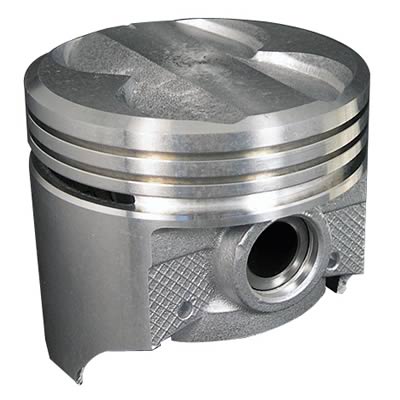
The pistons do sit to zero deck but after checking the volume of the valve reliefs and how the tops taper at the edges toward the rings, I came up with 23 ccs of volume.
Using a #308 head that has 72 cc chambers, a .051 Fel Pro head gasket puts this 340 at an abysmally low 7.67 to 1. If this engine had a 3.58" stroke like a 360, it would be 8.22. The shorter stroke has a difference of over half a point of compression. A 4.0" stroke, the go-to that most guys use, moves the ratio to 9.06 with no other changes.
It sure seems that The short stroke and heavily dished pistons just kill the compression ratio. Juggling the numbers, a zero deck flat top with no valve reliefs still only get to 9.52 to 1.
Were the 68-71 engines built with pistons that had positive deck height? How could they even get over 10 to 1 without that?
Here I am today with a 340 that I got maybe 15-16 years ago. I got it with a spun rod bearing so the the rods were resized, the crank turned and the cylinders honed since it was already .030 over. The pistons have valve reliefs but no recognizable marks to identify them. I wanted to know the compression ratio since long ago, I bought a cam and lifter set and was curious how it would all work out.
The pistons do sit to zero deck but after checking the volume of the valve reliefs and how the tops taper at the edges toward the rings, I came up with 23 ccs of volume.
Using a #308 head that has 72 cc chambers, a .051 Fel Pro head gasket puts this 340 at an abysmally low 7.67 to 1. If this engine had a 3.58" stroke like a 360, it would be 8.22. The shorter stroke has a difference of over half a point of compression. A 4.0" stroke, the go-to that most guys use, moves the ratio to 9.06 with no other changes.
It sure seems that The short stroke and heavily dished pistons just kill the compression ratio. Juggling the numbers, a zero deck flat top with no valve reliefs still only get to 9.52 to 1.
Were the 68-71 engines built with pistons that had positive deck height? How could they even get over 10 to 1 without that?