No spark 67 valiant

-

KB67

Member
Joined
Oct 12, 2025
Messages
8
Reaction score
9
Location
Seabeck WA
Hello! My name is Krystal. My car 225 slant 6 started fine one morning I drove it ,seemed ok maybe a little hesitation but I figured it was cold. I tried to start it 3 hours later and it just kept turning over...
We have replaced:
Spark plugs
Ignition coil
Condenser
Capacitor
Distributor cap and rotor
Ballast resistor
Points and contacts cleaned up
I think that's all.
Still no spark..
Where do we need to focus next? Please help
TIA
 
Be careful replacing the distributor cap, I recall having problems on new caps fitting correctly, to tall or something, do you have 12 vold to the distributor/coil ? Starter relay working right.. now that you have pulled everything that was running it scares me, fuel delivery for sure ?? Dribble fuel in your carb if not sure.. points showing a spark ? Plugs showing a spark.? Rotor button is on and reaching your pick ups in the distributor.

Let me tag our Dizzy tech here, he may help.
@halifaxhops
 
What is the point gap? See if you have power to the coil and ballast resistor.
 
Be careful replacing the distributor cap, I recall having problems on new caps fitting correctly, to tall or something, do you have 12 vold to the distributor/coil ? Starter relay working right.. now that you have pulled everything that was running it scares me, fuel delivery for sure ?? Dribble fuel in your carb if not sure.. points showing a spark ? Plugs showing a spark.? Rotor button is on and reaching your pick ups in the distributor.

Let me tag our Dizzy tech here, he may help.
@halifaxhops
Yes voltage to distributor and coil. Have not tried starter relay yet...? Fuel to carb have used gas and starter fluid and it just keeps cranking over.
 
Sounds like you wrung out the ignition pretty well did you check voltage going int the ballast resistor? Also are the parts new store bought? If so be ware the new quality is horrible. Disconnect the condenser and see if it starts quick if so shorted condensor, common with the new ones. This might help.
 
Last edited:
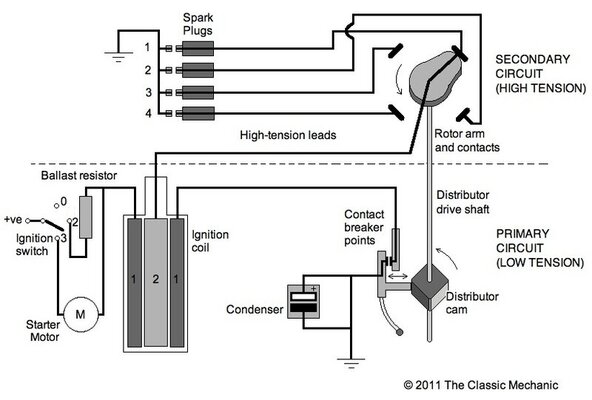
The ignition switch provides two sources of power to start the engine.

While cranking the coil gets its power from IGN 2 after the engine starts it gets its power from IGN 1.

If the ignition switch is not functioning correctly it will crank but not provide power to the coil.

To test this disconnect the yellow wire from the starter relay (That way the engine will not crank).

Check for voltage at the coil positive with the key in off it should read 0v, turn the key to run and it should read 6-10v, turn the key to start it should read 12v ( or whatever battery voltage is)

Then report back.

And welcome to the site!
 
Also....

Go to mymopar.com and download your cars factory service manual.(Free download)

Also Google "Chrysler master tech videos" & add the topic "ignition" the videos are corny but super clear and easy to follow
 
[1] Remove a spark plug lead.
[2] Stick a screwdriver in the end so that the shaft makes contact with the lug.
[3] Lay s'driver on the v/cover so that the shaft has a 1/4" gap to the v/cover;. use a eight if needed to hold in position.
[4] Crank & watch for a spark.
[5] If you get a spark, likely a fuel problem.
[6] Engine off, operate throttle linkage while looking inti the throttle bore for a fuel squirt from the accelerator pump. No squirt, could be many things: fuel pump bad, acc pump plunger worn out, others.
 
Forget the starter relay. If the starter works, the relay is OK

As Dana said, measure coil voltage. IF THE reading is full battery with key in "run" this means that either points are open (engine may have "landed" in that spot, or if you check under the cap and they are closed, and or bump the engine to visually be certain they are closed---if the reading is still battery, move your meter to the coil NEG which goes to the dist. If the reading is still battery, this means the points are not closed, not properly gapped, or are not conducting current, even if closed.

Make certain the points are actually opening and closing.

You can make up or buy an alligator clip jumper wire, and you really should have a couple for troubleshooting. Jumper from the alternator output stud, direct to the coil + terminal. This will eliminate vehicle wiring problems, BUT don't leave that there any longer that it takes to troubleshoot. This sends a lot of current to the coil. "Rig" a solid metal wire, that is, not radio noise suppressed, to a test gap or spark plug, to the coil tower, to test for spark. You can use low voltage wire if you "hang" it away from objects.

Keep in the back of your head that "new does not mean good." In other words the condenser/ capacitor can be be defective, even tho new, as can other parts
 
 
^^Unfortunately that is far from correct. I've gotten into many arguments about this, but if the cap/ condenser is bad or missing, the car will normally not start. So while, yes, it does keep the points from burning, it has to be in good working condition just to allow the vehicle to run. Ever look at an ignition scope pattern? The little sqiggles? That is "ringing" a term which is also applied to LC circuits (Inductor/ capacitor) circuits in RF circuits. Just like the coil magnetically charges, and then discharges, the cap ALSO charges due to the flow of current from the coil primary. These two trade energy back and forth, until "circuit losses" cause the ringing to dampen out.

In any circuit with L and C, "ringing" is THE definition of resonance, just like a bottle you blow across like a flute. If you change the value of L or C, AKA either inductance or capacitance larger, the resonant frequency is lowered. Less value of either raises resonant frequency.

Probably MUCH more important, is, in defiance of "internet wisdom," YOU CAN NOT check a capacitor with a multimeter!!!! This is because one huge problem with caps is LEAKAGE current. You MUST test caps for leakage and determine that leakage is low or unmeasurable, BEFORE you evaluate capacitance value. This is because a leaky cap, even one that is good enough that it still works -- perhaps poorly-- the leakage will cause a capacitance test to read flalsely HIGH. This means the actual capacity could have deteriorated, but the value test might read fine.

So how do you? Do what? test? Proabably cheapest and most reliable is to just replace the cap. That worked pretty well until chineseoization came along.

 
This all getting complicated for the OP. Mulimeter & test light should stay in ther tool box at this stage. Neither can determine if a condenser is bad or if the coil has an internal failure.
Mostly likely cause of the problem is ign, fuel or less likely timing chain jumped a tooth [ hard to determine ].

So concentrate on ign/fuel. You go the END of the line to find where the problem is. Then work backwards from there.
So use post #10 to do that.
 
Mulimeter & test light should stay in ther tool box at this stage
I have to disagree.

the car ran, then it didn't.

all of the ignition components were replaced (assumed for the moment to be good)

the car still does not fire.

Likely cause of the no fire is something that happened to something that was NOT replaced. checking for voltage at key points and under key conditions is a proper way to diagnose.


WE DO NOT KNOW enough abut the no fire condition to really know anything.

I AGREE that checking for spark is a quick way to test for power to the coil but it might not tell the entire story, like bad IGN 1 circuit or wire and it tries to start but let off the key and it dies.

EXAMPLE... a few months ago I was heading to a car show. stopped at a McDs started the car moved 20 feet and it died. cranked no fire, sometimes it would try then give up or sometimes with the throttle full to the floor it would start and lump lump till you let off the gas then die.

I had a timing light with me and it would show the timing mark at the right moment while cranking, so I had spark and at the right timing. the problem was a broken ground wire inside the dist. when the breaker plate was not moving due to vac advance the ground wire was making a poor connection. get a little vac advance and it would open the ground. ran a temporary ground wire and it ran fine and got me home.

point is just having spark doesn't tell the whole story
 
'Still no spark'. Post #1. What was the method used to test for spark??? It is not stated. That is why you go to the end of the line to check: spark plug terminal.
 
^^Unfortunately that is far from correct. I've gotten into many arguments about this, but if the cap/ condenser is bad or missing, the car will normally not start. So while, yes, it does keep the points from burning, it has to be in good working condition just to allow the vehicle to run. Ever look at an ignition scope pattern? The little sqiggles? That is "ringing" a term which is also applied to LC circuits (Inductor/ capacitor) circuits in RF circuits. Just like the coil magnetically charges, and then discharges, the cap ALSO charges due to the flow of current from the coil primary. These two trade energy back and forth, until "circuit losses" cause the ringing to dampen out.

In any circuit with L and C, "ringing" is THE definition of resonance, just like a bottle you blow across like a flute. If you change the value of L or C, AKA either inductance or capacitance larger, the resonant frequency is lowered. Less value of either raises resonant frequency.

Probably MUCH more important, is, in defiance of "internet wisdom," YOU CAN NOT check a capacitor with a multimeter!!!! This is because one huge problem with caps is LEAKAGE current. You MUST test caps for leakage and determine that leakage is low or unmeasurable, BEFORE you evaluate capacitance value. This is because a leaky cap, even one that is good enough that it still works -- perhaps poorly-- the leakage will cause a capacitance test to read flalsely HIGH. This means the actual capacity could have deteriorated, but the value test might read fine.

So how do you? Do what? test? Proabably cheapest and most reliable is to just replace the cap. That worked pretty well until chineseoization came along.

cond bad.png


'Still no spark'. Post #1. What was the method used to test for spark??? It is not stated. That is why you go to the end of the line to check: spark plug terminal.
exactly but if no voltage while cranking = no spark.

I think we can agree if either of us were there we would have answers in no time BUT being only able to get he info 1 piece at a time it makes it VERY difficult.
 
The ignition switch provides two sources of power to start the engine.

While cranking the coil gets its power from IGN 2 after the engine starts it gets its power from IGN 1.

If the ignition switch is not functioning correctly it will crank but not provide power to the coil.

To test this disconnect the yellow wire from the starter relay (That way the engine will not crank).

Check for voltage at the coil positive with the key in off it should read 0v, turn the key to run and it should read 6-10v, turn the key to start it should read 12v ( or whatever battery voltage is)

Then report back.

And welcome to the site!
This is a good point to start. Correct ways to diagnose ignition issues is forward from the beginning or backwards from the end. A lot of us go backwards because it's easy.
 
View attachment 1716466528


I'm sorry but if you do not do a high voltage leakage check you are spinning your wheels. I have found FAR more bad caps that were actually leaky rather than low or high in value, substantially.

The old outboards I mess with, I bet more than 75% of the caps get garbaged. I actually don't use new OEM style caps. I gut the cases, and stick a plastic cap in there, and "Goop" it into place.
 
I agree, Most people do not have that type of test set more to check if it is shorted.
 
I'm guessing at a faulty ignition switch and/or corroded/faulty connections at the firewall junction block.
But yeah, we don't have enough info to go on here.

@KB67, you are getting good advice and I'll add to the chorus: diagnosis is the thing to do – not just scattershot spending and throwing new parts (which may be worse than the old parts) at it. Follow the links in this post.

And no, @halifaxhops , @67Dart273 is right about the condenser; without it the engine will be difficult or impossible to keep running, if it starts at all. If no condenser, then no sharp drop from high to low (voltage to no voltage) in the coil primary winding, therefore crummy/no induction in the coil secondary winding, therefore crummy/no spark. Your info on how to check for an over- or under-capacity condenser is valid as far as it goes, but not really relevant at the moment.
 
Hello! My name is Krystal. My car 225 slant 6 started fine one morning I drove it ,seemed ok maybe a little hesitation but I figured it was cold. I tried to start it 3 hours later and it just kept turning over...
We have replaced:
Spark plugs
Ignition coil
Condenser
Capacitor
Distributor cap and rotor
Ballast resistor
Points and contacts cleaned up
I think that's all.
Still no spark..
Where do we need to focus next? Please help
TIA
Hey Thank you all so much for the feedback. It got a bit confusing but I tried to take in as much as possible. The car IS running now after a week and multiple replaced parts and Pertronix upgrade. Truly I don't know what the actual problem was.ended up replacing ignition coil twice.. possibly crumby one from the store? Who knows
 

Pertronix is not bad, I have one on my old Farmall 100 (updated Super A). But if you are going very far from home, I'd buy an extra one just for spares. The module, and the rotor, are both special parts. If you break down, you won't find them in parts stores.
 
-
Back
Top Bottom