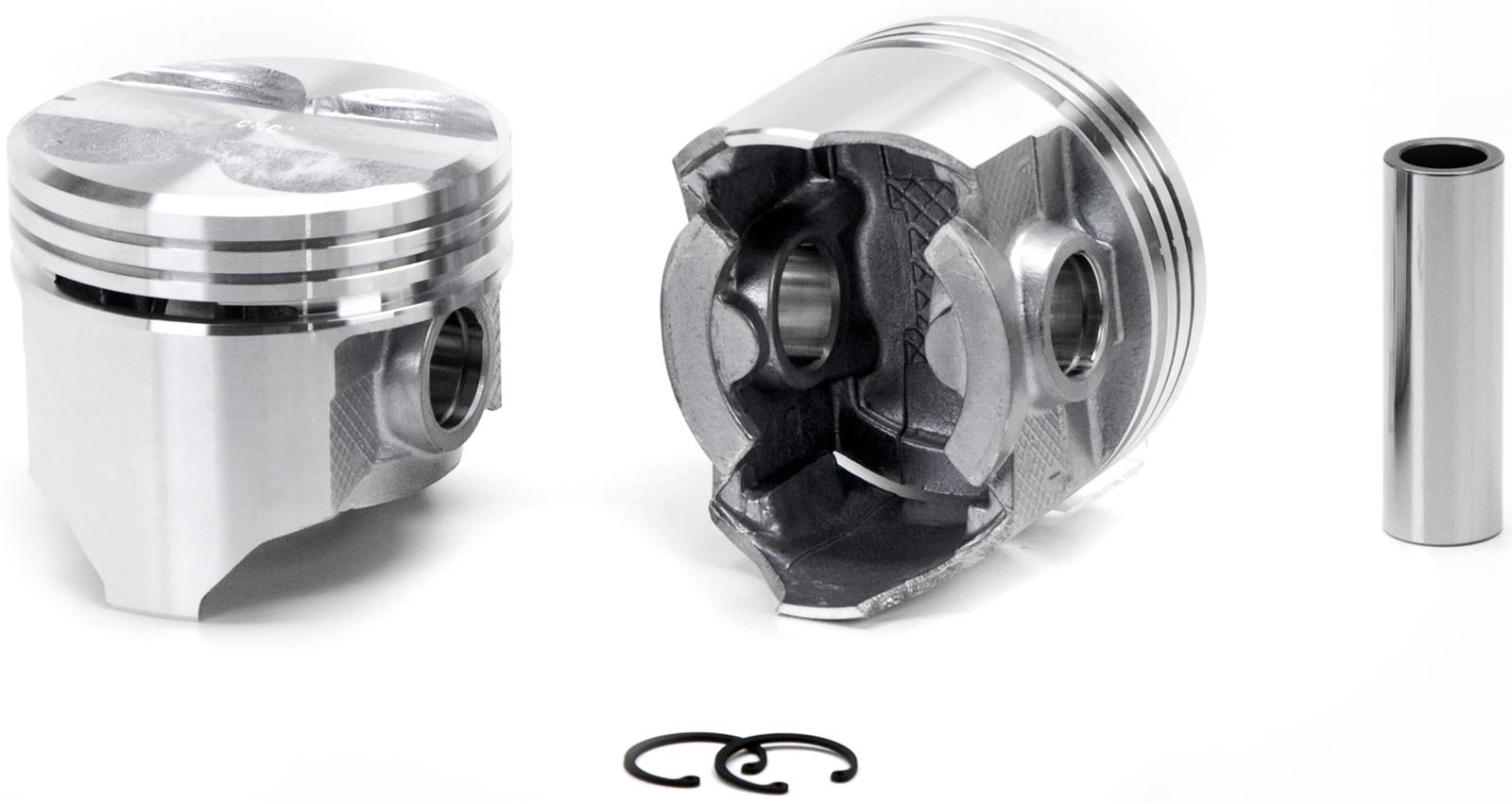
Low compression 340 VS high compression...

-
If you want an accurate piston dome volume you need to put the piston .500 down the bore from it's TDC position and use your CCing method to check the volume above the piston & compare that to the volume of the of the cylinder

Assuming 4.070 x .5 = 106.6798cc
 
Using .012 positive deck height, and using Summit's listing of -10cc for piston head volume, I get 10.978 on the United Engine calculator.

I'd be happy to be in the mid 9s but I don't understand how they get a 10 CC number when I was able to get 23 ccs into the voids of the piston. Is this accounting for the amount above deck?
Again, if I am above deck, I'd eat my hat.
 
Weren't the engines all built with a .020 steel head gasket ? That alone makes some difference.
Probably, but I'd think the stock combustion chambers would've been larger, right? If I recall, the set of X heads I had cc'd at around 71cc's. Plugging in those numbers, I'm getting around 9.8 on an early version, so I guess close to 10 at least.

With yours, I'm getting 8.55 w/ 72cc heads, zero deck, assuming 10 cc piston dish and .051" gasket like you mentioned. How'd you measure 23cc's? That'd be huge. I think my 408 piston dishes were like 21 and they were visibly much bigger that four valve reliefs.
 
I'd be happy to be in the mid 9s but I don't understand how they get a 10 CC number when I was able to get 23 ccs into the voids of the piston. Is this accounting for the amount above deck?
Again, if I am above deck, I'd eat my hat.
I don't know what to tell you, Greg. You cannot EYEBALL TDC. That's all I can tell you. If you think you can, you're mistaken. I've already pointed out that the block must be level. I don't know how else to say it. I don't know for sure that's the right piston, but from your description, it sure sounds like it. And yes, the positive deck clearance is counted, just like a negative deck clearance is. It's confusing, because a positive deck clearance is represented by a "negative" number, while a negative deck clearance is represented by a "positive" number. The reason for this is because the positive deck clearance REMOVES chamber volume - negative and a negative deck clearance adds to + the chamber volume.
 
Even harder to see with 60 year old eyes!
Glasses... No shame.
1763619306538.png
 

If you want accurate numbers CC the piston & the head.... Take the guess work out of the equation...

The heads I have here were checked last Spring and I did get 72 ccs.
Like with other stuff that I’m unfamiliar with, I’m just using common sense on this. I set the piston to TDC and see that here is plenty of volume in the valve reliefs. I put approximately 23 ccs of rubbing alcohol in the reliefs to essentially make the pistons flat across them. I took the 23 cc number and entered it in the ratio calculator. It still seems that by using this…

IMG_3171.jpeg


With Vaseline on the deck to seal the edges…

IMG_3172.jpeg


With the vent hole blocked, it filled the crevices of the piston and was ready to come up out of the fill hole. I don’t see how the engine sitting out of level would matter if the plexiglass was sealed and didn’t leak. If I’m wrong, I don’t mind being told why on this. I’d rather learn that to keep doing it wrong.
Stepping back, here are the only marks on these pistons:

IMG_3156.jpeg


IMG_3157.jpeg


Just the F. That is it.
I put this small torpedo level on the deck and checked. The piston is not above deck.

IMG_3168.jpeg


I used a dial indicator to verify that I was at TDC.
Yes, I rotated the crank to get the highest reading on the gauge. Once it was correct, I got this:

IMG_3169.jpeg


IMG_3170.jpeg


Yeah… .004 below deck. Those reliefs are huge, man.
My measuring method may not be what is commonly used but it is what made sense to me.
Wouldn’t the downfill method only be needed with pistons that really do sit above deck?
Shouldn’t the method I used still work?

 
Last edited:
Yup, piston is an odd ball.. Or the rods are short... Piston has the tapered edges like a 68-70 piston, the reason for the tapered edges is to clear the edges of the chamber when the piston is above deck....
 
Ok, so dig this.


That's the standard version of the piston I posted above. Notice here they have it at a measured POSITIVE 10cc. The fuckers. That's probably correct. I don't know where your 13 extra ccs is comin from, but 10ccs is about right for that piston top. I also ran the numbers for deck clearance using the UEM deck clearance calculator and got .002". well within tolerance for Chrysler's stupid deck machining practices.
 
Ok, so dig this.
I don't know where your 13 extra ccs is comin from, but 10ccs is about right for that piston top.

I don't know how else to make sense of it. I had 30 ccs in the syringe and had 7 in it when I was done. 23 ccs were used. None leaked through the rings
If I'm wrong, I'd welcome the advice.
 
Yup, piston is an odd ball.. Or the rods are short...
The rods were resized but I'd think that if the one rod that spun the bearing was too far gone to clean up within a few thousands, he would have told me and used another rod.
I thought they ground a few thousandths from the mating surface of the rod cap then bolted them back on and bored them to size?
 
One thing to try, run the piston down the bore, wipe vaseline around the bore to seal the rings, then bring the piston back to TDC& wipe away the excess vaseline... Measure it again...

Good idea.
I dunked the piston in 20w50 before installing but the Vaseline should retain liquid better.
I'm still below deck though.
 
The rods were resized but I'd think that if the one rod that spun the bearing was too far gone to clean up within a few thousands, he would have told me and used another rod.
I thought they ground a few thousandths from the mating surface of the rod cap then bolted them back on and bored them to size?
Typically resizing rods you cut less than .005 off the rod.... Early 340 pistons are usually .020+ above deck... If the block gets line bored the crank moves up a similar amount...
 
This is the only set of rods that I have ever had to resize and this was done so long ago, I don't recall the details.
 
I think the numbers are confusing because you are cc'ing the volume between the piston and "0" deck. You don't do that with below deck pistons. The calculator already takes care of that. That's where an extra 13cc of volume is coming from. Pistons with 2 valve notches typically add 5cc to the calculations. These have 4 notches so it would make sense that they would add 10cc. If you know the part #, you should be able to confirm the valve notch cc numbers in its specs. Make sure the rest of the specs are correct, especially the chamber volume, and you get your compression ratio.

As others have mentioned, it's easy enough to get a thinner head gasket and heads can be milled, if the chambers aren't smaller already.
Aftermarket stainless valves can reduce chamber volume a bit as well.
 
-
Back
Top Bottom