Cooling question - airflow - design

-

chorty55

Well-Known Member
Joined
Mar 20, 2025
Messages
264
Reaction score
111
Location
Usa
I'm in the process of fabbing up a radiator and transmission cooler in a, well, custom application.

The torque converter i'm using makes serious heat. They're using 3/4" steel pipe to/from an all iron cooler that's 20x20x4inch thick, and runs around 280-300 PSI. Its miserable heavy. I had to use the hoist to set it in place for mock up ideas/tape measure "fencing".

The radiator has an electric fan with shroud, and since the fans i'm using are reversible, i have an idea, and curious if anyone thinks it might be a bad idea.

I'm going to quickly use ASCII to interpret this ,and it's going to be ugly

AIR FLOW
<<------

Grill ----- FAN | Transcooler | Radiator | FAN ------- engine

My idear is to use a temp sensor in both the engine coolant and the transmission cooler line, then tie them together to the fan relays. Which ever circuit makes it first, both fans are called regardless, and the double duty should keep the other circuit satisfied even if it's not actually the one calling for fan, can't do it any harm, right? The fans will be phased so they don't fight, depending how they get hung and set in the frame of the machine.

Opinions? I need to make sure the transmission doesn't get hot, and other then using one fan, and the double temp sensors, i may as well bite the bullet ,and since it's apart, go ahead and cobble in a 2nd fan just for peace of mind. I don't know if one fan has nuts enough to push through 8 inches of cooler fins.

I'd rather buy 10 fans, 100 relays, and 12 alternators over removing this gearbox i can't find parts for or rebuild because i didn't want to spend $40 to shed extra heat.
 
I think at this point we all know you’re working on an old piece of farm equipment but seriously you should add pictures of all this stuff, it would be cool for us to see and help us get a visual of what you’re doing.
 
And to offer advice, I wouldn’t tie the fans from the cooling system of the engine together with the fans from the transmission cooler. If you can keep them separate they’ll be happier. I realize how a normal vehicle trans cooler works and it sounds like in your situation the gearbox/transmission is responsible for making much more heat and therefore will need a dedicated cooling effort.
 
i will. i'ts cold today so i'm pondering ideas. the radiator came today. So before i venture down into the cold shop. i'm brainstorming on the warm couch and full QWERTY keyboard.

this phone stuff is stupid.

I just got back from the local exhaust shop, they made some flanged down pipes, and i need to do the good ol' lobster back pie cut, as it dumps immediately into the starter on the 'passenger' side of the block.

The annoyance is getting to me, so i'm trying to do as much thinking before execution.
 
And to offer advice, I wouldn’t tie the fans from the cooling system of the engine together with the fans from the transmission cooler. If you can keep them separate they’ll be happier. I realize how a normal vehicle trans cooler works and it sounds like in your situation the gearbox/transmission is responsible for making much more heat and therefore will need a dedicated cooling effort.
i thought that too, but i don't think one fan is tough enough to move alot of CFM through the coolers back to back. On the road rippin 60mph up a slight grade, whatever, but not 3-5 Mph, churning planetaries, pushing 5000 pounds of material, on a machine that's empty breaks 18,000# easily.....i'll need fans heavily.

Reason i wanted both fans to run, no matter which circuit actually is calling for fan. One pushes one pulls, regardless who's too hot.

it really sucks. i wish i could of kept the double pulley straight blade belt driven fan, but that's no longer an option.
 
So they are not separate coolers? It operates similarly to a vehicle in that the trans cooler is part of the radiator?
 
So they are not separate coolers? It operates similarly to a vehicle in that the trans cooler is part of the radiator?
there's a separate trans cooler. it's almost the size of a full sized radiator.

not the little dinky ones you see on the F450 tow package the size of a lunch box.

the new radiator has ports for trans cooler, inthe bottom tank but im plugging them, they're too small and useless for this application.
 
Ok gotcha. Then my original advice of keeping the systems separated holds up. If you need multiple fans on a single radiator, know that fans in series (one front and one back) will increase the static pressure, good for moving air through a resistance (thick core, tight fins, etc) and fans in parallel will increase the volume (more cfm).
 
Ok gotcha. Then my original advice of keeping the systems separated holds up. If you need multiple fans on a single radiator, know that fans in series (one front and one back) will increase the static pressure, good for moving air through a resistance (thick core, tight fins, etc) and fans in parallel will increase the volume (more cfm).
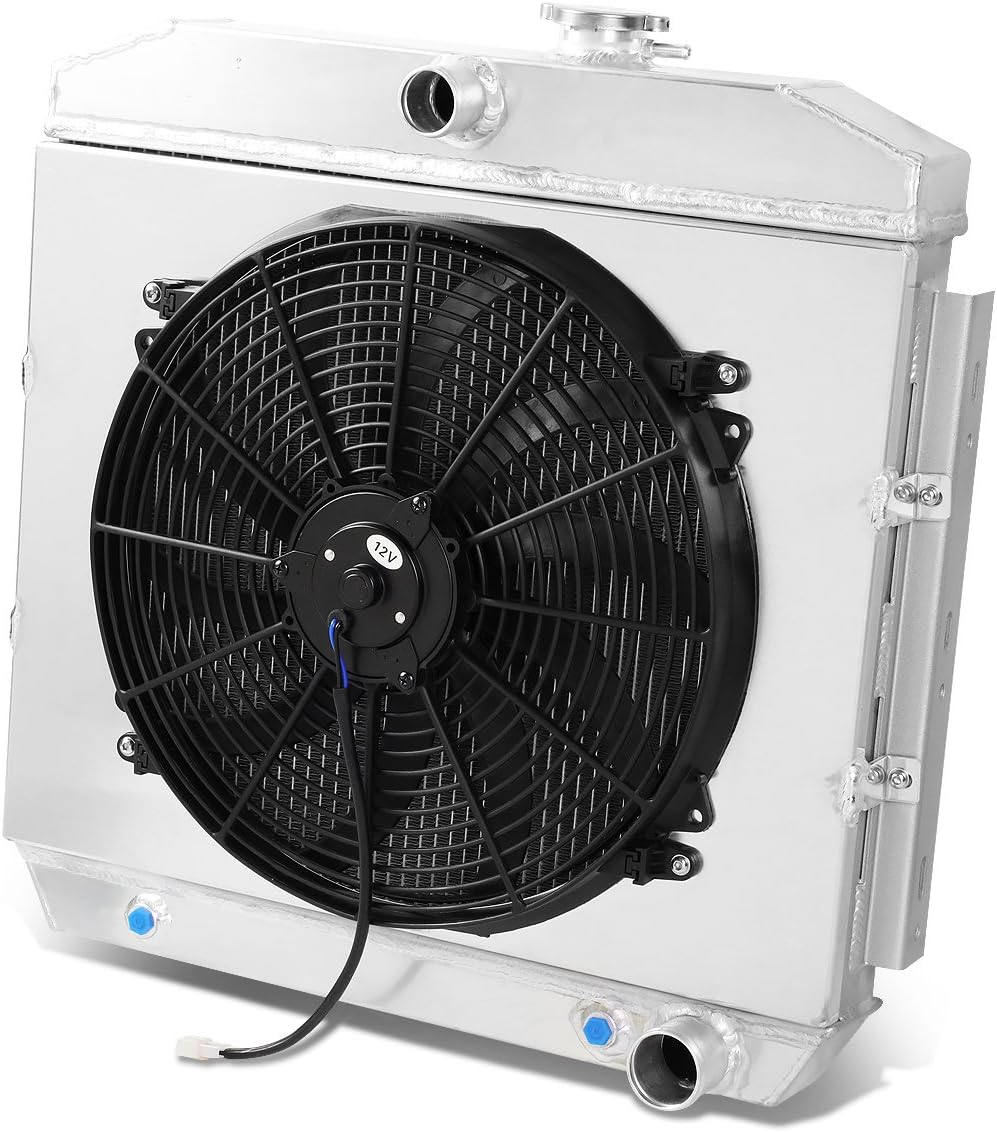
i bought one of these. the transmission cooler on the machine, which is just as large as the radiator pictured, is going to sit right behind it.

So, back to the first post, i was going to set a fan on the other side of this mess, and just have both of them run if either circuit needs to shed heat/needs cool air.

The fact it has a shroud i don't know is a plus or a gain for what i have going on, but $180 as is? I couldn't go wrong, and there reason for radiator purchase is as follows.

I chose this one because my frame is only so wide, and the roof is so far up, at the same time i'm out of center to use the fan that originally was on the water pump, the radiator/cooler(s) are/is going to be sitting too high since i'm running a small input shaft off the front of the crank to get power to a hydraulic pump. Factory fan blades are going to chop into my driveline.

So electric and up we go. Just need to battle CFM movement now. this radiator is 3.5" thick, and the trans cooler going behind it, is another 2-3 inches thick. and yes, the fins on the steel trans cooler are quite tight. I power washed 65 years of dirt and backed clay out of them, so that can't be a negative. Maybe i don't even need a fan on the trans cooler, but it's a risk i don't want to gamble.


71z9nZHPRGL._AC_SL1200_.jpg
 
Last edited:
Minimize the free air space between them, build ducting if you have to, to get the air going through them. And realize that hot air from the first cooler in line will be passing through the next cooler, so that might dictate which way you move air through them.
 
I do get that.

The concerns i'm setting is the factory setup, the belt fan roared all the time while the thermostat was closed, so the transmission cooler wasn't getting hot air off the radiator, but was always getting alot of airflow from the belt driven non-clutch fan.

Now it'll never get fan air flow unless the fan is on, which won't happen unless the cooling circuit of the engine is near maxed out.

The thermostat is closed, the engine radiator is not hot, but there's no fan, and the poor transmission fluid is over heating. Bad scenario.

only band-aid I can easily think up is to unnecessarily call for both fans at once, and dump air over both coolers regardless which circuit needs the cool air.
 
Capacity of the second cooler in line has to account for the heat of the first. It’s a crapshoot. Like the AC condenser in a car. When the AC is on and the condenser is dumping off hot air right in to the radiator, the capacity of the radiator and engines cooling system has to be sized such that it can handle both loads. You’re dealing with much larger heat loads and you’re going to have to design, test, and probably redesign a few times to get everything happy.
 
traditionally fans are not called right away. After the thermostat opens, and if the vehicle doesn't have air flow across the radiator to make the thermostat close again, then fans are called unless gain is made, like a green light.

But the way this was setup factory, the transmission cooler always got serious roaring air, regardless what the engine had going on.

So that tells me i really should make sure if the transmission oil gets hot, a temp switch flips on fans, regardless if the engine needs cooling or not. If the engine is also hot, then that temp switch will keep both fans on, eventually after both circuits are cooled down, then last temp switch triggered will stop the fans.

This i'm sure is why heavy equipment still uses belts. I know im asking alot out of this project, and i think if i approach it with generous room to breathe, i might win!
 
Well, cheap it is.

adding a 2nd fan. Its a bit whimpy. Only pulls 14 amps for a 16" fan.

This odd one laying around is 10.5", spins 4x the rpm, need to yell to speak around it, and gobbles twice the amps on wire twice the gauge.

China!
 
Is there a reason to use the cast iron cooler?

A liquid to liquid cooler, like that in your radiator of a typical Mopar, is very small but way more efficient.
 
3/4" steel lines coming to/from gearbox.
Cooler has 3/4" pipe threads.
its as big or bigger then an average radiator, in today's world.

and the lube cooler pressure gauge, when running in gear and really burning some fuel, reads 280 psi.

and its only 1.75" wide. Thought it was 2 or 2.5.

i guess if it didn't burst from pressure.
the liquid to liquid lookups in the bottom tank are way smaller.

Is there a reason to use the cast iron cooler?

A liquid to liquid cooler, like that in your radiator of a typical Mopar, is very small but way more efficient.

IMG_20250415_180823.jpg


IMG_20250415_180809.jpg

There's plenty of room to add a 2nd fan onto the other side.
 

Did the original setup have a mechanical fan? If so why recreate the wheel? Go back to stock.
Yes it did.

And good point. Not sure why I didn't think of that!!

Chop chop!!

Maybe I bought the wrong water pump?

IMG_20250416_092108.jpg
 
Did the original setup have a mechanical fan? If so why recreate the wheel? Go back to stock.

Yes it did.

And good point. Not sure why I didn't think of that!!

Chop chop!!

Maybe I bought the wrong water pump?

View attachment 1716393338

it really sucks. i wish i could of kept the double pulley straight blade belt driven fan, but that's no longer an option.
Maybe I’m confused here. I thought you said the stock mechanical fan was no longer an option?
 

it's not an option.

i'd have to cut off 3/4"s of the blades so it doesn't chop into the driveline. The mechanical belt fan is that big or my idea is this stupid.

Chop Chop!

So two 12v fans it is.
 
Which of these 6 holes would've most accurate reading water temp returning from radiator?

I got a hunch its anything on the water pump housing, but I'm no engineer. And water flows backwards on mars,,

signal-2025-04-17-21-06-19-674.jpg
 
None of them.

The water comes out of the bottom of the radiator and goes into the pump then into the block.

All the water on top of the engine is coming from the engine and going into the radiator or bypassing the rad.


Why do you need to know the rad return temp?
 
I don't need to know it, the electric fan does.

i was going to use a hole in the intake manifold for the "dash" gauge for me, after it's gone past the sleeves, head, intake, and out at the thermostat. That seemed most accurate to me.

But I need to do some custom plumbing on the hoses, so maybe i'll bung a hole in there somewhere. I assumed the 3 plugs on the water pump housing are on the other side of the impeller, which is on the timing cover, so it's not part of the block. But maybe Mar's doesn't have water. I could be wrong.
 
Last edited:
don't need to know it, the electric fan does.
I have never seen an electric fan that measures the output temp from the rad. That a new one for me. Typically they measure the engine temp from the coolant going into the Rad to determine when to turn on, an one the temp is below the set point they turn off. As in 180 deg thermostat 190 turn on 185 turn off that way the thermostat is open to help regulate the flow through the RAD. I know your running without a thermostat so the fan will maintain the high engine temp and load and OAT will dictate the low engine temp the return temp should be around 50 deg lower than the supply temp from the engine so, IMHO it will be more complicated to measure the return temp to regulate the engine temp. BUT it can be done. we are talking the same here, the upper rad hose is the output from the engine and the lower is the supply to the engine correct that's how you are talking yes?
 
correct.

after water flows through top hose, top tank, cores, bottom tank, then the return hose going to pump, and if water is still too hot or climbing, probably because of my 1/4 mile runs @ 7 minutes @ 3Mph, it'll trip the fan.

Seemed simple enough to me. Not having the bypass hose or a cabinet heater core circuit makes the water flow much more direct.

Now, finding a drop-in 33 inch hose.
 
-
Back
Top Bottom